Wednesday, September 30, 2015

PALLAVA ICONOLOGY A STUDY


PALLAVA ICONOLOGY A STUDY
 N.Nandhivarman
 
The Ecole Francaise D'Extreme Orient[ EFEO] is a place where silently lot of research is done but it is all  in French. "To know about all Saiva agamas one had to go to Paris University which had done extensive and intensive research", says Dr.Vijayavenugopal of the Epigraphy section of this French Institute." There are lots of Tamil scholars knowing French, but they don’t translate all these researches into Tamil. This results in French people having better knowledge on our culture than we” he says. As I frequent this institute I found the photographers Ravindran and Ramasamy Babu equally knowledgeable on all Temple Art of Tamil Nadu. They were showing in computer screen a pillar with a sculpture, and a young French lady immediately said it is from Kailasanatha temple of Kanchipuram. I was dumbfounded. Most Tamils may have visited temples, but just by seeing a sculpture they wont be in a position to recapture its identity and history.


 [The idol of Lord Nataraja in a different posture at Kailasanathar temple]

I got introduced and enquired about her mission. She is Valerie from Paris University who had come all the way from France and had stayed here at Pondicherry for 8 months. Miss Valerie is doing her PhD on Pallava iconography under the guidance of Ms.Nalini Balbir who works at University of Paris. Ms.Nalini Balbir, her Professor is specializing in Jainism. She had sent her two students to stay in Pondicherry to undertake researches. That is how Valerie, a French girl had come here. Another Srilankan Tamil girl Udaya Velupillai is doing research on Sirkazhi temple. It is needless to say that Mr.Jean Deloche took 6 years to do a research on Gingee. The time taken, efforts put in to make a research and the dedication of these scholars makes them excel in their findings. In another rare feat to the team of scholars is that the 11,000 manuscripts collected meticulously and preserved by EFEO Pondicherry had been declared last week as world heritage having been accepted by UNESCO.

Miss Valerie says that the " Pallavas invented new iconography in 7 to 8 th centuries, which never existed before. According to Miss. Valerie it is the beginning of South Indian iconography. Of particular mention is that of Saivite iconography for which no parallels are found in the North India. But when it comes to Vaishnavite iconography we find similar evidences in North India. The best of Pallava iconography belongs to the period of Rajasimha Pallaveshwaran. Kailasanatha temple of Kanchipuram is a temple with very rich evidences of art”.

 The idol of Lingodbhavar at Kailasanathar Temple Kanchipuram may appear to be depicting a myth about ego clashes between Hindu pantheons of gods. It shows Lord Shiva coming out of Lingam and Lord Vishnu in Varaga form digging the Earth to trace his feet. Lord Brahma assumes the  bird form of “annaparavai”.

And goes to find Lord Shiva’s  head.  In midway he returns with failure, whereas the efforts to reach his foot also did not bear fruit. Explaining the inner meaning of this myth it is said Brahma denotes mental power and Vishnu physical power. The message of the sculpture is that you can’t reach god by either mental power or physical power. This narrative panel of mythology is a remarkable piece of Pallava art.


A picture or sculpture is worth a thousand words. Iconography is the traditional art of portraying figures in pigment that symbolically mean more than a simple depiction of the person involved. Icons have been used by different religions including Hinduism, Buddhism, and Christianity. “In the case of the various Hindu gods almost everything is considered symbolism. The figures are blue-skinned (the color of heaven) with multiple arms holding various symbols depicting aspects of the god (the drums of change, the flower of new life, the fire of destruction, etc.). The many heads, eyes, feet, and arms do not have to be taken literally” opined a scholar. Iconography had grown into a new science called iconology. Nowadays study is devoted to all hidden aspects and meanings with the origins of such art forms, hence new name of iconology gained currency.
Soviet scholar Sergei Tokorav in his History of Religion writes “The cult of cross has nothing to do with the supposed instrument used for Christ’s execution. The Romans did in fact crucify people on crosses but they were in the form of letter “T”. The Christian cross was extremely an ancient symbol that can be found in Egyptian, Cretan and other art work. Its origin is hard to establish, but it is certain that cult of cross had nothing to do with the legend of the crucification of Christ”.
 As in West in India too nowadays scholars are looking for hidden meaning and roots of various symbols in the art. The snake on Lord Shiva denotes the Snake cult of the early Naga society. There is a debate among scholars about the origins of Saivism. One school claims it emerged from the lost continent of Lemuria. Other school argues that it came from Kashmiri Saivism.
 Near Baroda there is a place called Karom, which is shortened form of Kayaroganam. It is from this place, a sect of Saivism Kayaroganam emerged. In Tamil Nadu  Nagapattinam is called Thirunagai Kayaroganam., indicating the spread of that sect here. Kaya aroganam, indicates we have to reach upwards to God. Kaya avaroganam means God descending to Earth. These two sects of Saivism differ on this point. From this sect the musical term aroganam and avaroganum came, says Dr.Vijayavenugopal. There is also an opinion that Chola emperor Rajarajan brought pasupatham sect of Saivism from North.
 All these researches done in French will help Miss Valerie get a doctorate from Paris University. She refuses to talk about her research thesis, which is justifiable. But after this  thesis is submitted until it gets translated in English and Tamil, people of Pondicherry or Tamil Nadu will have to remain in dark about its content. The time difference will result in Tamil scholars lagging behind in updated knowledge on iconology.
 
 
Courtesy : July 2nd of 2005

Saturday, September 26, 2015

எனக்கு கடவுள் ஆன தங்கை மகள் கனிமொழி


என் கடவுளை நான் பார்த்து விட்டேன் என்றாள்


தாத்தா   பெரியார் சாமி  கும்பிட மாட்டாரா என்று நான்கு வயதில்  என் வளர்ப்புப் பேத்தி சுபலட்சுமி கேட்டாள்.  மாட்டார் என்றேன்.அண்ணா சாமி  கும்பிட மாட்டாரா என்றாள் அடுத்து.மாட்டார் என்றேன் ஏன் தாத்தா ? என்றாள் விடாமல். கடவுள் இல்லையடி என்றேன். அப்போ கோவிலில் இருப்பது சாமி இல்லையா என்று வினா தொடுத்தாள்.  அது சிற்பிகள் செதுக்கிய சிலை , சென்னை போகும் போது மகாபலிபுரம் அருகே பார்ப்பாயே என்றேன். அப்போ வீட்டில் இருக்கும் சாமி ? அது ஓவியர்கள் வரைந்த கற்பனை ஓவியம் என்றேன்.

சாமியே இல்லையா என்றாள் விடாமல். கடவுள் இருக்கிறார் , அவரை யாரும் பார்த்தது இல்லை . கண்டவர் விண்டிலர் விண்டவர் கண்டிலர் என்று பழமொழியே இருக்கு என்றேன்.

சற்று யோசித்தாள். என் கடவுளை நான் பார்த்து விட்டேன் என்றாள் . யார் அது என்று கேட்டேன். நீதான் தாத்தா என் கடவுள் என்று நான்கு வயதில் சொன்ன சுபலட்சுமி போஸே கொடுக்கச் சொன்னால் மூன்று வயதில் பெரியார்-அண்ணா படம் முன் நின்று படம் எடுக்கச் சொன்னாள்.  அந்த அன்பில் கரைந்து போனேன்.

Friday, September 25, 2015

The Citadel of Saiva Siddhantha and Ceylonese Scholars


The Citadel of Saiva Siddhantha and Ceylonese Scholars
N.Nandhivarman

The French India had attracted steady stream of scholars, though the names of Aurobindo and Bharathiar are popular, still there remain many who have to come to light. The Ceylonese connections to Pondicherry and the scholars of Saiva Siddhantha who landed here in pursuit of knowledge is one field that has to be researched further. Srilanka was then known as Ceylon and from Jafna Pandit Thenkovai S.Kandiah Pillai landed in Pondicherry and edited a weekly on Saiva Siddhantha. “Vittagam” which means the mind of the seed brought out for 3 years from 30.11.1933 was priced “one anna” which carried the title in French along with Tamil. Apart from the philosophical editorials, which formed a major part of the 8 page weekly publication, there is much news about the socio political situation of those times.

The Assembly of French India known as Conseil General was inaugurated on 25.11.1933 around 4 PM in the Municipal buildings amidst huge attendance by people. The French Governor George Bourret in his inaugural speech lamented at the lack of adequate education to the children from 6 to 13 years and urged the members of the assembly to improve the infrastructure of school education.  He expressed grave concern over the total neglect of Tamils in learning their mother tongue and in imparting education to their children in Tamil. George Bourret stressed that Tamil medium of instruction must be made compulsorily and higher education in Tamil must be improved. He felt that degrees should be conferred on students of Tamil medium on par with those who learn French. He also stressed the need to encourage private educational institutions. “ The foresight of the French Governor is laudable and his advice is applicable even for present days” opines Dr.Ira.Thirumurugan of Tamil Development Action Group, a private initiative of Tamil scholars in the Union Territory.

After the French governor’s speech election to the new assembly members took place. Advocate Chellan Naicker was chosen President. Mr.Thiagaraja Pillai of Karaikal and Mr. Sadhu Charan Mukkerjee of Chandranagore were elected as Vice Presidents. Mr. Balasubramania Pillai, Advocate Perumal Naicker and Selvarasu Chettiar were chosen as Secretaries. Mr.Balasubramania Pillai, Mr. Thanaraja Pillai, Mr. Yubert de Rozario, Mr.Henry Gaeble, Mr. Gnanou Thiagou, Mr. Joseph Laporte, Mr. Ramachandra Naicker, Mr. Sambasivam Chettiar, Mr. Veera Pillai were chosen members of the Economic Committee. “ Vittagam” apart from detailing this historical event also places on record that a Report of the Commission on Colonies (Rapport de la commission coloniale) was tabled in the assembly by Mr. Joseph Laporte.

This journal propagated the Thirumoolar School of Yoga. Thirumoolar it was believed lived for 3000 years and wrote one poem every year, which is called as “Thirumoolam” These treatises were focus of scholarly debate of those days when people felt that yoga is a way to gain longer life on earth. English bard Mathew Arnold wrote the poem Scholar gypsy in which he said gypsies possessed the knowledge to live beyond 200 or 300 years. Saint Vallalar believed that human body could transform into a body of light and vanish in the air and get lost in the vacuum. “Vittagam” and its writers were of the view that with the body they can attain divinity and stated that it was the True Attainment of Salvation. “ Unmai Mukhthi Nilai ” written by Pandit Thenkovai S.Kandiah Pillai expounds this theory in detail. The journal Vittagam went to India (British), Burma and Ceylon. The annual subscription was rupees 3, while for Malaya, Singapore and Saigon the annual rate was Rupees 4. A letter from a Teacher of Saint Johns College Jafna dated 18.1.1934 the reader S.G.Arulanandha said “ Your articles are very stimulating of thought and action. I am a fervent Christian and you are to me interpreting truly the life of my lord and Master Jesus.” In every week from the letters to the editor published it becomes clear that this magazine left a deep imprint in Ceylon, Tamil Nadu, Malaya, Saigon and Burma.

The publisher of this philosophical weekly Mr.R.Nagaratnam   was among the few nationalists who were with Aurobindo Ghosh in his initial years of the stay in Pondicherry. During the year 1923 the Inmates of Ashram as published by M.P.Pandit in the book “ Champaklal Treasures” are Rajangam, Tirupati, Khitish, Nolinda, Satyen, Kanai, Bejoy, Purani and Nagaratnam (a local devotee). Also in the picture are Punamchand, Champaben, Mrs.Kothandaraman, Mr.Kothandaraman, Champaklal, Moni, Amrita and Manmohan. Late R.Nagaratnam Pillai born in 9.05.1899 and passed away on 26.11.1992 in his 93 rd year. The nationalist who went on secret missions to bring freedom fighters to Pondicherry and who offered asylum in his house was detained by the British Police at Tindivanam and was in prison for 15 days from 25.12.1925.He headed an agency R.Nagarathinam Pillai and Brother  importing Austin and Ford Cars in French India. Also he was a Correspondent for Illustrated Weekly of India in French India and agent for Dinamani and Indian Express. Vittagam Press that brought out many books from its premises situated at2 & 4 Ambalathadum Iyer Madam Street. Those houses had been a place frequented by Mahakavi Bharathiar, Lalalajpat Rai, Chitaranjan Das, V.V.S.Iyer, Neelakanta Brahmachari, Suthanandha Bharathiar, Maraimalai Adigal and many scholars of Saiva Siddantha School.“The Saivite school and scholars of that ideology with various “siddhar peedams” around Pondicherry are fresh areas for further research” opines Dr.N.Sengamala Thayar, the daughter of R.Nagaratnam currently in charge of Bharathiar Museum at Pondicherry.

Courtesy : NEW INDIAN EXPRESS : 27th November 2004


Thursday, September 24, 2015

EARTH QUAKES, TSUNAMIS AND CONTINENTAL DRIFT


EARTH QUAKES, TSUNAMIS AND CONTINENTAL DRIFT


N.Nandhivarman

Tsunami hit Pondicherry recently and people were taken aback at its ferocity. The least expected unfolding of the Nature’s fury has stirred a debate on the changes in our coastline. Why did it happen and how it happened are subjects of current debate. Earth’s surface rests divided into 12 plates. Now the 13 th plate is in the offing. Throughout history scientists believe continents to be drifting, moving closer, or breaking from one another. Pangaea, the most recent super-continent on Earth began to break 160 million years ago. Paul Hoffman, Professor of Geology at Harvard University opines that while Pangaea broke up the Atlantic Ocean opened splitting North America from Eurasia. Then North America parted from Eurasia subsequently South America from Africa, Australia, Antarctica and India separated from Africa creating the Indian Ocean. The same scholar says, “ Atlantic and Indian Oceans continue to widen while Pacific gets smaller. In 100 million years North America and Asia will probably drift into each other”. Paul Hoffman had already named the new super-continent as Amasia.

Jeffrey Welssel at Columbia University’s Lamont-Doherty Earth Observatory says, “ The result of this crucial stage in the collision between India and Asia is the breakup of the Indo Australian Plate into separate Indian and Australian plates”. He also said “ In The Central Indian Ocean Nature is conducting a large scale experiment for us, showing us what happens to oceanic lithosphere (earth’s outer layer) when a force is applied.” This experiment had its repercussions, when on fault lines earthquakes hit almost exactly where Indo Australian plates have broken.

Group of researchers from NASA’s Goddard Space Flight Center have provided with schematic global tectonic activity map, which shows several types of faults, active spreading centers, and volcanoes. The fault-lines or geo fractures are areas where we must watch and take all precautions in constructions to save lives.

This may be a global watch, but Pondicherrian’s have specific areas to observe. A Report on Ground Water Survey and Exploration in the Union Territory of Pondicherry and its environs by a team of experts from Central Ground Water Board, Southern region in March 1973 says that “ The photo-geological study has also confirmed the existence of the fault to the west of the coastline a straight scarp running almost parallel to Pondicherry- Markanam Road” That finding was made three decades ago.

Dr.S.M.Ramasamy Director of Center for Remote Sensing of Bharathidasan University as early as 1993 said, “ The East North East- West South West trending faults on the contrary are showing left handed (sinistrel) ongoing translational movements. Such sinisterly and dextrally moving faults display definite morph tectonic anomalies in the remotely sensed data and also in the field. In addition, there is a conspicuous land subsidence between Pondicherry in the North East and Cumbum valley in the South West.

One such graben has been established along north east- southwest trending faults in between Pondicherry-Cuddalore in the northeast and Cumbum valley in the Southwest. It is significant to observe that the earthquake epicenters fall along such NE-SW trending fault in Cuddalore, Ariyalor, Dindigul and Kodaikanal.

In view of a geo-fracture i.e. fault line from Kalapet in Pondicherry to Cumbum Valley in South Tamil Nadu, great caution must be taken in construction of high rise structures wherever fault lines have been identified. Earthquake resistant construction design in places where one fault line passes, as mentioned above, is need of the hour. There are pictures taken by satellites using remote sensing techniques had identified studies covering Tamil Nadu its and various fault lines. It is high time sky scrappers do not come up in the fault line and quake prone areas.

While Earthquake precautions are need of the hour, the new threat to Tamil Nadu’s coast comes by way of Tsunamis. Tsunami is a known phenomenon in Pacific Ocean stretching from Chile in Latin America to Japan in Far East Asia. Seismic disturbances, coastal earthquakes, volcanic eruptions or under sea landslides that jolt the ocean floor cause tsunamis, which travels at speeds up to 500 miles per hour and reaches heights between 50 and 100 feet. Tsunami observatories and Earth Quake observatories must be set up for early warning systems. People living in low-lying coastal areas have faced the brunt. “ It is high time fishermen settlements are shifted to higher grounds. World Bank and global assistance that is forthcoming must be utilized to create fishermen colonies in high ground ’’opines Narambai Kanagasabai, President of Narambai Fishermen Panchayat of Pondicherry state.

The green house effect causes rise in sea water levels. Scientists have predicted that by 2100 A.D the rise in sea level will be between 0.5 to 1.5 meters. Before 1.5 million years Sea was closer to Madurai and before 90,000 years Chennai, Pondicherry and Vedaranyam were surrounded by sea. Due to fall in sea levels 65,000 years ago India and Ceylon joined and when sea level rose around 27,000 years ago they parted. Then 17,000 years ago due to fall in water level both joined and when water rose they parted. This is the study-report of Bharathidasan University’s Earth Sciences Department. All these studies and past history makes it clear that our coastline had undergone changes over centuries. Poompuhar of Chola Empire is beneath the seas. Sirkazhi once a coastal town is now an interior town. So changes in our coast is continuous. Caution must be taken about all dwellings in our coast, and let this tsunami attack be an eye opener.

Cortesy : NEW INDIAN EXPRESS dated January 1 of 2005


THE TAMILS OF REUNION AND THEIR HYBRID CULTURE


THE TAMILS OF REUNION AND THEIR HYBRID CULTURE

Colonialism cannot be condemned outright. This may sound outrageous. But colonialism in a way introduced the concept of outsourcing attempted in the bygone centuries and currently being debated in the free market era. In a world where free market dominates, the sweat and toils of the slave labourers may be forgotten, but we must realize that in their sufferings the foundations for global market economy is sown. ReUnion is a typical example of outsourcing by the French East India Company, and its history reveals how an hybrid culture emanated amidst Tamil settlers there, who are Tamils but could not speak Tamil, their mother tongue lost in the interregnum of 5 generations of separation from their homeland namely Pondicherry.

The archipelago, comprised of Mauritius, Rodrigues and Réunion, was christened the Mascarenes by Portuguese navigator Pedro de Mascarenhas, following its European discovery in 1512. In 1642 the French settled in the island when La Compagnie des Indes Orientales (the French East India Company) sent its ship, the St-Louis, and the King of France named it Île Bourbon. Much water had flown in the five rivers that irrigate this tiny island since then.

The French Revolution is a turning point in its history. The greatest achievement of the 1848 revolution for the colonies was the abolition of slavery. Slavery, the foundation of economic life in Martinique, Guadeloupe, Guyana and Reunion, had been abolished by the Convention in 1794 but was re-instituted by Napoleon.  National Assembly by way of definitive decree on April 27, 1848 declared that `slavery is an attack on human dignity', it `destroys the principal of natural law and duty . . . it is a flagrant violation of republican dogma," and that great unrest could erupt in the colonies if slavery were not ended, the law abolished slavery in all French colonies and possessions.  Thus a total of 262,564 slaves were thereby freed, most of them in the plantation colonies of the West Indies and Réunion.

But with this abolition of slave labour the need to fill that vacuum arose and plantation owners looked for French India to compensate the loss of slave labour. Thus lot of Tamils found their way to the island of Reunion situated in the Indian Ocean closer to Madagascar. Lot of people from Pondicherry and its surrounds went to the coffee and other plantations in Reunion as labour.

The coffee plantations were destroyed often destroyed by cyclones and the Tamil labour had to struggle hard facing the fury of Nature. Napoleon Bonaparte lost the island to the British for a short break of five years.  Under British rule, sugar cane was introduced to Réunion and quickly supplanted food production as the primary crop. It resulted in the dispossession of many small farmers who were forced to sell out to those with capital to invest in the new monoculture. The supplanted farmers migrated to the interior to find land and carry on with their agricultural activities. During this period, the Desbassyns brothers rose to success as the island's foremost sugar barons. The vanilla industry, introduced in 1819, also grew rapidly. The golden age of trade and development in Réunion lasted until 1870, when competition from Cuba and the European sugar beet industry, combined with the opening of the Suez Canal, resulted in an economic slump. Shipping decreased, the sugar industry declined and land and capital were further concentrated in the hands of a small French elite. Close on the cessation of hostilities in First World War global demand for sugar increased. This helped Reunion's economy out of the doldrums. But during World War II, an economic blockade once again crippled the island's economy. A colony under French law must provide to the French mainland goods of greater value than the amount of money allocated to it. A colony had to be profitable. This obligation was lifted in 1946, when Réunion's status changed from colony to overseas department, a change in status intended to provide the island with the benefits of social and political equality with the mainland. The island still falls under the jurisdiction of the French government.

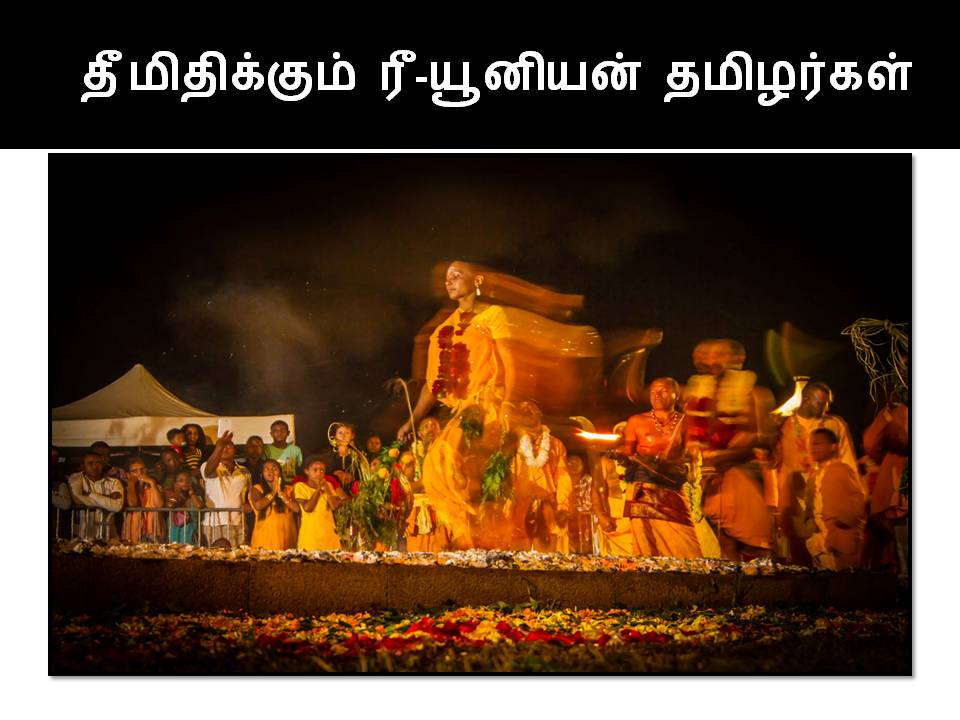
It cannot be said that Catholic faith dominates the island's religious character. It is visible in the shrines along every highway and byway, in caves, on cliff tops and in the many saint's days and holidays. St-Denis shuts down on Sunday, when half the city goes to the beach. Hindus and Muslims follow their respective religions freely and most large towns have both a mosque and a temple. Popular Hindu rites include teemeedee, which involves fire walking, and cavadee, involving piercing one's cheeks with silver needles, often take place. A great deal of syncretism with Catholicism has evolved over the years, and vice versa. Thus a hybrid religion had come into existence. People celebrating all festivals and worshipping all deities have produced a hybrid religion of tolerance. Lot of Hindu Temples is there for Lord Shiva, Lord Muruga and Godess Kaali.

French is the official language, but Créole is the most widely spoken. Few people speak English. Réunion Créole is even beyond most French people. A word, which means one thing in French, can mean something completely different in Créole. But the island which has around 4 lakh Tamils who own Tamil names and celebrate Hindu festivals, yet unable to speak Tamil. The Tamil Nadu Finance Minister Navalar Nedunchezian participated in a world Tamil Cultural Movements conference in neighbouring Mauritius and visited Reunion too. During this visit the Reunion Tamil Kazhagam seeking the help of Tamil Nadu Government to teach Tamil to the people of Reunion and to promote cultural exchanges with mainland Tamils put up demands. It remains still and unfulfilled dream. People in a distant place do not haunt our memory as we have other chores to attend in everyday life. But the Government of Tamil Nadu and Pondicherry must open Cultural Exchange Centres in all these isolate islands, and like the Alliance Francaise that keeps teaching French throughout world, institutionalized teaching of Tamil and spreading the tenets of Tamil Culture must be undertaken, all who visit islands like Reunion will have these thoughts linger in their minds.

The Maha Bhadrakaliaaman Temple authorities and the Natha Musical Academy of Reunion have invited the students of TamilNadu Government Music College to provide them some insights into Tamil folk arts. Professor M.Anbarasan who teaches folk arts in the College of Music who heads the team comprising his students Miss K.Kala, Miss.K.Vijayalaxmi, Miss.N.Selvarani, Miss.Santhi and Mr.Nallusamy will be participating in various functions in Reunion as depicted in this poster. This ambassadors of Tamil culture carry forward the message of goodwill from the people of Tamil Nadu, and whole Reunion Tamils must be reassured that in upholding Tamil customs, religious practices, arts, music and language, a day will come that Reunion cultural ambassadors arrive here and capture our attention and can win our admiration. Where there is a will, there will be a way, goes the saying. Reunion Tamils have the will. Let them cherish their hybrid culture with Tamil component, we all hope and wish so.

N.Nandhivarman


Courtesy: New Indian Express dated: 13th April 2004

FRENCH CITIZENS OF PONDICHERRY AND THEIR RIGHTS


FRENCH CITIZENS OF PONDICHERRY 

AND THEIR RIGHTS

 N.Nandhivarman
 
French drafted men for their army from colonies, and these soldiers have sacrificed their lives fighting for France in the World War I and II. Large sections who  completed their services in French army comprise the main component of French citizens in Pondicherry. There are more than 20 million French citizens living abroad in various former French colonies including Pondicherry. It will be interesting to note that in the post-colonial period too France maintains links with these citizens in a unique fashion giving them representation.
 
One hundred and fifty five delegates are elected by direct universal suffrage by the French communities abroad for a period of 6 years and this body is presided by the Minister of Foreign Affairs of France.  French citizens in America elect 32 delegates and from Africa 47 seats thus representatives from the total of “A series of constituencies” is 79. In “B series” there are 76 seats and the break up is 52 seats from Europe and from Asia-Oceania and from the Orient 24. Within these 24 seats two are chosen from Pondicherry. Half of the electoral  college is renewed every 3rd year.  All former colonies are divided into 52 electoral districts, with one or more delegates per district. A country may have several electoral districts, just as an electoral district may cover several countries.
 
Apart from Indian elections, the regular exercise in Pondicherry is the elections  to choose 2 representatives to the “Assembly of French People Living Abroad” known  as CSFE ( Counseil Superieur des Francaise de l’Etranger). It is recently renamed as AFE from 9th August 2004, published in Official Gazette of 11 August 2004 by the Government of France.  Lieutenant-Colonel Mouhamad Moustafa and Mr. Ejilane Souprayen were elected on 18 June 2000 for a 6 year-term for the Pondicherry constituency comprising all segments of the Union Territory of Pondicherry. The next elections will be held in 2006. It is interesting to note that both these representatives have served in the French army.
 

French people residing abroad through their 155 representatives elect twelve Senators to French Parliament. They get elected one-third at a time for 8 years in 2004 and for 7 years in 2007 and for 6 years from 2010. Currently the political party UMP (Union pour un mouvement populaire, which means Union for Popular Government) has 9 members thus elected. They are Mrs. Paulette Brisepierre, Mr. Jean-Pierre Cantegrit, Mr. Christian Cointat, Mr. Robert-Denis Del Picchia, Mr. Hubert Durand-Chastel, Mr. Louis Duvernois, Mr. André Ferrand, Mr. Michel Guerry, and Mr. Xavier de Villepin.
 
Parti Socialiste has 2 Senators, Mrs Monique Cerisier Ben Guiga and Mr. Guy Penne.The party CRC (Communiste, Républicain et Citoyen) has one Senator Mr. Pierre Biarnes.Twelve personalities appointed by the French Minister of Foreign Affairs for six-year terms "by reason of their competence in matters concerning the general interests of France abroad". They are renewed one-half at a time every three years. 

The Constitution of 27 October 1946 (IVth Republic) stipulated that the new Parliament would comprise a National Assembly and a "Council of the Republic" (as the Senate was called until 1958) within which "the French of the Exterior" would be represented. This may be like our lower and upper houses in Parliament. The National Assembly pondered and decided how to effect this representation. It decreed, in a resolution dated 13 December 1946, that three "Councillor of the Republic" seats (out of 320) would go to personalities representing Non Resident French citizens living in Europe, America and Asia-Oceania-Orient respectively.

Subsequently then Prime Minister, Robert Schuman, and his Foreign Minister, Georges Bidault signed a Decree setting up the High Council for French People residing abroad. on 7 July 1948. The first High Council was composed of 55 members and 8 ex officio members.. The first CSFE elections of 1950 were held in seventy countries of Europe, America, Asia and Oceania, according to a protocol defined in a Ministerial Decree dated 10 December 1949 and signed by Robert Schuman..
 
Article 24 of the Constitution of 25 September 1958 states, "French nationals settled outside France shall  be represented in the Senate." Two Executive Orders were issued, on 15 November 1958 and 4 February 1959 respectively, for organizing this representation and providing the CSFE with new status. The CSFE, while retaining its advisory role, became the sole electoral  college for electing Senators from abroad.

Their numbers   increased from three to six, two representing Europe and America, one representing Asia-Oceania and three representing Africa. It was thus divided into three sections for the Senatorial elections of 23 April 1959. The CSFE had 84 elected members   but it  became clear that Europe and America were under-represented in comparison with Africa.  The number of Senators was therefore brought up to nine for 1962 elections.

After the creation of the Democratic Association of French Citizens Abroad (Association Démocratique des Français à l´Etranger - ADFE) in 1980, the CSFE was reconstituted in 1982. The Act of 7 June 1982 paved way for the election by universal suffrage of Delegates to the CSFE, which (with the exception of twenty-one members chosen for their competence but not having Senatorial voting rights) was no longer a body of appointed personalities. And the election of twelve Senators thereafter is only by the elected members of the CSFE.

The AFE  is entrusted by law with the task of advising the Cabinet. The Minister of Foreign Affairs defines the objectives and priorities of the assembly chaired by him. The Senators place before the Senate, the National Assembly and the Economic and Social Council the propositions, motions, resolutions and wishes expressed by their electors. The twelve Senators, ex officio members of the AFE, can introduce Bills or legislative amendments reflecting the hopes and needs of French people living around the world.

By this unique system the ties between  French citizens living in Pondicherry and their chosen country France remains fostered conferring rights to its citizens and providing them a voice in the democratic set up.

Courtesy : New Indian Express dated : 19th March 2005


அடுத்த 11 வது உலகத் தமிழ்மாநாட்டிலாவது சுவாமி விபுலானந்தரின் எழுத்துக்களையும் பேச்சையும் ஆய்வு செய்ய....

தமிழ் ஆய்வுலகமும் தமிழ்ப் பல்கலைக்கழங்களும் அடுத்த 11 வது  உலகத் தமிழ்மாநாட்டிலாவது சுவாமி விபுலானந்தரின் எழுத்துக்களையும் பேச்சையும் ஆ...