Showing posts with label temples. Show all posts

Thursday, September 6, 2018

HIDDEN HISTORIES IN TEMPLE INSCRIPTIONS : TIMES OF INDIA : N.NANDHIVARMAN


HISTORY THROUGH THE EYES OF EPIGRAPHY
N.Nandhivarman

In Paris not in Chennai  two conferences on Tamil Epigraphy :Historical Sources and multi-disciplinary approach took place in 2005 and 2006 at Ecole Pratique des Hautes Etudies [EPHE] .  The groundbreaking works of several generations of pioneering scholars on Tamil epigraphy have proved beyond doubt that inscriptions constitute one of the most important sources for a better understanding of the historical, cultural and social evolution of the past, opines historian Romila Thapar.

Daud Ali focused his research paper on Gangaikondacholapuram temple inscriptions. This temple was first visited by Meckenzie  between 1818 and 1826. Subsequent surveys till 1993 yielded an epigraphic corpus, which was updated by Daud Ali.

 Philology is a study of the language together with its literature and the historical and cultural contexts which are indispensable for an understanding of the literally or other culturally significant texts defines Becker. Y.Subburayalu employed philology and lexical semantics in interpreting and understanding the epigraphic texts. There is an ancient Tamil word Pazhanam which means fields. The name Pazhani came to that temple town because it was situated in midst of fields. Unless one knows the word Pazhanam the correct meaning could not be imparted.

Rachel Loiseau turned her eyes to the abandoned Naganatheswara temple  of the tenth century. Supplementing  epigraphic sources with structural and iconographic observations, her study the first of its kind in stylistic evolution of a single monument. Rachel Loiseau finds out that the iconographic programmes of this Chola temple bear the influence of Sembiyan Madevi model.

Ten pottery inscriptions of Tamilnadu and two such from West Bengal in Sinhala-Prakrit script found by Iravatham Mahadevan sheds new light on long distance trade routes between Srilanka, Tamilnadu and West Bengal.
Anthropologic decoding of epigraphy of two inscriptions   of Rajaraja from Thanjavur temple undertaken by Tiziana Leucci which focuses on socio-religious aspects of Devadasi system  is noteworthy.

Charlotte de Percin-Sermet chose to deal with Chandesa, one of the important Nayanars of the Bhakthi movement. She finds pan-indian nature in the Tamil saiva nayanar. “ She establishes Chandesa’s presence as a violent deity or asura  in ancient sources like Mahabharatha or Agnipurana. She contrasts how Tamil literary sources depict a contrary image of the nayanar as an ideal devotee” says Appasamy Murugaiyan in his introduction to the book New Dimensions in Tamil Epigraphy . Because he teaches epigraphy in Ecole Pratique des Hautes Etudies [EPHE]  Paris , he and his friends organized two  conferences on Tamil epigraphy.

Foreign country evincing interest in Tamil epigraphy is because recent Survey on Indian Epigraphy (1996) places inscriptions of Tamil Nadu at the top of the list. The categories of language, alphabet and number of inscriptions on both stone and copper plates also indicate Tamil Nadu as the first among Indian States. From this survey it can easily be understood that Tamil Nadu has the bulk of inscriptions found in India. It has been estimated with a fair degree of accuracy that the inscriptions written in Tamil occupy the first position in volume, amounting nearly to 20,000, followed by those in Kannada (10,600), Sanskrit (7,500) and Telugu (4,500). Inscriptions in Tamil language are noticed from the third century BCE onwards. (Source: Journal of the Epigraphical Society of India Volume 19 : 1993)

Tamilnadu Government started The State Department of Archaeology  in the year 1961 .The aim of the department is to showcase the rich heritage and glorious traditions of Tamil Nadu with its classical Tamil language, magnificent monuments, exquisite temples, art and sculpture and diversified traditions The Department has  14 site museums, the Government Oriental Manuscripts Library and Research Centre at Chepauk, Chennai besides the Institute of Epigraphy. A separate epigraphy wing was started during the year 1966. The primary function of this wing is to copy inscriptions on boulders, stone pillars, stones, temple walls and on copper plates. The inscriptions are deciphered, edited and published.  So far, about 14,000 inscriptions are copied and  preserved in this wing. Some original copper plates and old palm leaf manuscripts are also under the custody of this department.

The Department of Archaeology has been recognized as a Centre for doing research in history and archaeology leading to Ph.D by the University of Madras during the year 2003. 
At national level The  Archaeological Survey of India (ASI), under the Ministry of Culture regulates all archaeological activities in the country as per the provisions of the Ancient Monuments and Archaeological Sites and Remains Act, 1958. It also regulates Antiquities and Art Treasure Act, 1972.

Publications of the ASI was started by A. Cunningham, the first Director General, who along with his associates, documented vigorously all the results of their tour from1862-63 onwards. In 1874, a new series entitled ‘New Imperial Series’ was launched which continued up to 1933 containing exhaustive research on antiquarian remains.

John Marshall introduced Annual Reports published in two parts from 1902 onwards. He also started the publication of a new series ‘Memoirs of the Archaeological Survey of India’, of which the first number appeared in 1919 and the latest (ninety-eight) in 2003. ‘Ancient India’ the Bulletin of the Archaeological Survey of India was started in 1946, which contained general and research articles on different aspects of archaeology in India and adjacent countries.  The most important among them, ‘Epigraphia Indica’ for Sanskrit inscriptions was first published in 1892. So far 42 volumes have been published. In the field of Arabic and Persian inscription, ‘Epigraphia Indo-Moslemica’ is being brought out. The ‘Annual Report on Indian Epigraphy’ has been brought out from 1887 till 1995-96, which contains the reports on the epigraphical discoveries made each year. In addition to these, inscriptions of various dynasties were also published under the series ‘Corpus Inscriptionum Indicarum’. For the epigraphical records of South India, a separate series ‘South Indian Inscriptions’ is also being published since 1890. The south Indian inscriptions are also dealt with from 1905 to 1946 in another series called ‘Annual Report of South Indian Epigraphy’ which contains brief notes on inscriptions of south India collected during a particular year. The  Epigraphy Branch of the Survey caters to the needs of the Sanskrit & Dravidian inscriptions and coins (Headquarters at Mysore) and Arabic & Persian inscriptions and coins (Headquarters at Nagpur)

Underwater Archaeology Wing

India has 7,516 km long coastline, 1197 islands and 155,889 sq. km of territorial waters and 2,013,410 sq. km exclusive economic zone. The vast water area of the country is rich in underwater cultural heritage. The importance of underwater archaeology was realized as early as in the VI five-year plan. Beginning of underwater archaeology in India can be traced back to 1981. Off shore explorations in the country have generated a lot of popularity to this discipline. Establishment of the Underwater Archaeology Wing (UAW) in the Archaeological Survey of India (ASI) in 2001 marked a major step towards the development of the subject. Since its inception the UAW is actively engaged in conducting underwater archaeological studies in the Arabian Sea and Bay of Bengal.

Protection of underwater cultural heritage and regulation of underwater activities aimed towards the cultural heritage is one of the main concerns of the UAW. Adoption of “Convention on the Protection of the Underwater Cultural Heritage” by UNESCO in 2001 displays the global concern about the protection and management of underwater cultural heritage. UAW has initiated steps for the protection and preservation of the underwater cultural heritage.

So far what steps both Central and State Governments had taken to preserve our cultural heritage including conferences held in Paris reveal painstaking efforts but sad part is various universities and Tamil scholars show no interest in inscriptions. Temple authorities forget these are treasure troves of history. They focus on deities neglecting temple history.

Archaeological Survey of India in its Annual Report of Epigraphy 1895 had brought to notice 12 inscriptions, numbering 53 to 64 in the series. In Annual Report on Epigraphy 1930-1931, they have brought to notice 88 inscriptions numbering 121 to 208. The lethargy comes while publishing such inscriptions, whereas out of 100 inscriptions only 50 have been read deciphered and published. A place called Thiruchotruththurai in Mayiladuthurai-Kumbakonam road 4 kilometers near Thirukalliyur , in spite of copying 50  , in its Second Volume of Annual Report of Epigraphy only 50 inscriptions are published .50 copied but not published had been the target of study by Dr.Vijayavenugopal, epigraphist and multi disciplinary Tamil genius . So he revisited Thiruchotruthurai and deciphered these inscriptions which are going to see the light of the day.
Photo 1 : A sample page of Annual Report on Epigraphy

The above page of the ARE mentions some of 70 inscriptions found in 1903 and 1924 in Piranmalai of Trichy district, in a temple under Kunrakudi Atheenam. Piranmalai was known in earlier days as Thirukodunkunram. South Indian Inscriptions Volume 8  shows 70 stone inscriptions as noticed but less than 30 only deciphered and published. A team of epigraphists led by Dr.Vijayavenugopal and photographers Ravi and Babu associated with French Government organization Ecole Francaise de Extreme Orient visited 4 times in between 2009 and 2014 to Piranmalai to find new inscriptions, or precisely re-find inscriptions noticed in South Indian Inscriptions book. The poojari of Mangaipagar Koil refused to let them in in spite of the team saying published report mentions in 435 serial number about an inscription by Kulothunga Chozhan. During 4th visit, thanks to the new pujari, the team could read that Kulothunga Chozhan inscription.

Picture 1. Temple poojari in camphor light shows the wall behind the deity and says there is no inscription.
Photo 2 and 3 : The epigraphists argue that South Indian Inscriptions mentions 425 th inscription by Kulothunga Chozhan....
Photo 4 : 4th visit successful, and team finds that Kulothunga Chozhan inscription in the temple.

This one incident will reveal how much efforts are needed even to trace an inscription once found. The application of sandal paste in walls, santhanakkappu had hidden this Kulothunga Chozhan inscriptions.

The team led by Dr.Vijayavenugopal are currently in search of new inscriptions in Karnataka state, more particularly which were once Tamil territories. There ancient inscriptions are in Tamil, later day inscriptions being Tamil but written in Kannada script and recent period inscriptions are in Kannada. This shows waning influence of Tamil Kings over these adjoining Tamil territories, where Kannada officials gradually replaced Kannada with Tamil in inscriptions.
  
Photo 5 and 6 : In Someshwara Temple Karnataka Village Gudihalli of Kolar District. Dr.Vijayavenugopal and photographer Babu inspecting a monument

EFEO team visited Karnataka to verify the authenticity and to update the 300 or so inscriptions noticed by Archaeological Survey of India. In that process found few new inscriptions, which they have deciphered and going to publish.'

All such new discoveries are getting published in a journal Avanam published for over 25 years or so by a private association Thamizhaga Tholliyal Kazhagam sponsored by Department of Epigraphy and Archaeology of Tamil University Thanjavur with financial support from Indian Council of Historic Research.
Photo 7 : Avanam journal recent 2013 issue, 24th issue.


Photo 8 and 9 Along with the team out of curiosity to know how they are deciphering inscriptions, the author of this article visited Senthalai temple in Tiruvaiyaru region of Thanjavur District.

This temple during renovation the masons who undertook the work had thrown the order of inscriptions out of gear, and between one inscription and next continuity is missing, hence to re-read it and suggest proper chronological order of the inscriptions in grantha and devanagiri scripts, team of epigraphists must re-visit such temples.

Photo10 : Dr.Vijayavenugopal inspecting Irumbai Mahaleswar Temple inscription in Vanur Taluk Villupuram District of Tamilnadu


It is a great blunder that Tamilnadu which housed around 70000 inscriptions in Ooty allowed its transfer to Mysore, where Tamil related inscriptions faced decay and destruction. Even the request by Tamil University to have Xerox copies of those inscriptions being turned down, was a thorny issue which recently had been resolved. ASI and Tamilnadu Archaeological department have joined hands to bring out a publication deciphering such monuments, which will throw new light on South Indian history much to the delight of Tamils...


Thursday, September 24, 2015

THE TAMILS OF REUNION AND THEIR HYBRID CULTURE


THE TAMILS OF REUNION AND THEIR HYBRID CULTURE

Colonialism cannot be condemned outright. This may sound outrageous. But colonialism in a way introduced the concept of outsourcing attempted in the bygone centuries and currently being debated in the free market era. In a world where free market dominates, the sweat and toils of the slave labourers may be forgotten, but we must realize that in their sufferings the foundations for global market economy is sown. ReUnion is a typical example of outsourcing by the French East India Company, and its history reveals how an hybrid culture emanated amidst Tamil settlers there, who are Tamils but could not speak Tamil, their mother tongue lost in the interregnum of 5 generations of separation from their homeland namely Pondicherry.

The archipelago, comprised of Mauritius, Rodrigues and Réunion, was christened the Mascarenes by Portuguese navigator Pedro de Mascarenhas, following its European discovery in 1512. In 1642 the French settled in the island when La Compagnie des Indes Orientales (the French East India Company) sent its ship, the St-Louis, and the King of France named it Île Bourbon. Much water had flown in the five rivers that irrigate this tiny island since then.

The French Revolution is a turning point in its history. The greatest achievement of the 1848 revolution for the colonies was the abolition of slavery. Slavery, the foundation of economic life in Martinique, Guadeloupe, Guyana and Reunion, had been abolished by the Convention in 1794 but was re-instituted by Napoleon.  National Assembly by way of definitive decree on April 27, 1848 declared that `slavery is an attack on human dignity', it `destroys the principal of natural law and duty . . . it is a flagrant violation of republican dogma," and that great unrest could erupt in the colonies if slavery were not ended, the law abolished slavery in all French colonies and possessions.  Thus a total of 262,564 slaves were thereby freed, most of them in the plantation colonies of the West Indies and Réunion.

But with this abolition of slave labour the need to fill that vacuum arose and plantation owners looked for French India to compensate the loss of slave labour. Thus lot of Tamils found their way to the island of Reunion situated in the Indian Ocean closer to Madagascar. Lot of people from Pondicherry and its surrounds went to the coffee and other plantations in Reunion as labour.

The coffee plantations were destroyed often destroyed by cyclones and the Tamil labour had to struggle hard facing the fury of Nature. Napoleon Bonaparte lost the island to the British for a short break of five years.  Under British rule, sugar cane was introduced to Réunion and quickly supplanted food production as the primary crop. It resulted in the dispossession of many small farmers who were forced to sell out to those with capital to invest in the new monoculture. The supplanted farmers migrated to the interior to find land and carry on with their agricultural activities. During this period, the Desbassyns brothers rose to success as the island's foremost sugar barons. The vanilla industry, introduced in 1819, also grew rapidly. The golden age of trade and development in Réunion lasted until 1870, when competition from Cuba and the European sugar beet industry, combined with the opening of the Suez Canal, resulted in an economic slump. Shipping decreased, the sugar industry declined and land and capital were further concentrated in the hands of a small French elite. Close on the cessation of hostilities in First World War global demand for sugar increased. This helped Reunion's economy out of the doldrums. But during World War II, an economic blockade once again crippled the island's economy. A colony under French law must provide to the French mainland goods of greater value than the amount of money allocated to it. A colony had to be profitable. This obligation was lifted in 1946, when Réunion's status changed from colony to overseas department, a change in status intended to provide the island with the benefits of social and political equality with the mainland. The island still falls under the jurisdiction of the French government.

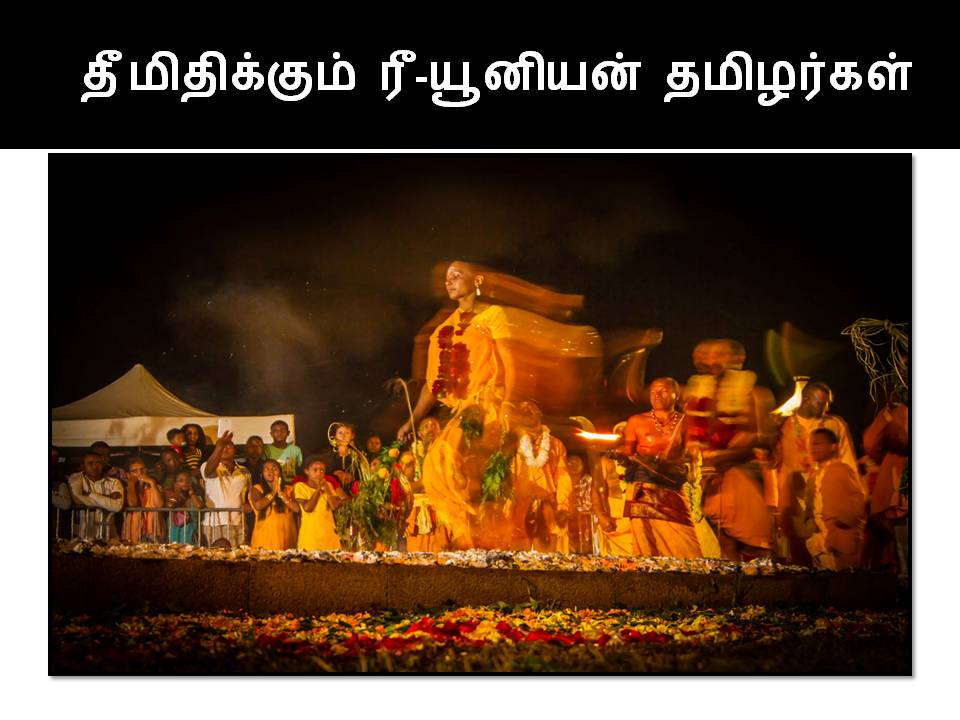
It cannot be said that Catholic faith dominates the island's religious character. It is visible in the shrines along every highway and byway, in caves, on cliff tops and in the many saint's days and holidays. St-Denis shuts down on Sunday, when half the city goes to the beach. Hindus and Muslims follow their respective religions freely and most large towns have both a mosque and a temple. Popular Hindu rites include teemeedee, which involves fire walking, and cavadee, involving piercing one's cheeks with silver needles, often take place. A great deal of syncretism with Catholicism has evolved over the years, and vice versa. Thus a hybrid religion had come into existence. People celebrating all festivals and worshipping all deities have produced a hybrid religion of tolerance. Lot of Hindu Temples is there for Lord Shiva, Lord Muruga and Godess Kaali.

French is the official language, but Créole is the most widely spoken. Few people speak English. Réunion Créole is even beyond most French people. A word, which means one thing in French, can mean something completely different in Créole. But the island which has around 4 lakh Tamils who own Tamil names and celebrate Hindu festivals, yet unable to speak Tamil. The Tamil Nadu Finance Minister Navalar Nedunchezian participated in a world Tamil Cultural Movements conference in neighbouring Mauritius and visited Reunion too. During this visit the Reunion Tamil Kazhagam seeking the help of Tamil Nadu Government to teach Tamil to the people of Reunion and to promote cultural exchanges with mainland Tamils put up demands. It remains still and unfulfilled dream. People in a distant place do not haunt our memory as we have other chores to attend in everyday life. But the Government of Tamil Nadu and Pondicherry must open Cultural Exchange Centres in all these isolate islands, and like the Alliance Francaise that keeps teaching French throughout world, institutionalized teaching of Tamil and spreading the tenets of Tamil Culture must be undertaken, all who visit islands like Reunion will have these thoughts linger in their minds.

The Maha Bhadrakaliaaman Temple authorities and the Natha Musical Academy of Reunion have invited the students of TamilNadu Government Music College to provide them some insights into Tamil folk arts. Professor M.Anbarasan who teaches folk arts in the College of Music who heads the team comprising his students Miss K.Kala, Miss.K.Vijayalaxmi, Miss.N.Selvarani, Miss.Santhi and Mr.Nallusamy will be participating in various functions in Reunion as depicted in this poster. This ambassadors of Tamil culture carry forward the message of goodwill from the people of Tamil Nadu, and whole Reunion Tamils must be reassured that in upholding Tamil customs, religious practices, arts, music and language, a day will come that Reunion cultural ambassadors arrive here and capture our attention and can win our admiration. Where there is a will, there will be a way, goes the saying. Reunion Tamils have the will. Let them cherish their hybrid culture with Tamil component, we all hope and wish so.

N.Nandhivarman


Courtesy: New Indian Express dated: 13th April 2004

Sunday, July 20, 2014

TAMIL HISTORY THROUGH THE EYES OF EPIGRAPHY

 Dr.Vijayavenugopal inspecting Irumbai Mahaleswar Temple inscription in Vanur Taluk Villupuram District of Tamilnadu


N.Nandhivarman

In Paris not in Chennai  two conferences on Tamil Epigraphy :Historical Sources and multi-disciplinary approach took place in 2005 and 2006 at Ecole Pratique des Hautes Etudies [EPHE] .  The groundbreaking works of several generations of pioneering scholars on Tamil epigraphy have proved beyond doubt that inscriptions constitute one of the most important sources for a better understanding of the historical, cultural and social evolution of the past, opines historian Romila Thapar.

Daud Ali focused his research paper on Gangaikondacholapuram temple inscriptions. This temple was first visited by Meckenzie  between 1818 and 1826. Subsequent surveys till 1993 yielded an epigraphic corpus, which was updated by Daud Ali.

 Philology is a study of the language together with its literature and the historical and cultural contexts which are indispensable for an understanding of the literally or other culturally significant texts defines Becker. Y.Subburayalu employed philology and lexical semantics in interpreting and understanding the epigraphic texts. There is an ancient Tamil word Pazhanam which means fields. The name Pazhani came to that temple town because it was situated in midst of fields. Unless one knows the word Pazhanam the correct meaning could not be imparted.

Rachel Loiseau turned her eyes to the abandoned Naganatheswara temple  of the tenth century. Supplementing  epigraphic sources with structural and iconographic observations, her study the first of its kind in stylistic evolution of a single monument. Rachel Loiseau finds out that the iconographic programmes of this Chola temple bear the influence of Sembiyan Madevi model.

Ten pottery inscriptions of Tamilnadu and two such from West Bengal in Sinhala-Prakrit script found by Iravatham Mahadevan sheds new light on long distance trade routes between Srilanka, Tamilnadu and West Bengal.Anthropologic decoding of epigraphy of two inscriptions of Rajaraja from Thanjavur temple undertaken by Tiziana Leucci which focuses on socio-religious aspects of Devadasi system  is noteworthy.

Charlotte de Percin-Sermet chose to deal with Chandesa, one of the important Nayanars of the Bhakthi movement. She finds pan-indian nature in the Tamil saiva nayanar. “ She establishes Chandesa’s presence as a violent deity or asura  in ancient sources like Mahabharatha or Agnipurana. She contrasts how Tamil literary sources depict a contrary image of the nayanar as an ideal devotee” says Appasamy Murugaiyan in his introduction to the book New Dimensions in Tamil Epigraphy . Because he teaches epigraphy in Ecole Pratique des Hautes Etudies [EPHE]  Paris , he and his friends organized two  conferences on Tamil epigraphy.

Foreign country evincing interest in Tamil epigraphy is because recent Survey on Indian Epigraphy (1996) places inscriptions of Tamil Nadu at the top of the list. The categories of language, alphabet and number of inscriptions on both stone and copper plates also indicate Tamil Nadu as the first among Indian States. From this survey it can easily be understood that Tamil Nadu has the bulk of inscriptions found in India. It has been estimated with a fair degree of accuracy that the inscriptions written in Tamil occupy the first position in volume, amounting nearly to 20,000, followed by those in Kannada (10,600), Sanskrit (7,500) and Telugu (4,500). Inscriptions in Tamil language are noticed from the third century BCE onwards. (Source: Journal of the Epigraphical Society of India Volume 19 : 1993)

Tamilnadu Government started The State Department of Archaeology  in the year 1961 .The aim of the department is to showcase the rich heritage and glorious traditions of Tamil Nadu with its classical Tamil language, magnificent monuments, exquisite temples, art and sculpture and diversified traditions The Department has  14 site museums, the Government Oriental Manuscripts Library and Research Centre at Chepauk, Chennai besides the Institute of Epigraphy. A separate epigraphy wing was started during the year 1966. The primary function of this wing is to copy inscriptions on boulders, stone pillars, stones, temple walls and on copper plates. The inscriptions are deciphered, edited and published.  So far, about 14,000 inscriptions are copied and  preserved in this wing. Some original copper plates and old palm leaf manuscripts are also under the custody of this department.

The Department of Archaeology has been recognized as a Centre for doing research in history and archaeology leading to Ph.D by the University of Madras during the year 2003. At national level The  Archaeological Survey of India (ASI), under the Ministry of Culture regulates all archaeological activities in the country as per the provisions of the Ancient Monuments and Archaeological Sites and Remains Act, 1958. It also regulates Antiquities and Art Treasure Act, 1972.

Publications of the ASI was started by A. Cunningham, the first Director General, who along with his associates, documented vigorously all the results of their tour from1862-63 onwards. In 1874, a new series entitled ‘New Imperial Series’ was launched which continued up to 1933 containing exhaustive research on antiquarian remains.

John Marshall introduced Annual Reports published in two parts from 1902 onwards. He also started the publication of a new series ‘Memoirs of the Archaeological Survey of India’, of which the first number appeared in 1919 and the latest (ninety-eight) in 2003. ‘Ancient India’ the Bulletin of the Archaeological Survey of India was started in 1946, which contained general and research articles on different aspects of archaeology in India and adjacent countries.  The most important among them, ‘Epigraphia Indica’ for Sanskrit inscriptions was first published in 1892. So far 42 volumes have been published. In the field of Arabic and Persian inscription, ‘Epigraphia Indo-Moslemica’ is being brought out. The ‘Annual Report on Indian Epigraphy’ has been brought out from 1887 till 1995-96, which contains the reports on the epigraphical discoveries made each year. In addition to these, inscriptions of various dynasties were also published under the series ‘Corpus Inscriptionum Indicarum’. For the epigraphical records of South India, a separate series ‘South Indian Inscriptions’ is also being published since 1890. The south Indian inscriptions are also dealt with from 1905 to 1946 in another series called ‘Annual Report of South Indian Epigraphy’ which contains brief notes on inscriptions of south India collected during a particular year. The  Epigraphy Branch of the Survey caters to the needs of the Sanskrit & Dravidian inscriptions and coins (Headquarters at Mysore) and Arabic & Persian inscriptions and coins (Headquarters at Nagpur)

Underwater Archaeology Wing

India has 7,516 km long coastline, 1197 islands and 155,889 sq. km of territorial waters and 2,013,410 sq. km exclusive economic zone. The vast water area of the country is rich in underwater cultural heritage. The importance of underwater archaeology was realized as early as in the VI five-year plan. Beginning of underwater archaeology in India can be traced back to 1981. Off shore explorations in the country have generated a lot of popularity to this discipline. Establishment of the Underwater Archaeology Wing (UAW) in the Archaeological Survey of India (ASI) in 2001 marked a major step towards the development of the subject. Since its inception the UAW is actively engaged in conducting underwater archaeological studies in the Arabian Sea and Bay of Bengal.

Protection of underwater cultural heritage and regulation of underwater activities aimed towards the cultural heritage is one of the main concerns of the UAW. Adoption of “Convention on the Protection of the Underwater Cultural Heritage” by UNESCO in 2001 displays the global concern about the protection and management of underwater cultural heritage. UAW has initiated steps for the protection and preservation of the underwater cultural heritage. 

So far what steps both Central and State Governments had taken to preserve our cultural heritage including conferences held in Paris reveal painstaking efforts but sad part is various universities and Tamil scholars show no interest in inscriptions. Temple authorities forget these are treasure troves of history. They focus on deities neglecting temple history.

Archaeological Survey of India in its Annual Report of Epigraphy 1895 had brought to notice 12 inscriptions, numbering 53 to 64 in the series. In Annual Report on Epigraphy 1930-1931, they have brought to notice 88 inscriptions numbering 121 to 208. The lethargy comes while publishing such inscriptions, whereas out of 100 inscriptions only 50 have been read deciphered and published. A place called Thiruchotruththurai in Mayiladuthurai-Kumbakonam road 4 kilometers near Thirukalliyur , in spite of copying 50  , in its Second Volume of Annual Report of Epigraphy only 50 inscriptions are published .50 copied but not published had been the target of study by Dr.Vijayavenugopal, epigraphist and multi disciplinary Tamil genius . So he revisited Thiruchotruthurai and deciphered these inscriptions which are going to see the light of the day.

Photo 1 : A sample page of Annual Report on Epigraphy


The above page of the ARE mentions some of 70 inscriptions found in 1903 and 1924 in Piranmalai of Trichy district, in a temple under Kunrakudi Atheenam. Piranmalai was known in earlier days as Thirukodunkunram. South Indian Inscriptions Volume 8  shows 70 stone inscriptions as noticed but less than 30 only deciphered and published. A team of epigraphists led by Dr.Vijayavenugopal and photographers Ravi and Babu associated with French Government organization Ecole Francaise de Extreme Orient visited 4 times in between 2009 and 2014 to Piranmalai to find new inscriptions, or precisely re-find inscriptions noticed in South Indian Inscriptions book. The poojari of Mangaipagar Koil refused to let them in in spite of the team saying published report mentions in 435 serial number about an inscription by Kulothunga Chozhan. During 4th visit, thanks to the new pujari, the team could read that Kulothunga Chozhan inscription.

Picture 1. Temple poojari in camphor light shows the wall behind the deity and says there is no inscription.


Photo 2 and 3 : The epigraphists argue that South Indian Inscriptions mentions 425 th inscription by Kulothunga Chozhan....


Photo 4 : 4th visit successful, and team finds that Kulothunga Chozhan inscription in the temple.


This one incident will reveal how much efforts are needed even to trace an inscription once found. The application of sandal paste in walls, santhanakkappu had hidden this Kulothunga Chozhan inscriptions.

The team led by Dr.Vijayavenugopal are currently in search of new inscriptions in Karnataka state, more particularly which were once Tamil territories. There ancient inscriptions are in Tamil, later day inscriptions being Tamil but written in Kannada script and recent period inscriptions are in Kannada. This shows waning influence of Tamil Kings over these adjoining Tamil territories, where Kannada officials gradually replaced Kannada with Tamil in inscriptions.

EFEO team visited Karnataka to verify the authenticity and to update the 300 or so inscriptions noticed by Archaeological Survey of India. In that process found few new inscriptions, which they have deciphered and going to publish.

All such new discoveries are getting published in a journal Avanam published for over 25 years or so by a private association Thamizhaga Tholliyal Kazhagam sponsored by Department of Epigraphy and Archaeology of Tamil University Thanjavur with financial support from Indian Council of Historic Research.
Photo 7 : Avanam journal recent 2013 issue, 24th issue.


 Along with the team out of curiosity to know how they are deciphering inscriptions, the author of this article visited Senthalai temple in Tiruvaiyaru region of Thanjavur District.


This temple during renovation the masons who undertook the work had thrown the order of inscriptions out of gear, and between one inscription and next continuity is missing, hence to re-read it and suggest proper chronological order of the inscriptions in grantha and devanagiri scripts, team of epigraphists must re-visit such temples.


It is a great blunder that Tamilnadu which housed around 70000 inscriptions in Ooty allowed its transfer to Mysore, where Tamil related inscriptions faced decay and destruction. Even the request by Tamil University to have Xerox copies of those inscriptions being turned down, was a thorny issue which recently had been resolved. ASI and Tamilnadu Archaeological department have joined hands to bring out a publication deciphering such monuments, which will throw new light on South Indian history much to the delight of Tamils...


Tuesday, June 24, 2014

DRAVIDIAN SCULPTURAL ART....


MYTHOLOGICAL SCULPTURE IS SCIENCE FICTION OF THOSE DAYS

Study of Temples turned into Fort reveals past...... N.Nandhivarman


Temples in Tamilnadu were turned into forts and the fortification of such temples were found in water colour paintings of French Engineers in archives at Hague and Paris. Having found such maps of temples which were used as Forts, though no vestiges of military structures are found around their enclosures now, since most of them were dismantled by the British at the beginning of the nineteenth century, Jean De Loche, octogenarian scholar who lives in Pondicherry for more than 52 years and had number of books to his credit, had written a book Ancient Fortifications of the Tamil Country as recoded in Eighteenth Century French Plans..

Temples of South India are unique in the world for their sculptural art. Temples were not only home of the deities, they were centres of learning, socializing and schools of art, music and philosophy, in short a place everyone can gain knowledge in every field.  

In a  book titled  “Mysteries of the Dravidian Sculptural Art depicting the Hindu version of the Supreme, the birth, growth and death of the Sun, Stars, the human and standard of living “ its author P.S.Subramanyam , Palace Architect of Mysore hailing from Thanjavur says “ Our mythological sculpture is rooted in deep scientific thought  and mastery of the sublime cosmic truths. Cosmology, Cosmogony, Biology, the Stellar Universe, all about Earth and the Heavens , inter relation between man and planets, and stars, the place of man in divine scheme of things, his duties and aims in his voyage through existence , these and other kindred topics form the subject of our mythological sculptures.”

 We forget to undergo comparative study of our mythology and that of other civilizations and if we do, we can understand everywhere mankind is one in its quest to understand our living on earth and its meaning. Sculptures of our Temple failed to attract us because we forgot it was a planetarium of those days. The Death of the Sun and Stars depicted in our sculptures is proven by NASA findings now. Devotion to deity which offers solace to us and total neglect of other sculptures, stone carvings, inscriptions etc led to idol thefts which are hitting headlines nowadays. Temples were demolished when early invaders came into India.

During the rule of Muslim emperors (1310-1311) Srirangam was captured and the riches plundered .They took off the statue of Alagiyamanavalar Perumal. The statue of Alagiyamanavalar Perumal was sent to Delhi. In Delhi the daughter of the Sultan persuaded the Sultan to return the statue of Alagiyamanavalar Perumal back to Guru Ramanujar. She possesses a separate temple near Srirenganathar temple and people worship her as "Thulukka Nachiyar". This mythology is proof of stolen artefacts returned to original places of worship.  There is also a legend “ that the temple of Srirangam which was plundered by Muslim invaders of the 14 th century [ Malik Kafur in 1310-1311 and Ulugh Khan in 1323 ] and recaptured by Hindu Prince Kumara Kampanna in 1371 had its enclosures fortified after this Hindu restoration to prevent a new invasion “writes R.Orme in his History of the Military Transactions of the British Nation in Indostan.  

The Srirangam temple is enclosed by 7 concentric walls (termed prakarams (outer courtyard) or mathil suvar) with a total length of 32,592 feet or over six miles. These temple has 21 gopurams (towers), 39 pavilions, fifty shrines, Ayiram kaal mandapam (a hall of 1000 pillars) and several small water bodies inside. The space within the outer two prakarams (outer courtyard) is occupied by several shops, restaurants and flower stalls. Non-Hindus are allowed up to the second outer courtyard) but not inside the gold topped sanctum sanctorum.

Speaking about the temple enclosures Jean Deloche writes “ The temple enclosures were not meant to be defence works as specifically mentioned in technical treatises of Indian Architecture such as the Ajitagama and the Mayamata which note enclosure walls but do not bring the idea that they could be considered military structures to the fore. The outward wall is called mahamaryadabhitti wall of the great sacred boundary., the pyramidal tower over the entrance gate to the precinct of the temple is known as the gopura i.e protector, a word which might evoke a defence function but purely has symbolic value said P.S.Filliozat.”
“ The second half of the 18th century , however the armies of the Muslim rulers and the British companies used these walls as fortifications, in spite of protests by the temple authorities.  The desecration of these temples is specifically mentioned in English and French sources which show the looting soldiers had become the objects of horror to the local population. When the temple for Achalpuram surrendered to the British in 1749 they forced an entry to the sanctuary  and the Hindus of Thanjavur army enraged at the pollution to which their shrine was exposed, attacked the English in the temple.”

“ At Kovipapakudi in April 1755 when the British seized the temple the soldiers were permitted to plunder and nothing as usual escaped them., for findings in the temple of the pagoda a great number of brazen images, worshipped by the people of the country,they tore them down from their pedestals, hoping to sell them at least for the metal weight be worth” wrote R.Orme in the History of Military Transactions of the British Nation in Indostan. Similar protest welcomed the French when they entered Chidambaram in 1750.

 In Srirangam however in 1751 when the English troops as well as those of the Nawab entered the temple they did not enter the sanctum sanctorum  . Rajputs in Chanda Sahib’s army and Hindu allies of the Europeans would not have permitted such sacrilegious act .  During Karnatic Wars both French and British kept their troops within the temples.  During Karnatic Wars temples were commonly used as forts.

Jean Deloche in his book mentions Kanchipuram,Vandavasi, Sethupattu, Karunguli, Tiruvannamalai, Arakantanallur, Valudavur Tirukoilur, Sankarapuram, Kallakurichi, Thiyaga Durgam, Elavasanoor Kottai, Ulagiyanallur, Chidambaram, Devikotta, Tirumalpatti, Mettupatti, Srirangam, Thanjavur and Madurai temples which were made into forts.  The first prakara was fortified for shielding the people from the attack of the enemy. There was also space to walk over the wall for defence purposes. 1,2,3 rd prakaras were used for defence purposes he says.
Forts and Temple Fortification after gun powder was introduced in battles had undergone changes. These modifications have come to light with books of Jean Deloche. But people who live in these places don’t have an inkling of what had happened to their temples. British had demolished these fortifications , but after so much plunder, modifications, the focus of Tamilnadu Government should be to form a team of epigraphists to study the stone inscriptions in temple walls. During periodical renovations , ignorant about epigraphy , masons have misplaced many in the wall. By cementing to join them, the last lines were covered. They should be re-arranged in original chronological order to bring to light past history hidden, distorted and buried beneath cement. Also all the surrounding walls of temples be freed of encroachments and while kumbabishegams performed , the inscriptions in those walls not be painted, but must be restored to its original format.


In our pious nature we were used to fix or eyes on the prime deities, present generation does not even know the mythology. We must dig in  our mythological past and mythological art to trace current proven scientific facts, such as the predicted death of sun forecast now even by scientists is chiselled in our sculptures...and scriptures...

அடுத்த 11 வது உலகத் தமிழ்மாநாட்டிலாவது சுவாமி விபுலானந்தரின் எழுத்துக்களையும் பேச்சையும் ஆய்வு செய்ய....

தமிழ் ஆய்வுலகமும் தமிழ்ப் பல்கலைக்கழங்களும் அடுத்த 11 வது  உலகத் தமிழ்மாநாட்டிலாவது சுவாமி விபுலானந்தரின் எழுத்துக்களையும் பேச்சையும் ஆ...