On Tamil culture,civilization,history,literature,heritage and Tamil Diaspora
Showing posts with label gnanou diagou. Show all posts
Friday, October 19, 2018
Thursday, September 20, 2018
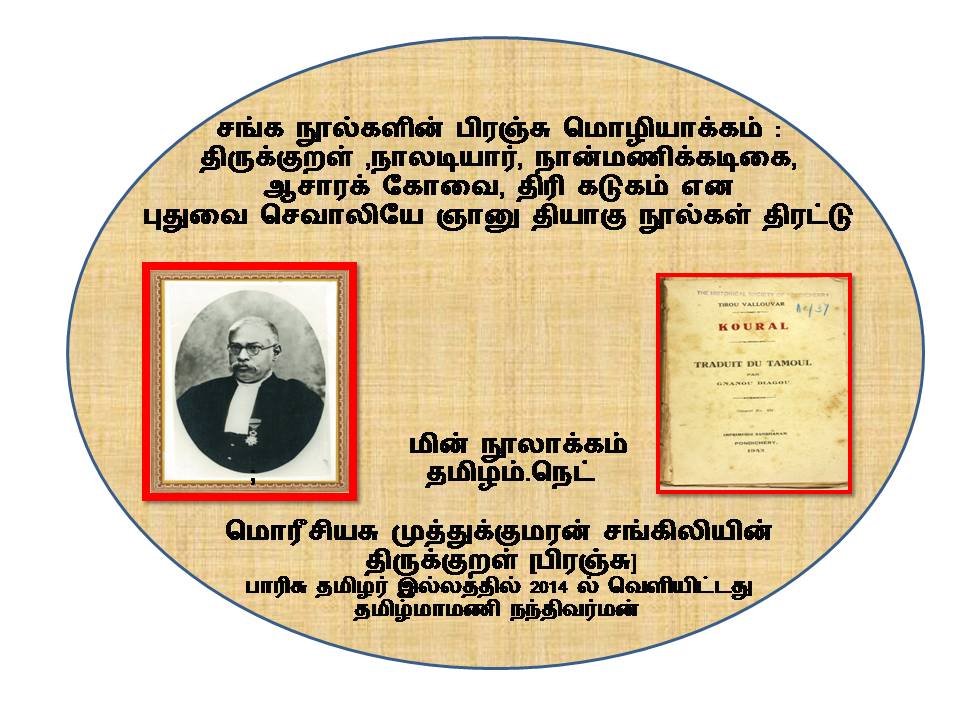
Great litterateur Gnanou Diagou
Great litterateur Gnanou
Diagou
Great men and great deeds may get
lost in the sands of history. But a grateful society leaves monuments for
successive generations to remember them with gratitude.
Behind every monument there is a
history. A statue at the Pondicherry Government Hospital reminds us of the
donor who gifted the land for its construction. The clock tower of
grand Bazaar also rekindles memories of its donor, the grandfather of an
illustrious, son of the soil, Le Bottennier Gnanou Diagou.
The 127th birth
anniversary of Le Boutonnière Gnanou Diagou, a man of letters and
philanthropist falls on August 15. Not just the monuments but Gnanou Diagou’s
contribution to Tamil Literature has been forgotten by the literary world and
local population. His French translations of Kamba Ramayanam, Araneri
Saaram, Assara Kovai, Nanmani Kadigai, Naladiar and the Thirukural are
everlasting contributions that must be lauded by a grateful society. Sir CP
Ramaswamy Iyer, in the foreword written to the French Translation of the
Thirukural lauds thus, ‘‘Mr Gnanou Diagou’s rendering of Thiruvalluvar’s Kural
into French is important and significant to international cultural
collaboration.’
Gnanou Diagou, born on August 15,
1877, was an eminent lawyer and served as the president of Bar association. For
nearly three decades he taught students of the Ecole de Droit Pondicherry as
Professor of Law and wrote several Books on Hindu and Mohammedan law. He was
also a popular political leader of Pondicherry from 1908 to 1925. He founded
The Historical Society and left his imprint as its Vice President from 1911
till his son Cojande Dairianathan succeeded him in 1948.
The conferment of honours
initiated by Napolean Bonaparte in 1802 has the following titles of honour
similar to our padma Bhushan, Padma Vibhushan and Padmasri. Grand Officier da
la Legion d’ honneur is the first in rank. The second one is Chevalier de la
legion d’ honneur. This was conferred on meritorious people for social service
and the French government in recognition of his services had honoured him by
conferring the second medal of honour, The Legion of Honour, on January 15,
1920. He also won awards like Officier d’ Academie and Chevalier du merite agricole.
A member of the Counseil General, the the French version of the Legislative
assembly with limited powers, he served the public.
Gnanou Diagou was the descendent of
one of the oldest and distinguished ‘‘Dubash’’ families of Pondicherry. Lazario
De Motha Tanappa Modeliar, the illustrious ancestor of Gnanou Diagou had
collaborated with Francois Martin in 1673 in the very foundation of the French
settlement in Pondicherry. His successors Moutiappa Modeliar and his son Pedro
canagaraya Modeliar were no less distinguished. Pedro
Canagaraya Modeliar was the recipient of the gold medal from Louis
XV, King of France, for his good offices in securing Karaikal from the Maharaja
of Tanjore in 1739. There is a street named after him that in current days
called Canteen Street, though in name it exists in street boards. His son
Diagou Modeliar, the grandfather of Gnanou Diagou, erected the clock tower in
the Grand Bazaar apart from many choultries to feed the poor. The Street
parallel to Nehru Street is named after Diagou Modeliar.
Hailing from such an
illustrious family, Gnanou Diagou scaled greater heights in public esteem
through his literary works . He wanted to preserve the history of Pondicherry
and was instrumental in having the manuscript of Ananda Ranga Pillai’s diaries
copied from the original for publication purposes. He analyzed the decisions of
the Superior Council from 1735 to 1820, the work of almost a century, and
published them in eight volumes. He has written an authoritative book on
General de lally, the unlucky successor of Dupleix in whose period
the entire white town including the Palace of Dupleix was destroyed.
History is not a mere record
of the events of the past. It has a meaning to be learnt. The acts of
philanthropy are lauded to inculcate in the present generation such noble
qualities. The intercultural exchange by taking the essence of Tamil classical
literature to French, as done by Gnanou Diagou, is an incomplete mission for
every generation of writers.
Courtesy: The New
Indian Express-week end-14.08.2004
|
Friday, August 31, 2018
THE TAMIL FRENCH LITERARY CONNECTIONS
Thiruvalluvar’s
Thirukural is Tamils pride and everybody’s guide in life. Secularism, essence
of our constitutional principles springs from each and every couplet of this
great treatise of wisdom written 2000 years ago. And Sir C.P.Ramasamy Iyer
places a befitting tribute to its grandeur on record. In his preface to the
French Translation of Thirukural Sir C.P.Ramasamy Iyer says “ It has been
rightly remarked that the Kural addresses itself to all classes and
communities, and indeed to the whole human race and charges itself with the
promulgation of virtue and of right conduct in the guise of familiar and
friendly advice. In a series of pithy maxims, it lays down rules of universal
acceptability dealing with most of our domestic and social problems and
situations. In the well known words of the philosopher, Spinoza, it is written
sub specie eternitate though characterized by tenderness and comprehensive
human sympathy, human life and love in all their forms as well as the regular
of existence in the social and economic fields are alike dealt with on the
basis of practical spirituality”.
Thirukural,
the secular book on morals had been translated in many languages and is next to
that of Bible in the number of such translations. The French version of
Thirukural rendered by a great littérateur Mr.Gnanou Diagou had fascinated many
scholars. It is a matter of pride to all Pondicherrians that Mr.Gnanou Diagou
is one of the illustrious sons of this soil having earnt a name and fame in the
19th century.Thirukural had been translated into the following
languages. 1) Burmese Mr. Myo Thant, Thirukkural 2) Chinese
Mr.Chi Eng Hsi, Thirukkural (1967) 3). Czech Mr. Kamil V Zvelebil,
Thirukural (1952-1954 4) Dutch Mr. D.Kat, Thirukural (Netherlands, 1964)
5) Fiji, Mr.S.L Berwick, Na. Thirukkurala, 1964) 6) Finnish Mr.
Aalto, Pentit, Kural - The Ancient Tamil Classic (1972) 7) German
Albrecht, Fenz and K. Lalithambal: Thirukural von Thiruvalluvar aus dem Tamil,
Madurai (1977), Mr.A.F Cammera, Thirukural Leipzig (1803) Mr Karl. Graul, Der
Kural des Thiruvalluvar, (London 1854), Mr. Karl Graul, Der Tamu lische gnomes
dichtar Thiruvalluvar, (Leipzig, 1865) Mr.Frederick Rickert Thirukural,
selections, (Berlin, 1847) Mr. William and Norgate, Der Kural des
Thiruvalluvar, (2nd ed, London, 1866) 8) French Ariel, M, Kural de
Thiruvalluvar (traduits du tamoul), Paris, 1848, Barrigue de, Fontaineu, G, Le
livre de l'amour de Thiruvalluva, Paris, 1889, Danielou, Alain, Thiruvallouvar
Kural, Pondicherry, 1942, Jacolliot, Louis, Kural de Thiruvalluvar,
(selections) Paris, 1767 Lamairesse, M, thirukural in French, Pondicherry, 1867)
9) Latin Graul, Charles, Kural of Thiruvalluvar, Tranquebar, 1866
Veeramamunivar, Thirukural (Books I and II), London, 1930 10) Malay
Ismail, Hussein: Thirukural sastera kalasik Tamil yang, Kuala Lumpur,
1967,Ramily Bin Thakir Thirukural (in verses), Kuala Lumpur, 1964 11) Polish Umadevi, Wandy Dynowskiev, Thiruvalluvar
Kural, Madras, 1958 12) Russian
J.J Glazov and Krishnamurthi, A, Thirukural, a book on virtue, politics
and love, Moscow, 1963 Glazov,
Thirukural in couplets with illustrations, Moscow, 1974 13)Swedish
Frykholm Ingya, Thirukural, Uddavalla, 1971. The list is incomplete.
The
complete list of languages in which Thirukural got translated is yet to be
compiled. The irony is we live in an age of information technology where at our
fingertips we should keep these facts. Many authors will boast that next to
Bible the only other book that was translated in many languages is Thirukural.
Yet none bothers to compile the data of all such translations undertaken and
books published in various languages. Let scholars and institutions start
compiling such lists, uploading in the Net to enable all Tamil lovers easy
access. Particularly Pondicherry with all its connections with France and with
prestigious institutes like French Institute functioning here it will be
appropriate that better coordination exists between Pondicherry University,
Pondicherry Institute of Linguistics and Culture which hopes to become a deemed
University soon and other Tamil scholars well versed in both the languages.
A
great bilingual scholar Desigam Pillai in his book Tamizhagamum
Frenchukararum dutifully records the services of scholars who promoted
cultural exchanges with zeal. The Jesuits priests who came here to propagate
their religion learnt Tamil and for the purpose of their kinsmen to understand
the nuances of Tamil they wrote many books in French. The services of
Mr.Boucher (1655-1732), Mr.De la Lane (1669-1746), Mr.Bouze (1673-1735),
Mr.Gargam (1690-1742), Mr.Calmette (1693-1740), Mr.Coeurdoux (1699-1774) in
writing books to help French acquire proficiency in Tamil, is thus listed by
Desigam Pillai. Mr.Desigam Pillai, a lawyer and Tamil scholar also mentions the
names of those who learnt Tamil. Mr.Perrin (1754-1820), Mr.Maguy (1758-1822),
Mr.Dubois (1770-1848), Mr.Dupuis (1806-1874), Mr.Mousset (1808-1888),
Mr.Legouste (1880-1863), Mr.Lap (1834-1893). These lists may be tiring to
normal readers. But it is a list to be remembered to understand the cultural
fraternity that developed between the French and Tamil-speaking peoples.
Many
scholars who collected the Tamil manuscripts and palm leaf texts during their
stay in Pondicherry had given them to the Bibliotheque Nationale de Paris. Even
now in many homes including this writer there remains palm leaf texts ravaged
by time. It is high time that academic institutions in the soil of Pondicherry
and the Governments here that speak of heritage engage in a quest to collect
all such texts, digitalize them and microfilm such rare collections hidden in
Museums of both countries and private homes. Messrs.Mousset and Dupuis wrote
the Dictionnaire Français Tamoul (French Tamil Dictionary) running into
1270 pages and a Dictionnaire Tamoul Français-2 Vols. (Tamil French
Dictionary) running into 1660 pages. Mr.Jules Gordin who came from France to
contest an election here for the house of elders and who became a French
Senator took steps to start Tamil section in the Paris University. The dream
came true in 1879. From 1890 in the Ecole des Langues Orientales Tamil classes
became a reality. Mr. Vinson Julien wrote a grammar called Manuel De La
Language Tamoule Grammaire, Texts, Vocabulaire ,and Mr.P.Lap, A Brege De
La Grammaire Française Tomoule.Mr.M.J.Baulez wrote on colloquial Tamil Méthode
De Tamoul Vulgaire
These
are the pioneers and many authors who succeeded them had laid down firmly the
path of inter cultural exchange and language fraternity. To a layman it appears
that in the post independence era, these exchanges have mellowed down, and an
impetus is needed to reactivate the vigour with which Tamil was welcomed with
open arms by French. The entire French literature must be translated into Tamil
and vice versa. The unfinished agenda must be undertaken with renewed interest.
Before the old generation that had mastery over both languages bids adieu to
earthly existence, these unfinished tasks must be taken up with urgency, while
for younger generations the need to nourish this cultural legacy left between
the most lovable languages on earth, becomes a quest with thirst for
knowledge.
Wednesday, September 30, 2015
THE TAMIL FRENCH LITERARY CONNECTIONS
N.Nandhivarman
Thiruvalluvar's Thirukural is Tamils pride and
everybody's guide in life. Secularism, essence of our constitutional principles
springs from each and every couplet of this great treatise of wisdom written
2000 years ago. And Sir C.P.Ramasamy Iyer places a befitting tribute to its
grandeur on record. In his preface to the French Translation of Thirukural Sir
C.P.Ramasamy Iyer says " It has been rightly remarked that the Kural
addresses itself to all classes and communities, and indeed to the whole human
race and charges itself with the promulgation of virtue and of right conduct in
the guise of familiar and friendly advice. In a series of pithy maxims, it lays
down rules of universal acceptability dealing with most of our domestic and
social problems and situations. In the well known words of the philosopher,
Spinoza, it is written sub specie eternitate though characterized by tenderness
and comprehensive human sympathy, human life and love in all their forms as
well as the regular of existence in the social and economic fields are alike
dealt with on the basis of practical spirituality".
Thirukural, the secular book on morals had been
translated in many languages and is next to that of Bible in the number of such
translations. The French version of Thirukural rendered by a great littérateur
Mr.Gnanou Diagou had fascinated many scholars. It is a matter of pride to all
Pondicherrians that Mr.Gnanou Diagou is one of the illustrious sons of this
soil having earnt a name and fame in the 19th century.Thirukural had been
translated into the following languages. 1) Burmese Mr. Myo Thant, Thirukkural
2) Chinese Mr.Chi Eng Hsi, Thirukkural (1967) 3). Czech Mr. Kamil V Zvelebil,
Thirukural (1952-1954 4) Dutch Mr. D.Kat, Thirukural (Netherlands, 1964) 5)
Fiji, Mr.S.L Berwick, Na. Thirukkurala, 1964) 6) Finnish Mr. Aalto, Pentit,
Kural - The Ancient Tamil Classic (1972) 7) German Albrecht, Fenz and K.
Lalithambal: Thirukural von Thiruvalluvar aus dem Tamil, Madurai (1977), Mr.A.F
Cammera, Thirukural Leipzig (1803) Mr Karl. Graul, Der Kural des Thiruvalluvar,
(London 1854), Mr. Karl Graul, Der Tamu lische gnomes dichtar Thiruvalluvar,
(Leipzig, 1865) Mr.Frederick Rickert Thirukural, selections, (Berlin, 1847) Mr.
William and Norgate, Der Kural des Thiruvalluvar, (2nd ed, London, 1866) 8)
French Ariel, M, Kural de Thiruvalluvar (traduits du tamoul), Paris, 1848, Barrigue
de, Fontaineu, G, Le livre de l'amour de Thiruvalluva, Paris, 1889, Danielou,
Alain, Thiruvallouvar Kural, Pondicherry, 1942, Jacolliot, Louis, Kural de
Thiruvalluvar, (selections) Paris, 1767 Lamairesse, M, thirukural in French,
Pondicherry, 1867) 9) Latin Graul, Charles, Kural of Thiruvalluvar, Tranquebar,
1866 Veeramamunivar, Thirukural (Books I and II), London, 1930 10) Malay
Ismail, Hussein: Thirukural sastera kalasik Tamil yang, Kuala Lumpur,
1967,Ramily Bin Thakir Thirukural (in verses), Kuala Lumpur, 1964 11) Polish
Umadevi, Wandy Dynowskiev, Thiruvalluvar Kural, Madras, 1958 12) Russian J.J
Glazov and Krishnamurthi, A, Thirukural, a book on virtue, politics and love,
Moscow, 1963 Glazov, Thirukural in couplets with illustrations, Moscow, 1974
13)Swedish Frykholm Ingya, Thirukural, Uddavalla, 1971. The list is incomplete.
The complete list of languages in which Thirukural got translated is yet to be
compiled.
The irony is we live in an age of information technology
where at our fingertips we should keep these facts. Many authors will boast
that next to Bible the only other book that was translated in many languages is
Thirukural. Yet none bothers to compile the data of all such translations
undertaken and books published in various languages. Let scholars and
institutions start compiling such lists, uploading in the Net to enable all
Tamil lovers easy access.
Particularly Pondicherry with all its connections with
France and with prestigious institutes like French Institute functioning here
it will be appropriate that better coordination exists between Pondicherry
University, Pondicherry Institute of Linguistics and Culture which hopes to
become a deemed University soon and other Tamil scholars well versed in both
the languages. A great bilingual scholar Desigam Pillai in his book
Tamizhagamum Frenchukararum dutifully records the services of scholars who
promoted cultural exchanges with zeal. The Jesuits priests who came here to
propagate their religion learnt Tamil and for the purpose of their kinsmen to
understand the nuances of Tamil they wrote many books in French. The services
of Mr.Boucher (1655-1732), Mr.De la Lane (1669-1746), Mr.Bouze (1673-1735),
Mr.Gargam (1690-1742), Mr.Calmette (1693-1740), Mr.Coeurdoux (1699-1774) in
writing books to help French acquire proficiency in Tamil, is thus listed by
Desigam Pillai. Mr.Desigam Pillai, a lawyer and Tamil scholar also mentions the
names of those who learnt Tamil. Mr.Perrin (1754-1820), Mr.Maguy (1758-1822),
Mr.Dubois (1770-1848), Mr.Dupuis (1806-1874), Mr.Mousset (1808-1888),
Mr.Legouste (1880-1863), Mr.Lap (1834-1893). These lists may be tiring to
normal readers. But it is a list to be remembered to understand the cultural
fraternity that developed between the French and Tamil-speaking peoples.
Many scholars who collected the Tamil manuscripts and
palm leaf texts during their stay in Pondicherry had given them to the
Bibliotheque Nationale de Paris. Even now in many homes including this writer
there remains palm leaf texts ravaged by time. It is high time that academic
institutions in the soil of Pondicherry and the Governments here that speak of
heritage engage in a quest to collect all such texts, digitalize them and
microfilm such rare collections hidden in Museums of both countries and private
homes. Messrs.Mousset and Dupuis wrote the Dictionnaire Français Tamoul (French
Tamil Dictionary) running into 1270 pages and a Dictionnaire Tamoul Français-2
Vols. (Tamil French Dictionary) running into 1660 pages. Mr.Jules Gordin who
came from France to contest an election here for the house of elders and who
became a French Senator took steps to start Tamil section in the Paris
University. The dream came true in 1879. From 1890 in the Ecole des Langues
Orientales Tamil classes became a reality. Mr. Vinson Julien wrote a grammar
called Manuel De La Language Tamoule Grammaire, Texts, Vocabulaire ,and
Mr.P.Lap, A Brege De La Grammaire Française Tomoule.Mr.M.J.Baulez wrote on
colloquial Tamil Méthode De Tamoul Vulgaire
These are the pioneers and many authors who succeeded
them had laid down firmly the path of inter cultural exchange and language
fraternity. To a layman it appears that in the post independence era, these
exchanges have mellowed down, and an impetus is needed to reactivate the vigour
with which Tamil was welcomed with open arms by French. The entire French
literature must be translated into Tamil and vice versa. The unfinished agenda
must be undertaken with renewed interest. Before the old generation that had
mastery over both languages bids adieu to earthly existence, these unfinished
tasks must be taken up with urgency, while for younger generations the need to
nourish this cultural legacy left between the most lovable languages on earth,
becomes a quest with thirst for knowledge.
Tuesday, July 29, 2014
Subscribe to:
Posts (Atom)
அடுத்த 11 வது உலகத் தமிழ்மாநாட்டிலாவது சுவாமி விபுலானந்தரின் எழுத்துக்களையும் பேச்சையும் ஆய்வு செய்ய....
தமிழ் ஆய்வுலகமும் தமிழ்ப் பல்கலைக்கழங்களும் அடுத்த 11 வது உலகத் தமிழ்மாநாட்டிலாவது சுவாமி விபுலானந்தரின் எழுத்துக்களையும் பேச்சையும் ஆ...
-
Siddha Research: The Basic Difficulties by Dr. T. N. Ganapathy, Ph D Director of the Tamil Siddha Yoga Research Project (The f...
-
Master Thesis Proposal Author: Ravi Devaraj guide: Mr.N.Nandhivarman E-mail: ...
-
G U Pope’s Metrical Translation of the Tirukkural: An Evaluation of the Translation of a Classic R. Margaret Joy Priscilla Wom...