On Tamil culture,civilization,history,literature,heritage and Tamil Diaspora
Showing posts with label plantation labour. Show all posts
Monday, November 19, 2018
Saturday, August 9, 2014
SINGAPORE LOCATED BY A TAMILIAN
N.Nandhi Varman
Role of Tamils in history of Singapore
“The
second successful six year term of unanimous choice for President Sellappan
Ramanathan of Singapore is a silent revolution.
It denotes recognition could be earned by constitutional means by peace loving
Tamils anywhere in the world” said Director of Pondicherry Institute of
Linguistics and Culture Dr.Marudhanayagam. Pondicherry
has many a contact with Singapore .
The handloom weavers of Muthialpet for long had been exporting to Singapore .
Pe.Tha.Rasan of Tirumalairayanpattinam of Karaikal region went to Singapore , made
a fortune and participated in that country’s politics. He wrote a monumental
book Singaporin Varalatril Vazhukinra Thamizhargal.
Chinese named
Singapore
as Pu-luo-chung, which meant "island at the end of a
peninsula" in third century. Javanese
language book Nagarakretagama' of 1365 calls as Temasek,
or Sea town. Vietnamese source for that
name is there. But from 14th century Singapuram
which means Lion City is commonly used indicating the
predominance of Tamil settlers.
On 29 January
1819 Sir Stamford Raffles, Lieutenant-Governor of Bencoolen
landed in the island to establish a trading station at the southern tip of
the Malay Peninsula after having
surveyed other nearby islands. Along with him came Narayana Pillai and Pe.Tha.Rasan
records the contribution of Narayana Pillai in building of Singapore . Singapore
proved to be a prized settlement.
The opening
of the Suez Canal in 1869 made Singapore
a major port of call for ships navigating between Europe and East
Asia . Rubber planting, especially after the 1870s made Singapore the main exporter for
rubber in the world. At the end of the 19th century Singapore experienced unprecedented
prosperity with eightfold trade expansion between 1873 and 1913. This
prosperity attracted immigrants from countries around. The population grew to 80,792 by 1860 with Chinese 61.9 per cent
the Malays and Indians 13.5 and 16.05 per cent respectively; and others,
including the Europeans, 8.5 per cent.
Dravidian
Movements impact on Singapore
In that
island nation the unity of the multi ethnic society did not come over night. It
had been a long and strenuous period with visionaries shaping the destiny of
that nation. Its Union with Malaya ,
subsequent independent nationhood, all
were passing phases. In that phase the political movements of Tamil Nadu played an important
role. Periyar visited Malaya in 1929 to
inaugurate Malaya Tamil Congress. In later years after he parted company with Congress , Singapore
Dravida Kazhagam and subsequently Singapore Dravida Munnetra Kazhagam came up
as independent outfits. They were not extensions of the Tamil Nadu based
political outfits. They were independent parties dedicated to the country and
they never had extra territorial ambitions. Leaders like Anna advised Tamils to
be loyal to the country of settlement. This mature guidance led to amalgamation
of Tamils in that country’s national mainstream. Pe.Tha.Rasan was the General
Secretary of Singapore Dravida Munnetra Kazhagam. In his time even in Ceylon there
was a separate Dravida Munnetra Kazhagam
unit with A.S Manavaithambi as General Secretary, so was the case of Malaysia
Dravida Munnetra Kazhagam. They waning of the influence of Indian nationalists,
communists and Dravidian movement in the South East Asian countries where
Tamils went as settlers created a vacuum which was occupied by militancy in
Srilanka, but in Malaya and Singapore though these parties lost relevance, the
ground they prepared helped Tamils gaining national identity, Tamil language
getting official language status, and now Tamil heading a multi ethnic country
like Singapore.
As settlers
from Europe amalgamated into American society
Tamils and Indians became Singaporeans and Malaysians. Peace prevails in a
multi linguistic and ethnic country unlike other places of turmoil. Immediately
after independence doubts over its very survival were raised in international
media. The pressing issues were unemployment, housing, education, lack of
natural resources and lack of land.
Its
leaders decided that the population would need to be fluent in English and
English was made the medium of education for all schools. Education, at least
for primary schooling was made compulsory. The education system was designed to
be rigorous and intensive, with emphasis on immediately practical, rather than
intellectual, applications, such as on the technical sciences as opposed to
political discussion or philosophy. A large portion, around one-fifth of Singapore 's
budget was devoted to education to facilitate a large and competent work force
upon graduation.
Language
Policy Evolution in Tamil Nadu and Singapore
It is pertinent
to note that DMK founder C.N.Annadurai’s visit to Singapore
and Malaysia
in 1965 was an eye opener to the leader who later introduced the two language
formula without diluting the importance of English. His visit and meeting with
Lee Kuan Yew played an influential role in his later day policy perceptions on
language as Tamil Nadu Chief Minister.
The
leadership of Lee Kuan Yew achieved a
miracle. After dominating political scene for longest period in office now Lee
is looking back at his past policies in a mode of introspection .
In spite of
all that Lee still has soft corner for his mother tongue. Lee expressed concern
about the declining proficiency of Mandarin among younger Singaporeans. In one
of his parliamentary speeches, he said: "Singaporeans must learn to juggle
English and Mandarin". Subsequently, he launched a television program in
January 2005, in an attempt to attract young viewers to learn Mandarin. In June
2005, Lee published a book, Keeping My Mandarin Alive, documenting his
decades of effort to master Mandarin, a language which he said he had to
re-learn due to disuse. The racial unity was fostered well during Lee Kuan
Yew’s regime.
TAMIL
PRESIDENT OF SINGAPORE : S.R.Nathan
Now an ethnic
Tamil had been chosen for a second term. Mr. Sellapan Rama Nathan received a
walkover on nomination Day i.e 18 August 1999 for his first Presidential election.
The Presidential Elections Committee said in the second Presidential election
in August 18 2005 that Mr. Nathan has all the credentials for the office. “Not
only is Mr. Nathan well regarded and respected for his public service, he is
also a man of integrity, good character and reputation”.
The Tamil
becoming unopposed again as President of Singapore has generated lot of
interest in Pondicherry and The students
of Dr.Ambedkar Law college launched a signature campaign in various colleges to
urge Pondicherry University to confer Honorary doctorate on S.R.Nathan citing
the precedent of Maldives President getting doctorate from Pondicherry
University at an earlier period. The author of the book that records all the
services of Tamils in nation building of Singapore Pe.Tha.Rasan after 45 years
in Singapore
is back to Karaikal and presides over Kamban Kazhagam of Karaikal. It is irony
of fate.
|
Courtesy: New Indian Express 17.09.2005
|
Friday, July 11, 2014
Sunday, July 6, 2014
THE TAMILS OF REUNION AND THEIR HYBRID CULTURE
Colonialism
cannot be condemned outright. This may sound outrageous. But colonialism in a
way introduced the concept of outsourcing attempted in the bygone centuries and
currently being debated in the free market era. In a world where free market
dominates, the sweat and toils of the slave labourers may be forgotten, but we
must realize that in their sufferings the foundations for global market economy
is sown. ReUnion is a typical example of outsourcing by the French East India
Company, and its history reveals how an hybrid culture emanated amidst Tamil
settlers there, who are Tamils but could not speak Tamil, their mother tongue
lost in the interregnum of 5 generations of separation from their homeland namely
Pondicherry.
The archipelago,
comprised of Mauritius ,
Rodrigues and Réunion, was christened the Mascarenes by Portuguese navigator
Pedro de Mascarenhas, following its European discovery in 1512. In 1642 the
French settled in the island when La Compagnie des Indes Orientales (the French
East India Company) sent its ship, the St-Louis, and the King of France named
it Île Bourbon. Much water had flown in the five rivers that irrigate this tiny
island since then.
The French
Revolution is a turning point in its history. The greatest achievement of the
1848 revolution for the colonies was the abolition of slavery. Slavery, the
foundation of economic life in Martinique, Guadeloupe ,
Guyana and Reunion ,
had been abolished by the Convention in 1794 but was re-instituted by
Napoleon. National Assembly by way of
definitive decree on April 27, 1848 declared that `slavery is an attack on
human dignity', it `destroys the principal of natural law and duty . . . it is
a flagrant violation of republican dogma," and that great unrest could
erupt in the colonies if slavery were not ended, the law abolished slavery in
all French colonies and possessions.
Thus a total of 262,564 slaves were thereby freed, most of them in the
plantation colonies of the West Indies and
Réunion.
But with this
abolition of slave labour the need to fill that vacuum arose and plantation
owners looked for French India to compensate the loss of slave labour. Thus lot
of Tamils found their way to the island
of Reunion situated in the Indian
Ocean closer to Madagascar .
Lot of people from Pondicherry and its surrounds
went to the coffee and other plantations in Reunion
as labour.
The coffee
plantations were destroyed often destroyed by cyclones and the Tamil labour had
to struggle hard facing the fury of Nature. Napoleon Bonaparte lost the island
to the British for a short break of five years.
Under British rule, sugar cane was introduced to Réunion and quickly
supplanted food production as the primary crop. It resulted in the
dispossession of many small farmers who were forced to sell out to those with
capital to invest in the new monoculture. The supplanted farmers migrated to
the interior to find land and carry on with their agricultural activities.
During this period, the Desbassyns brothers rose to success as the island's
foremost sugar barons. The vanilla industry, introduced in 1819, also grew
rapidly. The golden age of trade and development in Réunion lasted until 1870,
when competition from Cuba
and the European sugar beet industry, combined with the opening of the Suez Canal , resulted in an economic slump. Shipping
decreased, the sugar industry declined and land and capital were further
concentrated in the hands of a small French elite. Close on the cessation of
hostilities in First World War global demand for sugar increased. This helped Reunion 's economy out of the doldrums. But during World
War II, an economic blockade once again crippled the island's economy. A colony
under French law must provide to the French mainland goods of greater value
than the amount of money allocated to it. A colony had to be profitable. This
obligation was lifted in 1946, when Réunion's status changed from colony to
overseas department, a change in status intended to provide the island with the
benefits of social and political equality with the mainland. The island still
falls under the jurisdiction of the French government.
It cannot be
said that Catholic faith dominates the island's religious character. It is
visible in the shrines along every highway and byway, in caves, on cliff tops
and in the many saint's days and holidays. St-Denis shuts down on Sunday, when
half the city goes to the beach. Hindus and Muslims follow their respective
religions freely and most large towns have both a mosque and a temple. Popular
Hindu rites include teemeedee, which involves fire walking, and cavadee,
involving piercing one's cheeks with silver needles, often take place. A great
deal of syncretism with Catholicism has evolved over the years, and vice versa.
Thus a hybrid religion had come into existence. People celebrating all
festivals and worshipping all deities have produced a hybrid religion of
tolerance. Lot of Hindu Temples is there for Lord Shiva, Lord Muruga and Godess
Kaali.
French is the
official language, but Créole is the most widely spoken. Few people speak
English. Réunion Créole is even beyond most French people. A word, which means
one thing in French, can mean something completely different in Créole. But the
island which has around 4 lakh Tamils who own Tamil names and celebrate Hindu
festivals, yet unable to speak Tamil. The Tamil Nadu Finance Minister Navalar
Nedunchezian participated in a world Tamil Cultural Movements conference in
neighbouring Mauritius and
visited Reunion too. During this visit the
Reunion Tamil Kazhagam seeking the help of Tamil Nadu Government to teach Tamil
to the people of Reunion and to promote
cultural exchanges with mainland Tamils put up demands. It remains still and
unfulfilled dream. People in a distant place do not haunt our memory as we have
other chores to attend in everyday life. But the Government of Tamil Nadu and Pondicherry must open Cultural Exchange Centres in all
these isolate islands, and like the Alliance Francaise that keeps teaching
French throughout world, institutionalized teaching of Tamil and spreading the
tenets of Tamil Culture must be undertaken, all who visit islands like Reunion will have these thoughts linger in their minds.
The Maha Bhadrakaliaaman
Temple authorities and the Natha
Musical Academy of Reunion have invited the students of TamilNadu Government
Music College
to provide them some insights into Tamil folk arts. Professor M.Anbarasan who
teaches folk arts in the College of Music who heads the team comprising his students Miss
K.Kala, Miss.K.Vijayalaxmi, Miss.N.Selvarani, Miss.Santhi and Mr.Nallusamy will
be participating in various functions in Reunion
as depicted in this poster. This ambassadors of Tamil culture carry forward the
message of goodwill from the people of Tamil Nadu, and whole Reunion Tamils
must be reassured that in upholding Tamil customs, religious practices, arts,
music and language, a day will come that Reunion
cultural ambassadors arrive here and capture our attention and can win our
admiration. Where there is a will, there will be a way, goes the saying.
Reunion Tamils have the will. Let them cherish their hybrid culture with Tamil
component, we all hope and wish so.
N.Nandhivarman
Courtesy: New
Indian Express dated: 13th April 2004
Saturday, July 5, 2014
Tuesday, June 24, 2014
GARIBS OF INDIA MIGRATED TO CARRIBIENS
N.Nandhivarman
It is said that in his third
voyage Christopher Columbus found Trinidad island in 1498. But archaeological excavations in 29
places of Eastern Caribbean prove of earlier settlements of human beings dating
back even to 7000 years ago. These tribal’s who lived there belong to stone
age. Later their culture was classified as Hacienda Grende culture [250 BC to
300 A.D] ,Cuevas culture [400to 600 A.D]. Prosperity culture [ 1 to 300 A.D]
Coral Bay Lang ford culture [ 350-550 A.D]. These settlers were from the river
banks of Orino river that flows in Latin American country, Venezuela. They drove
away the Ortorvid tribes and developed agriculture. Those who think that
Columbus found a no man’s continent are mistaken in their belief. Tribal
cultures prevailed and were well nourished much before Europeans set their foot
in Trinidad and Tobago. The name Caribbean is derived from the Caribb tribes,
whose pictures reveal sacred ash like mark in the forehead of the tribal women.
Really a puzzle on how come traces of a Saivite
practice existed among those tribes, is matter for research.
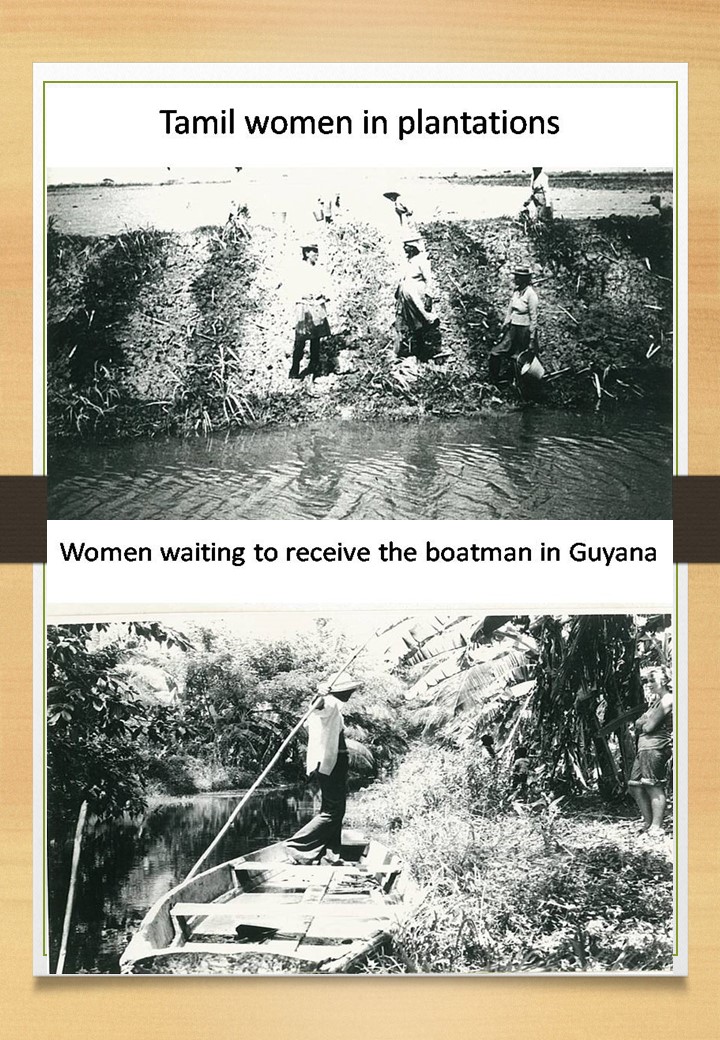
178 years ago, British
rulers of India trained their eyes on the teeming millions of India for
manpower. Abolition of slavery resulted in shortage of labour to work in their
sugarcane plantations. The father of British Prime Minister William Gladstone,
Mr. John Gladstone on 4th January 1836 wrote a letter to a company
based in Calcutta that he needed 100
labour on 5 to 7 year contract to work in his sugarcane plantations of Guyana.
This company had a proven track record of earlier having sent slaves to
Mauritius. On 5th May 1838 in two ships Whitby and Hesperes 396
slaves including 22 women sailed to Guyana from Calcutta. John Scroble who belonged to British
Ant-Slavery Society wrote that these hill tribes were not taken voluntarily but
were forcibly abducted and smuggled out of India.
They took the hill coolies
of Chota Nagpur areas as bonded labour. Another ship carrying such coolies left
Calcutta in February 1838 and reached Guyana on May 5th of 1868 with
420 hill coolies including 50 women and 10 children. Many perished to diseases
during the voyage and those who escaped disease and death on reaching the
islands under a five year contract had to die unable to bear the stress and
strain of their working conditions. The work conditions were designed in such a
way that the workers were perpetually in debt to their employers. An Indian
coolie was fined 24 dollars which was equivalent to six months wages , if he
absented from work for more than 7 days . Suresh Kumar Pillai, a Keralite
social scientist researched, wrote, shot, produced and directed the three part
50 minute documentary series titled Jahaji Bhai , a documentary
with Urdu title. Title means brothers of the ship. The protagonists are not
sailors in the same boat but slaves spirited away in the same vessel. Jahaji
Bhai was shot in Guyana and Trinidad and produced by Trikkan Image Systems .It
was telecast in televisions of Caribbean islands and India in 2003.
Suresh Kumar Pillai holds a
post graduate diploma in mass communications in addition to fifteen years of journalistic
experience. His another documentary on
migration of an Indian family in 19th century from Bihar and Uttar
Pradesh to Caribbean titled Once More Removed for HBO documentaries USA is of
special importance.
Through these documentaries
he had depicted how migrant Indians to Caribbean’s lost their roots and
culture. Negroes liberated from slavery climbed up in the social ladder,
whereas Indian migrants went to fill up
the vacuum at the lowest strata of society. Most of them took to alcohol and
for few women polyandry became the order of the day. Africans joined Europeans
to suppress the brown race from India. Indian coolies were never allowed to
practice their religious faiths or to speak their native tongues in the
plantations. Quoting from various sources Suresh Kumar Pillai highlighted the
plight of Indian immigrant labour including every day of their life in islands.
An unknown chapter of the struggle waged
by Roar Guyana Movement and its leader Ravi Deb were recorded in the
documentary Jahaji Bhai. It includes an interview of 108 year old man who
recollects his fellow travellers of the slave ship which took him to the
islands.
The temple in sea, built by
Sadhu Sivadas symbolises the struggle for religious freedom waged by a Bihari
in Trinidad. Born in January 1 of 1903 , Sivadas while he was only 4 years old
went along with his parents in ship named S.S.Mutla to Trinidad. His parents
and the boy worked as slaves in the Waterloo farm. When Sivadas grew he ran a
grocery shop there and was saintly in his sermons to people. He bought a small
piece of land closer to Waterloo Bay from a compant in 1947 and built Lord
Shiva temple. The company which sold the land to Sivadas ordered him to
demolish the temple. He refused and was sentenced to 14 day imprisonment and
400 dollars fine on claim that he grabbed the land. While he was in prison
temple was demolished in 1952 and land records burnt. “ You can destroy the
temple but I will build in sea vowed Sivadas Single handed carrying bricks and
cement in his bicycle within 500 meters to sea Sivadas started constructing
Siva Mandir. Sometimes others too helped him. But mostly he alone accomplished
the task like a Hanuman. This temple is a monument for Indian struggle to
religious faith. After this victory nearly 300 Hindu temples came up in
Trinidad and Tobago. In 1971 Sivadas passed away and grateful people erected
his statue in 1995.
Members of British
Parliament voiced protests against Indians being taken as slaves to Caribbean
islands from British India to work in plantations . British India halted its
slave ships. In that place French India stepped in to supply new slaves. So on
this hidden history Suresh Kumar Pillai shot another documentary titled Songs
of Malabaris. The Songs of Malabaris “ was shot for Nederland based OHM Media
Network and was telecast on Nederland National Television Channel in June 2004.
All South Indians were referred as Malabaris in those days. French recruited
between 1854 to 1920 around 50,000 coolies from Pondicherry, Karaikal, Mahe,
Yenam , Chandranagore, French enclaves in India. They were taken to Guadeloupe
and Martinique to work as plantation labour. The Indian labour in French
colonies had to face stiff opposition from Africans, because Indians were ready
to work for paltry pittance, which was not acceptable to Africans, who eyed
Indians with enmity. Thus Indians
occupied the lowest position in the French Caribbean society and were derogatively called as Coolie
Malabaris or even as Chappa Coolies. In French colonies Indians had
to be French in every sense, forgetting their native language and gods. But in
Dutch colony of Surinam or British colony of Trinidad and Guyana , Indians
enjoyed some degree of religious and linguistic freedom. The documentary Songs of Malabaris
gives us glimpses of the history of migration of Indians mostly Tamils from
French India to French West Indies and their struggle to retain their language
and culture against the French policy of assimilation.
The habitations of people of
Indian origin are spread across many island nations, such as Trinidad and
Tobago , Jamaica, Grenada. Barbados, and Saint .Vincent, Saint .Lucia, and in
South American countries like Guyana and Surinam.
Indian Government headed by
Narendra Modi, must assemble all these islands and nations where Indians went
as migrants and evolve schemes for cultural revival and religious renaissance
apart from building strong economic partnership with these nation states. Even
in our neighbourhood to Srilanka Indian labour mostly Tamils went as plantation
labour. While Caribbean countries assimilated Indians, India signed
Srimavo-Sastri pact to take back our labour, nowhere in world such agreement
was signed. It created a cursed category of stateless people. European settlers
everywhere became citizens, Indian settlers were branded as stateless, due to
the failure of our diplomacy. A healing touch towards our kinsmen who went to
toil in plantations is need of the hour. Only Poet Bharathiar recorded the
agonies of our women in sugar cane plantations.
Tamilnadu Government must
initiate steps to start Tamil schools, colleges and institutions to reawaken
the forgotten linguistic affinity these migrants from Tamilnadu and Pondicherry
had once upon a time and deprived by cruel hands of colonialism.
Subscribe to:
Posts (Atom)
அடுத்த 11 வது உலகத் தமிழ்மாநாட்டிலாவது சுவாமி விபுலானந்தரின் எழுத்துக்களையும் பேச்சையும் ஆய்வு செய்ய....
தமிழ் ஆய்வுலகமும் தமிழ்ப் பல்கலைக்கழங்களும் அடுத்த 11 வது உலகத் தமிழ்மாநாட்டிலாவது சுவாமி விபுலானந்தரின் எழுத்துக்களையும் பேச்சையும் ஆ...
-
Siddha Research: The Basic Difficulties by Dr. T. N. Ganapathy, Ph D Director of the Tamil Siddha Yoga Research Project (The f...
-
Master Thesis Proposal Author: Ravi Devaraj guide: Mr.N.Nandhivarman E-mail: ...
-
G U Pope’s Metrical Translation of the Tirukkural: An Evaluation of the Translation of a Classic R. Margaret Joy Priscilla Wom...


.jpg)