Showing posts with label siddha doctors. Show all posts

Tuesday, September 18, 2018

SIDDHA IS A FREE THINKER AND REVOLUTIONARY : UNDERSTAND TAMIL SIDDHARS


Siddha Research: The Basic Difficulties
by Dr. T. N. Ganapathy, Ph D
Director of the Tamil Siddha Yoga Research Project

(The following article is excerpted from our forthcoming book, "The Yoga of Tamil Siddha Boganathar" by Dr. Ganapathy)

There are certain basic difficulties, which every writer on Tamil Siddhas has to encounter. The basic difficulties relate to:

1. The definition of the term "Siddha", the classification of the Siddhas and their number;
2. The absence of reliable editions, the poetic form, and the language used by the Siddhas.
3. The number of siddhis and views regarding the siddhis;
4. The use of tantric yoga as the method of the Siddhas;
5. Identification of the Siddhas with the alchemists.
6. The philosophy of the human body and
7. A trustworthy biographical account.

Let us discuss the above basic difficulties in detail.

1. The definition and classification of the Siddhas.
The basic difficulty of a study of the Siddhas begins with the term "Siddha" itself which has several inter-connected and often overlapping meanings without any common accepted usage. It is a Sanskrit term meaning "fulfilled". A Siddha is a "videgdha", "fully boiled", i.e., perfect being. He stands for the Indian ideal of perfection. The Tamils refer to four types of mukti or liberation. They are salokya, the status of living in the world of God, samipya, the status of being nearer to God, sarupya, the status of getting the form of God, and sayujya, the status of being one with the God. The Siddhas are those who have attained the last type of liberation. The first three types of liberation are called padamukti by Tirumular and the last one is called siddhi. Tirumular says that one whose mind is serene and clear like an ocean without waves is a Siddha. In Tamilnadu it is customary among the Siddhas to trace their origin to Siva, who is also called a Siddha.

A Siddha is one who has realized the non-duality of jiva and Siva. He is the one who has realized Siva in himself. He is one who has attained Sivanubhava. Sivanubhava stands for the state of experience where there is non-dualism or oneness between the experiencing jiva and Siva, a jiva-Siva-aikya. There is a Tamil saying "Sittan pokku, Sivan pokku" meaning that a Siddha walks or follows the way of Siva.

A Siddha is a yogin. Saint Tirumular says that those who live in yoga and see the divine power and light through yoga are the Siddhas.8 He is an experimental yogin who attains perfection by the method of self-effort.9 As yogins the Siddhas are said to have the triple control - the control of breath, the control of the seminal fluid, i.e. the control of all passions and the achievements of desirelessness - and the control of mind. A Siddha is one who has succeeded in stabilizing these controls in oneself and maintains equanimity and a sense of equilibrium.

A Siddha is one who has attained siddhi, a special psychic and supernatural power, which is said to be eightfold in the science of yoga. The eight siddhis are :
(i)anima, the ability to become as minute as an atom;
(ii)mahima, the ability to expand infinitely;
(iii)laghima, levitation or the ability to float through the air;
(iv)garima, the ability to reach everywhere;
(v)prakamya, freedom of will, or the ability to overcome natural obstacles;
(vi)isitva, the ability to create or control;
(vii)vasitva, domination over the entire creation; and
(viii)kamavasayitva, the gift of wish-fulfilment or the ability of attaining everything desired or to attain the stage of desirelessness.

The term "Siddha" comes from the word "siddhi" which means the experience of Siva. Siddhisvara, God of Siddhis, is a name of Siva. Siddhis indicate whether the practitioners of yoga have attained a stage to reach the ultimate goal, namely, liberation. It is wrong to think that the Siddhas are magicians or uncouth ascetics credited with supernatural powers. They are not atheists or agnostics as is commonly believed. They believe in God, but not a God of this or that religion. For most of them there is a God, a Siva, without any limitation or attributes, Siva is grammatically and philosophically an impersonal conception. The real name for "Siva" is "It" or "Atu" or "Thatness" or "Suchness". A genuine Siddha is beyond atheism and faith (theism) alike.

A Siddha is a free thinker and a revolutionary who refuses to allow himself to be carried away by any religion or scripture or rituals. One Tamil Siddhas says: "A Siddha is one who has burnt the sastras". This is to be interpreted not in the literal sense but in the sense that for a jnanin, "the Vedas are not Vedas". A Siddha is one who has attained a stage of realization where he is not bound by the injunctions of the sastras, and where he has gone beyond the Vedas. At this stage sastras become irrelevant trifles. There is always a gulf between words and the experience, which they stand for. To seek enlightenment in words and ideas is like expecting the sight of a menu card to reach and satisfy the inner processes of a hungry man. A description can never in itself transmit experience. All the sastras, Vedas, Puranas, and the various religious sects turn humanity into conditioned animals. Truth is felt experience and it cannot be translated fully in any sastra. As a Doha song says: "Looking at the fruit in the tree is not smelling it. Does the disease fly away at the sight of the physician?" The Siddhas seem to be opposed to the scriptures, but their temper is devout. They are "pious rebels" inside the field of religion and as such they are not atheists. Karai Siddhar draws a distinction between a Siddha and a non-Siddha by saying that a Siddha points to the path of the experience whereas a non-Siddha points to the path of scriptures.

A Siddha is one who enjoys perfect bliss even while he is in his physical body. The body is treated by him as the best medium of realizing the truth. Similar to the sacred rivers, temples, mountains, etc., the body is a sacred passage to the ultimate Reality. Sivavakkiyar raises a pertinent question: why should we go out to these places when the threshold is in us. 

Siddhas know how to preserve the body through light rays ("mani" in Tamil) sound waves ("mantra") and medicine ("marundu" or "ausadha" in Tamil). The technique of the preservation of the body is called kaya sadhana: it is an attempt to attain a perfect body called Siddha deha. In short, one who has obtained the power of dematerializing and spiritualizing the body, and knows how to transmute the corruptible physical into the incorruptible superphysical basis of life is a Siddha.

 A Siddha attains and possesses an eternal spiritual body called the divya-deha and is one who finally breaks out of the karmic cycle and attains deliverance from time. Using the expression of Mircea Eliade we may say that the Siddhas are those "who understood liberation as the conquest of immortality".

A notable feature that we find among the Tamil Siddhas is the total absence of any local cult of the deity. They are not "henolocotheists", believers in one local God. No genuine Siddha in Tamilnadu including Tirumular, has sung in praise of any local God or deity or personal God. This is a feature that distinguishes Siddhas from other saints, especially Alwars and Nayanmars.

We may say that the chief characteristic feature, the differentia, to determine a genuine Siddha from a non-Siddha is to find out whether he/she has sung in praise of any local God or Deity. 

According to Sivavakkiyar a Siddha does not worship any deity in the temple. As a Baul sings: "the road to the Absolute is blocked by temples, mosques and the teachers. Markendaya Purana says that the knower of yoga should not participate in pilgrimages to the shrines of gods. Pambatticcittar also says that those who have built temples for local Gods and have offered prayers are those who do not get at the feet of the real Lord. 

Tirumular also refers to Siddhas as those who have not tried the path of any (sectarian) religion. The Tamil Siddhas do not belong to any religion or samayam. "Samayam" in Tamil means "convention", "rule".

The songs of the Siddhas do not show any trace of collective thinking; neither is there any suggestion of preaching; they indicate only the direction. One can discern certain common characteristics among the Siddhas, which make them distinct from the "learned" poets on the one hand and sectarian religious poets on the other. To be a Siddha, sectarian affiliation is irrevelent. Their philosophy is enlightenment as distinct from doctrine; it is not a theoretical and formalist approach to problems. 

The Tamil Siddhas are not system-builders; their whole technique is to jolt people out of their intellectual ruts and their conventional, barren, morality. They laid before their audience an abrasive, shocking, uncompromising message exhorting them to shed their delusions, pretensions, and empty orthodoxies in favour of an intense, direct, personal confrontation with truth. They are the "untethered", non-conformist, spiritual aspirants, yearning for a direct and natural approach to, and a more intense experience of, the absolute truth. They reject, the value and prestige of the scriptures, which remain the privilege of the few in Hinduism. The Tamil Siddhas may be considered as "scriptureless" or "bookless" or nirgrantha school of Hinduism, as they are detatched from any scriptual authority.


The Tamil Siddhas belong to a non-conformist, "counter-tradition". What is meant by "counter tradition" is not that "which opposes tradition". But the "tradition which opposes". 

The Siddhas challenged many of the accepted beliefs and practices of the Hindu society and thought. They denounced idol and ritualistic worship and petitionary prayers as fetters holding back the soul from liberation. Their language was as unconventional as were their lives. This led many people to think that the Tamil Siddhas were Buddhists in disguise, since Buddhism also criticized vehemently the doctrines of the Hindus.

Siddha, sectarian affiliation is rather unnecessary and irrelevant. Yet it is customary to classify Siddhas into the above groups. The Hatha-Yoga Pradipika, a classical text on hatha yoga, contains a list of Maha-Siddhas beginning with Adinatha. Adinatha is the mystical name for Siva. The Siddhas belonging to the school of Adinatha are called Natha Siddhas. They are known as kan-phatta, because they have to pierce the cartileges of their ears and pass a heavy ring, known as darsana, around which by its weight cut longish slits upto their ear lobes. Gautama Buddha was having this mark on him. The Natha Siddhas originated in North India, and their literature contains a number of hatha yogic texts of which the famous are the Hatha Yoga Pradipika, the Gheranda Samhita and the Siva Samhita. They had the agnomen of Natha added to their proper names. The term "Natha" in its theological sense is restricted to a Saiva preceptor just as the surname of gosain is confined to the teachers of the Vaishnava faith. In this connection it would be interesting to note the view that the term "Natha" is derived from the Prakrit word "Nattha" meaning the nose-string used for controlling an animal. This term probably has been adopted by the Siddhas to refer to one who has controlled his mind through yoga.

The concept of sacrifice is connected with this number, and "eighteen" appears to be the symbolic equivalent of man as sacrifice. According to the Chinese mythology there are eighteen lohans(arhats). From the point of view alchemy eighteen is an important number. In Rasesvara Darsana eighteen modes of elaboration of mercury or eighteen modes of treating quick silver are discussed. In the Ramayana the war took place for eighteen days: and that there are eighteen Agamas, eighteen consonants, etc. There is another view that the number "eighteen" may also refer to the "eighteen" worlds of ordinary human beings - the six sense organs, the objects of the six sense organs and the six forms of consciousness of eye, ear, nose, tongue, body and mind. The Siddhas are those who have gone beyond, transcended these eighteen worlds of ordinary men. Hence they are referred to as "eighteen Siddhas" i.e. people who have conquered the "eighteen worlds". In Siddha medicine number "eighteen" has a special place. Macchamunmi says that there are eighteen important herbs. In kundalini yoga "eighteen" is a significant number; kundalini after reaching sahasrara has to cross further through eighteen mahavidyas. That is eighteen energized subtle centres encircling the sahasrara region, finally to unite with Siva, in an act known as maithuna yoga In Sattaimuni Jnanam the Siddha refers to the "eighteen" letters that are part and parcel of valai, i.e. the kundalini sakti. In his work Padinen Siddhar Yogakkovai Parayanappa, Yogi Ramaiah says that the number "eighteen" represents eighteen different aspects of yoga though he has not explained them. He also says that out of the eighty four Siddhas, the most important are eighteen and hence this tradition of yoga is called Padinen Yoga Siddha Tradition. All these internal evidences from Siddha yoga and medicine have been taken to show that "eighteen" in the "eighteen Tamil Siddhas" does not refer to the number of Siddhas (because Siddhas are innumerable) but to the attainments of a Siddha. But it seems to the author that the number "eighteen" refers to the eighteen siddhis. The Siddhas are those who have attained the eighteen siddhis. In short, the numeral "eighteen" is a holy number among the Tamil Siddhas. There is a verse which says that Siddhas know eighteen languages. Here language means siddhi.

Copyright. Babaji's Kriya Yoga and Publications. December 2001

Yoga of Siddha Bogarnathar by Ganapathy
T. N. Ganapathy, trans. The Yoga of Siddha Boganathar. St. Etienne de Bolton, Quebec: Babaji’s Kriya Yoga and Publications, 2003 and 2004. Paperback, vol. 1, xvii + 355 pages; vol. 2, xv + 523 pages. Vol. 1: US $24.45 / CAN $32.16; Vol. 2: US $30.95 / CAN $34.72. Prices include shipping (and local taxes for orders from Canada).

The teachings of the Siddhas ( Sitthars) of Tamilnadu are little known among Western Yoga practitioners, and there are only a handful of research organizations that investigate this branch of the yogic heritage. Also, few researchers are qualified to translate the Tamil scriptures on Yoga, because the Siddhas generally use highly symbolic and covert language to speak about their experiences and realizations. Among those rare scholars is Prof. T. N. Ganapathy, who is head of the newly created Yoga Siddha Research Centre in Chennai, which was launched in 2003 in collaboration with Babaji’s Kriya Yoga Order of Acharyas ( Canada).

Boganathar, or simply Bogar, is said to have been the guru of the famous Babaji Nagaraj, founder of Kriya-Yoga. Prof. Ganapathy has devoted an entire chapter to Bogar’s life and teachings. The fact is, very little is known of this adept’s lifestory, and the little we know stems from autobiographical comments in Boganathar’s own work (i.e., The 7000 [Verses] ofBogar), which the translator has diligently scanned for every last scrap of relevant information. Bogar appears to have been born into a family of gold-smiths, was initiated into Kundalini-Yoga by Kalangi (a disciple of the famous Tirumular), and gained Self-realization and all the great paranormal abilities of an adept.

Bogar further claimed to have acquired a golden-hued “divine body” ( divya-deha), which he kept alive for thousands of years and in which he traveled in many foreign lands, notably China (some pundits even think that Bogar is identical with Lao Tzu. In his poetry, he also speaks of such anachronisms as a parachute, an airplane, a steamship, and a self-propelled car. Did the adept gaze into the future? Given this kind of self-testimony, Prof. Ganapathy abstained from fixing Bogar’s life chronologically. But if Bogar was indeed a disciple of one of Tirumular’s pupils, he can be placed sometime between the 300 and 600 A.D. Indian traditionalists, however, disagree with the conventional scholarly dating of Tirumular and place this Siddha in the third millennium B.C. and earlier.

Luckily, Tirumular’s and also Bogar’s exact dates are quite irrelevant when it comes to appreciating their respective works. If it is claimed, however, that the latter practiced Kundalini-Yoga as does Prof. Ganapathy, then we must also place Bogar into the appropriate era. Kundalini-Yoga, as he wrote about it, did not come into its own until c. 500 A.D., with the full emergence of Tantra as a scriptural tradition. Without stating so, Prof. Ganapathy appears to favor such a date himself, since he interprets Bogar’s reference to the “twelve religions” in verse 13 of the Jnana Pujavidias including the Madhyamaka and Yogacara Schools of Buddhism, which belong to the second and fourth centuries A.D. respectively. Bogar also claimed to have seen the disciples of Jesus, which, unless we assume he was able to travel into the future or possessed the faculty of remote-viewing or precognition, also confirms his later date. In this case we may take his statement as indicative of his ability to “visit” the past in deep meditation.

Be that as it may, Bogar’s teaching is not only profound (as one would expect of a Tantric teaching) but also illuminating for anyone wishing to penetrate the secrets of Kundalini-Yoga. As one might expect, his yogic teaching in many ways parallels what we can glean from the Sanskrit scriptures of Tantra and Hatha-Yoga. The advantage of studying Bogar’s work is that it was clearly authored by a master of the Tantric tradition, and his words have a special power.

The claim made by Marshall Govindan Satchidananda in his foreword to volume 2 that this is the first rendering into English of any of Boganathar’s writings is incorrect, as the American Tamil scholar Layne Little published a selection of this great adept’s verses some years ago. However, the present two-volume rendition has at least three advantages. First, it is the most extensive anthology on Boganathar available today. Second, the translation was prepared by a scholar who over many years has immersed himself deeply into the Siddha literature and spiritual teachings. Third, each of the two volumes includes the Tamil text in transliteration, a word-by-word translation, the excellent translation itself, a summary, and an all-important commentary without which many of the verses would remain unintelligible to the lay reader.

Tamil is a very challenging language, and the Tamil Siddhas are especially difficult to translate. Even an accomplished scholar and translator as Prof. Ganapathy has had to struggle at times to ferret out the meaning of a verse or find the right words to express it in English. Fortunately, he was added in his labors by flashes of insight in the middle of the night—a gift from the Siddhas themselves, perhaps.

Bogar—yogi, miracle-worker, and healer—is one of the most colorful figures in the long history of India’s spiritual heritage. One can only hope that Prof. Ganapathy’s translation will reach many Western students of Yoga, and Kriya-Yoga in particular, and that it will serve as a stepping-stone to a complete English rendering of Bogar’s7000. Until then, we are greatly indebted to the present translator for his pioneering efforts.

The two volumes can be ordered from: Kriya Yoga Publications, 196 Mountain Road, P.O. Box 90, Eastman, Quebec, Canada J0E 1P0.
Copyright ©2006 by Georg Feuerstein. All rights reserved.
Reproduction in any form requires prior permission from Traditional Yoga Studies.

Treasure Trove of Tamil Yoga Siddha Manuscripts Released
on 2016/2/3 19:03:15 ( 1388 reads )
Source

INDIA, January 31, 2016 (Babaji's Kriya Yoga): "The Treasure Trove of Tamil Yoga Siddha Manuscripts" is a guide and a large collection of verses composed by Tamil Yoga Siddhars during the medieval Sangam period. These verses, found only on palm leaf manuscripts, were collected, scanned, transcribed into modern Tamil and edited by an eminent team of scholars and manuscriptologists during the past 15 years. The guide is a valuable resource, not only for lovers of Siddha poetry, but also for scholars, translators and researchers in the fields of Yoga and Tantra.
All 13,276 verses on 1,677 pages are included in a compact disc inserted in the rear cover. This new publication will be released at a function in Chennai, India, on February 6, 2016, at 6:30 pm organized by Babaji's Kriya Yoga Order of Acharyas and the Yoga Siddha Research Centre. For more information, click "source" above.


Wednesday, November 30, 2016

MODEL MOU FOR SIDDHA CLINICAL TRIALS

SIDDHA CLINICAL TRIALS THROUGH JIPMER
ALMOST READY MEMORANDUM OF UNDERSTANDING

[ First party absconded so  looking for Fresh Qualified Doctors to Pursue from where it got struck up ]             N.Nandhivarman

            This Memorandum of Understanding is executed on this day, ------ of ------2016 BY and BETWEEN……………………………….. (hereinafter referred to as the First Parry) on the one part,

            And the Jawaharlal Institute of Postgraduate Medical Education and Research (JIPMER), Puducherry represented by its Medical Superintendent (hereinafter referred to as the Second Party) on the other, witnesseth as under.

            WHEREAS, the ………………. research in Bio Nano Science, Nano drug design, Nano drug delivery for Cancer.

            WHEREAS, Jawaharlal Institute for Postgraduate Medical Education and Research (JIPMER), Puducherry (Second Party) is an Institution providing Medical Education and has Department of Pediatrics and Obstetrics & Gynecology along with maternity ward facilities,

            WHEREAS, the ……………………………….. undertaken to initiate Breast Cancer clinical trials at the premises of the Second Party to accomplish the objectives of the AYUSH Ministry national Program on Breast Cancer Cure and Control.

            WHEREAS, to ensure smooth clinical trial for breast cancer at Jawaharlal Institute of Postgraduate Medical Education and Research (JIPMER), Puducherry, both the First Party and the Second Party have at an understanding and have resolved to reduce in writing the broad outlines thereof, NOW THEREFORE, this Memorandum of Understanding witnesseth as here under.

1.      The Second Party may provide adequate patients and space to carry out the clinical trials and the minimum required facility in this regard shall be under.

a)     One Room measuring 15’ ×10’ feet for early diagnosis with sound treated facility based room near maternity ward

b)     One 10’ × 10’ feet electrically isolated room for Auditory Brainstem Response (ABR)
2.      The First Party  shall recruit two posts – Siddha Physician (1 No.) and Siddha Pharmacist (1 NO.) on contract basis to work at Jawaharlal Institute of Postgraduate Medical Education and Research (JIPMER), Puducherry.  Salary would be paid to those staff from (First Party) on submission of monthly attendance statement in the prescribed format duly signed by the NBS-Coordinator of the Second Party.

3.      First Party) shall procure the equipments like OAE Screener, AEP equipment, Immittance meter, Sound field audiometer (on each) and other tools / equipment required for the New Born Screening Programme and arrange to deliver the same to Jawaharlal Institute of Postgraduate Medical Education and Research (JIPMER), Puducherry.

4.      The First Party shall also make available funds for the Second Party for purchase of furniture, spare & accessories, stationary / consumable materials and to meet other expenditure of NBS programme by allocation and release of grant-in-aid required in a financial year,

5.      The Second Party may nominate / designate one of the regular staff members to supervise and monitor the screening activities by maintaining good rapport with the Coordinator designated by the First Party.

6.      The Second Party may maintain and open a separate bank account for accounting the receipt of grants released / and other funds received and payments made / expenditure incurred in connection with the screening activities and shall also make available the related account books, vouchers, files etc., for inspection either by the First Party or Ministry of AYUSH Govt. of India.  The bank account so opened shall be operated by any two among Dean & Director, NBS – Coordinator and any other, officer appointed or / nominated by the First Party / Second Party.

7.      The Second Party may maintain the stock registers in respect of equipments procured by the First Party and furniture, spare and accessories, stationery and other materials purchased by Second Party for carrying out the screening activities and produce for verification, as and when required.

8.      The Second Party may make a regular employee responsible / in-charge for maintenance of the stock registers by entering the details and conduct and annual physical stock verification of such equipments and send the report to ………………

9.       The Second Party may submit periodically statement of accounts along with Utilization Certificate in the prescribed format for the funds released by the First Party, as and when required.

10.  The Second Party may abide by any other guidelines / directions / instructions that may be given by the First Party from time to time for efficient and smooth implementation of Breast Cancer Clinical Trials.

11.  All the disputes arising out of the said agreement will be settled in accordance with the Conciliation and Arbitration Act, 1996 and failing which the matter shall be taken up to the appropriate courts within the jurisdiction of Pondicherry.

12.  The Contract can be terminated by either party by giving one month notice.

13.  The agreement once entered is subject to approval of the GB/IB of the Institute.

14.  The Second Party (JIPMER) may intimate any time that is inability to comply the directions of providing manpower, resource support.  The first party has to abide by the information and provide the alternative.


IN WITNESS WHEREOF, both the parties have set their hands to this Memorandum of Understanding at Puducherry onthis  2015 in the presence of under mentioned witnesses..

Tuesday, November 29, 2016

INDIAN SIDDHA SCIENTISTS URGE THAILAND TO PROMOTE SIDDHA CURE


Thailand was said to be  ruled by a Divine blessed RAMA IX  who was urged when he was alive to come forward for a collaboration for Clinical Trials in Cure of Breast Cancer d Colon Cancer, through the nano-compound medicines prepared by Tamil Siddha Scientists and Doctorates from  India.
Tamil the oldest classical language had been enriched by grammarians, poets, saints, singers and scholars at various periods of Tamil literary history. Special classification of some of the epoch making times in Literature such as Sangam Literature, Bhakthi Literature, Siddhar Literature, Modern Literature and even Post-Modern Literature illuminates this living classical language. But of these Siddhar Literature is the least discussed in scholarly world. But its glory is hidden in poems written in twilight language.
The grievance that all Siddhar poems were yet to be compiled in complete collections echoed in sixties of last century remains alive even in 21st century. Collection of Palm leaf texts made by Thanjai Tamil University or Saraswathy Mahal library in India are yet to be deciphered and the hidden meaning of preparation of medicines that can cure incurable diseases have to be highlighted before the scholarly world globally.
Apart from that all these palm leaf texts needs to be digitized. Even books that had been published have yet to see re-print or lost in the ravages of times in many homes and those publications that brought out such rare books have downed their shutters. During colonial period many palm leaf texts fortunately have been taken to foreign countries, where it has been preserved in various archives. Western world had invented and patented many medicines made by using the intellectual property of Tamil Siddhars. Even a History of such Cross Cultural Travel on Indigenous Knowledge had yet to be written.

TAMIL SIDDHAR’s PHILOSOPHY

In this century there is keen awareness to debate discuss and deliberate on Siddhar Literature.

 Former President of India Dr.Sarvapalli Radhakrishnan wrote two volumes on Indian Philosophy. In terms of philosophical world view the world [matteror nature] is everything that exists outside the world of and independently from man, while man is part of the world. But man is a very special part of it, one that thinks and cognizes the whole of which it is a part and transforms it in accordance with its own social nature and the level of knowledge acquired. The relation between this part and whole determines, in the finalanalysis, the entire specificity of philosophical problems, the relations between being and thinking, between object and subject, matter and consciousness, nature and spirit, nature and society, society and man etc. Tamil Siddhar’s philosophy and its thought stream derived from our One World i.e Vasudeva Kudumbam in Sanskrit and One Creed One God , the quotable quote of Tamil Saint Thirumoolar.

So in this background the Mystical Aspects of Alphabets be it in Sanskrit and Tamil needs deepest research and comparison. Etymological study and Comparative Linguistics must unravel the mystery of the mystical aspects in Tamil language or in classical languages of humanity.
 Mystical Aspects of Tamil Alphabets, the Hidden Truths expressed in Twilight Language or Sandyabasha as said in Sanskrit holds key to cure of many incurable diseases that confront humanity today.The debate over numbers of Siddhars ,whether it should be limited to 18 or include all Siddhars in Tamil Language and trace at the roots of their source in all India perspective whether Bengal influences or North Indian influences enriched Siddhar traditions be undertaken.
The interaction between Tamil and Chinese medicines be comparatively analysed by various Universities since two of Tamil Siddhars Bhogar and Pulipaani are by some scholars claimed to be of Chinese origins.
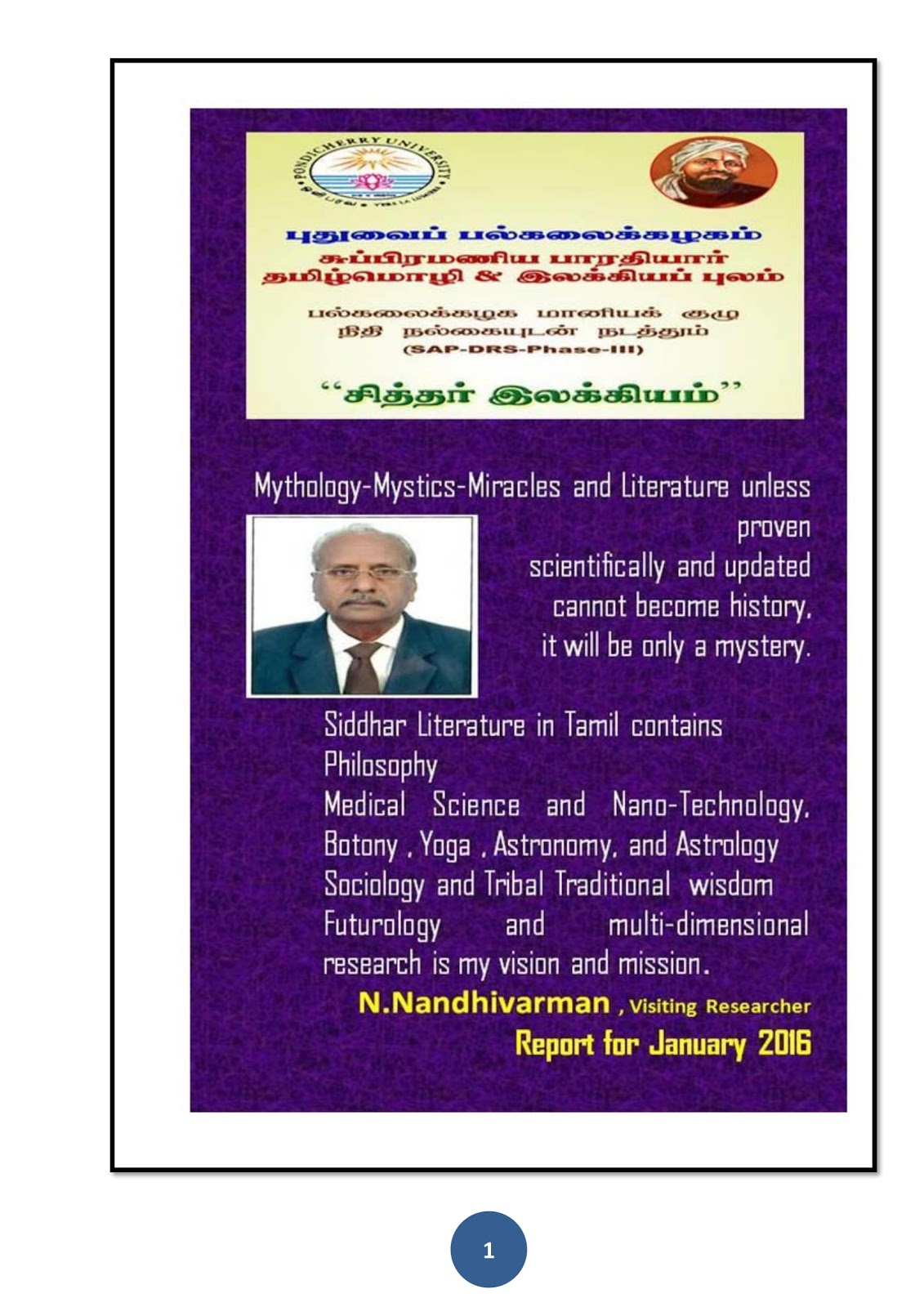
Since as Visiting Researcher atPondicherry University in India I am doing research on the  Hindu–Buddhist-Jain connections to Siddhar Literature, the cultural exchange between India and China and South East Asia where the Martial arts, Medicines, Yoga systems show striking similarity and cross cultural connectivity titled Siddhar Literature in the Historical Perspective with Scientific Outlook.Tamil Chinese- Buddhist connectivity and Tamil-Jain contributions to Tamil Literature should be focussed and quest to place history on the basis of truth is need of the hour.
Humanity had craved for disease free world and various medical systems evolved in various cultures be it Arabic or Chinese or Sanskrit or Tamil cultures. And there are hidden truths about inventions in every culture. From Thirumoolar’s Yoga to Chinese Falun Dafa yoga similarities have to be studied. We intend to generate awareness on Universal Man and Universal Vision of Tamil Siddhars to redeem humanity from illness of body and mind and inculcate in minds aspirations beyond galaxies.
Based on Karuwoorar's table of 18 Pathinen Sidhars
[mentioned in his work AttamaaSiddhi]
 1.Kumbamuni, 2.Nandimuni, 3.Gorakkar, 4.Pulipani, 5.Pusundarishi, 6.Thirumoolar,7.Theyraiyar, 8.Yugimuni, 9.Machamuni, 10.Pon_nakeesar, 11.Idaikaadar, 12.Poonaikannar, 13.Sivavakkiyar, 14.Chandikesar, 15.Romarishi, 16.Sattanathar, 17.Kaalangi, 18.Bohar
Nijaa_Nantha Botham's List of Pathinen Sidhars ....
1.Agathiyar, 2.Bohar, 3.Nandeesar, 4.Punnakeesar, 5.Karuwoorar, 6.Sundaranandar, 7.Anandar, 8.Konkanar, 9.Bramma muni, 10.Romamuni, 11.Vaasamuni, 12.Amalamuni, 13.Kamalamuni, 14.Gorakkar, 15.sattaimuni, 16.Machamuni, 17.Idaikaadar, 18.Brammamuni
Periya Gnaana Kovai's List of Sidhars ....
1.Agathiyar, 2.Agapeyi, 3.Alhukannar, 4.Idaikkadar 5.Kamalamuni, 6.Karuwoorar, 7.Kaalanginaathar, 8.Konkanar, 9.Gorakkar, 10.Sattanaathar, 11.Sundaranandar, 12.Danvanthiri, 13.Thirumoolar, 14.Theyraiyar, 15.Nandi, 16.Pathanjali, 17.Paambatti, 18.Punnakeesar, 19.Pulathiyaar, 20.PoonaiKananaar, 21.Bohar, 22.Machamuni, 23.Vaamadevar, 24.Vanmeekar
Abithana Chintamani's List of Pathinen Sidhars ....
1.Agathiyar, 2.Bohar, 3.Gorakkar, 4.Kailasanaathar, 5.Sattaimuni, 6.Thirumoolar, 7.Nandi, 8.Koonkannar, 9.Konganar, 10.Machamuni, 11.Vaasamuni, 12.Koormamuni, 13.Kamalamuni, 14.Idaikaadar, 15.Sundaranandar, 16.Pon_Naakeesar, 17.Romarishi, 18.Brammamuni
Navanaatha sidhargal, from north india
Sathya naathar, Sathoga naathar, Aathi Naathar, Veyguli Naathar, MathangaNaathar, Machendra Naathar, Katenthra Naathar, Anaathi Naathar, Gorakka naathar.
Other Sidhars ( listed & nonlisted...)
1 Thirumoolar 2 Kalanginathar 3 Agathiyar 4 Machamuni 5 Sattaimuni 6 Aluguni_sidhar  7 Idaikkadar 8 Pattinathaar 9 Kamalamuni 10 Pampatti_sidhar 11 Sattainathar 12 Pon_Naakeesar 13 Nandidevar 14 Pulippani 15 Bhogar 16 Karuwoorar 17 Kudambai_sidhar 18 Agappeysidhar 19 Konganavar 20 Kaduveli_sidhar 21 Gorakkar 22 Ramadevar 23 Kaudambar 24 Theyraiyar 25 Kaakaiyar 26 Pulattiyar 27 kaagapusundar 28 Sivavakkiyar 29 Kumbamuni 30 Brammadevar 31 Danvantiri 32 Kannisidhar 33 Kasyapar 34 Pujandar 35 Naradanar 36 Vyasar 37 Sundarar 38 Markkandar 39 Pulattiyar 40 Datchanamurthi 41 Kaubalasidhar 42 Sothimamuni 43 Damaraganar 44 Sundaranandar 45 Urvasiyal (woman) 46 Arivanandar 47 Subramaniar 48 Yogimuni 49 Diranakkiyamuni 50 Chandeesu_varar 51 Kakakandar 52 Mulatisar 53Valmeegar/ Valmeegi 54 Nandeesar 55 Jothimunivar 56 Damarakar 57 Viswamithrar 58 Kalakandarisi 59 Jamadakkini 60 Diranakkiya_munivar 61 kondeesar 62 Tirumoolavarkkam 63 Idaikaadar 64. Mular 65. Vara_Risi 66 Muth_theesar 67 Naaval_Marathadiyar 68 Moongil_adiyar 69 Vasistar
The Siddha tradition believes that there are more than 210 divine masters ,who, along with their disciples keep taking birth as divine incarnations in different times and different places around the world constantly to keep up with the changing humanity needs and effecting change.
For instance, Jesus Christ is said to have been Siddhar Pullipani having reincarnated. Jesus Christ have been to india, and have been with many Sidhars, especially with Sidhar Amaravathy Atrangarai Karuwoorar
Lao Tzu was claimed by Siddhar Bhogar to have been one of his incarnations. ::
Jainism, Buddhism, Christianity, Islam... were all given by different divine masters/ Sidhars. All the Literature given by Sidhars, as paadal (songs),manuscripts& Holy Inscriptions which render solutions to the unsolved miseries of mankind.
Thus Hinduism is a 'way of life' designed by 18 Pathinen Sidhars.
Tamil Siddhar Scientists  Palm Leaf Texts-Rare books had read the hidden meaning in the twilight language used my Siddhars, whom the westerners call as mystics and men of medicine.

LITERARY EVIDENCES FOR MEDICINES PROPOSED IN THIS PROJECT 
Tamilmaamani Awardee of Pondicherry Government 2009 : N.Nandhivarman

Much before the scholars of the western world, in India we have scaled greater heights in many fields of Science but all knowledge is being mostly confined to our mother tongues and remain buried in the sands of history. One such achievement of Tamil language is the compilation of THESAURUS millennium before the word Thesaurus was coined in English Language.And Tamil Siddhar Bhoganathar alias Bogar is a great scientist who wrote Bogar Nigandu 1200 [ Bogar Thesaurus 1200] . Our project aims to produce drugs for clinical trials to cure breast cancer based on this thesaurus.

The writings of Boganathar, the greatest scientist of Siddha tradition have been translated into English and a useful commentary on these profound and difficult texts has been rendered. The translation of Poems of Bogar with commentary [ book page 194 ] reads like follows : “ I wrote with pride the seven cantos to disseminate, I wrote a glossary to attain vettaveli, apart from writing the topmost seven hundred and odd aphorisms. I gathered together a glossary of six tens and seven hundred, I wrote mantras of Yoga. I wrote the pattern for the diction and signification of words. I wrote the formula for performing the mantras, to maintain and stabilize the Yoga called Vaci “ Glossary of six tens and 7 hundred terms , is a reference to 60 X 700= 42000 terms of glossary called NIGANDU in Tamil.
We have relied upon the Tamil version of Bogar Nigandu 1200 pages 212 verses 780 to 783 for the preparation of Rasa parpam to be used in our clinical trials.
In general usage, a thesaurus is a reference work that lists words grouped together according to similarity of meaning (containing synonyms and sometimes antonyms), in contrast to a dictionary, which provides definitions for words, and generally lists them in alphabetical order. The main purpose of such reference works is to help the user "to find the word, or words, by which [an] idea may be most fitly and aptly expressed" – to quote Peter Mark Roget, architect of the best known thesaurus in the English language.
Although including synonyms, a thesaurus should not be taken as a complete list of all the synonyms for a particular word. The entries are also designed for drawing distinctions between similar words and assisting in choosing exactly the right word. Unlike a dictionary, a thesaurus entry does not give the definition of words.
In library science and information science thesauri have been widely used to specify domain models. Recently, thesauri have been implemented with Simple Knowledge Organization System (SKOS)
Etymology The word "thesaurus" is derived from 16th-century New Latin, in turn from Latin thēsaurus, which is the Latinisation of the Greek θησαυρός (thēsauros), "treasure, treasury, storehouse".[2] The word thēsauros is of uncertain etymology. Douglas Harper derives it from the root of the Greek verb τιθέναι tithenai, "to put, to place."[2] Robert Beekes rejected an Indo-European derivation and suggested a Pre-Greek suffix *-arwo-.
From the 16th to the 19th centuries, the term "thesaurus" was applied to any dictionary or encylopedia, as in the Thesaurus linguae latinae (1532), and the Thesaurus linguae graecae (1572). The meaning "collection of words arranged according to sense" is first attested in 1852 in Roget's title and thesaurer is attested in Middle English for "treasurer"
History
Peter Mark Roget, author of the first thesaurus.
In antiquity, Philo of Byblos authored the first text that could now be called a thesaurus. In Sanskrit, the Amarakosha is a thesaurus in verse form, written in the 4th century.
The first modern thesaurus was Roget's Thesaurus, first compiled in 1805 by Peter Mark Roget, and published in 1852. Since its publication it has never been out of print and is still a widely used work across the English-speaking world Entries in Roget's Thesaurus are listed conceptually rather than alphabetically. Roget described his thesaurus in the foreword to the first edition:
It is now nearly fifty years since I first projected a system of verbal classification similar to that on which the present work is founded. Conceiving that such a compilation might help to supply my own deficiencies, I had, in the year 1805, completed a classed catalogue of words on a small scale, but on the same principle, and nearly in the same form, as the Thesaurus now published.

Scientists Have Developed a Map of Where the Brain Processes Different Words
The new discovery may eventually give voice to people who have lost the ability to speak.By Rachel Dicker | Associate Editor, Social Media April 29, 2016.

The brain is incredibly complex and mysterious.Just one layer of understanding unveils hundreds of new questions.Such is the case in a study published in Nature that revealed a "semantic atlas" of the human brain. An interactive version of the atlas is available online.

Researchers at the University of California - Berkeley studied the brains of seven native English speakers as they listened to a podcast of the Moth Radio Hour. Then, they mapped out which areas of the brain lit up in response to hearing different words in different contexts.
  
This is What Your Brain Looks Like on LSD

They found that words are grouped in certain areas of the brain based on their relative meanings, and they also discovered where these groups are housed.

For example, in the right temporal parietal junction, in an area a few millimetres in width, words like "wife," "pregnant," and "mother" were processed, and an area just adjacent to it processed some of the same social words, as well as some related ones having to do with people and places, such as "house" and "owner."

“The similarity in semantic topography across different subjects is really surprising,” said study lead author Alex Huth, a postdoctoral researcher in neuroscience at UC Berkeley, in a press release.

It's a potential breakthrough for people who have lost the ability to speak. If scientists are able to map out where the brain processes words – and that map is relatively uniform – they may be able to help people suffering from ALS or victims of stroke be understood through technology.

“Although the maps are broadly consistent across individuals, there are also substantial individual differences,” said study senior author Jack Gallant, a UC Berkeley neuroscientist, in the release. “We will need to conduct further studies across a larger, more diverse sample of people before we will be able to map these individual differences in detail.”

II. THE SECOND MEDICINE WE PROPOSE FOR CLINICAL TRIAL

The second medicine we propose to clinical test is based on the formulations of Ramadevar alias Yacob. In his book VAITHIYA SINTHAMANI 700 first published in 1996 and second edition by Thamarai Publications in 2008, in page 238 the preparations of Vagara Vanga Senthuram is mentioned. Verse 475 is of relevance to our research.


III. THIRD MEDICINE FOR CLINICAL TRIAL

The book preserved at Archives of Tamilnadu published in 1903 titled : Pulasthiar Vaatha Soothiram, Gnana Karpan, Thiruvalluvar Parimuppu Soothiram published first in 1995, and third edition is out by Thamarai Publications page 73 speaks on Valai Rasa Pathangam in verses 257 to 267. This medicine we propose for clinical trial.

Same book page 10 : Another medicine Sandarasa parpam is being mentioned in verse 5 to 22. Same book page 14 : Another medicine Vaalai rasa mezhugu is mentioned from verse 23 to 34.

Siddha medicine is closely associated with Alchemy since it has a chemical process. Hence one of our Co-Investigator is a Doctorate in Chemistry.

Alchemy is called vagara markam in Tamil. There is a treatise Agasthiar Karma Kandam which tells diseases to be direct consequences of past misdeeds of a man or woman. There is an ancient Tamil text called Sura-nool, a treatise on fevers. Based on the position of planets and stars one gets fevers, this astronomical view point is stressed in this book.
  
“ The Siddhas used the following four methods for obtaining perfect knowledge in respect of health and disease. They are 1. Scriptural Testimony 2. Perception or Direct Observation 3. Inference 4. Reasoning or experimental confirmation . By applying these 4 yardsticks they were able to give appropriate description of 500 diseases. Botanical and pharmacological knowledge of more than 2000 drugs of herbal origins. Detailed description of the method of purification and oxidation of 150 drugs of mineral and metallic origins for internal use. Preventive and promotive aspects of health care in different seasons and at different places writes T.N.Ganapathy of Yofa Siddha Research Center.


THE LITERARY EVIDENCES FOR BREAST CANCER CURE IS GIVEN HERE. IN THE METHODOLOGY AND PROTOCAL IN SEPARATE CHAPTER
WE HAVE GIVEN THE MEDICINE AND METHODOLOGY OF CURE.


I.                  EFFICACY OF RASA SUNNAM, VAGARA VANGA SENDURAM AND KOSIGAR KUZHAMBU THE SIDDHA MEDICINES IN CARCINOMA OF BREAST


II.               WE HAVE PRESCRIBED THE MEDICINES FOR COLON CANCER 


EFFICACY OF POORA MEZHUGU, RASA PARPAM AND POORNACHANDROTHAYAM THE SIDDHA MEDICINES IN CARCINOMA OF COLON

Literary evidences will be provided shortly. We want Thailand to promote Medical Tourism in its soil, and to collaborate with us in clinical trials for both Breast Cancer and Colon Cancer to begin with.

We hope for a longstanding relationship to prove to the West that East has answers to many anxieties of the West .


N.NANDHIVARMAN 
அடுத்த 11 வது உலகத் தமிழ்மாநாட்டிலாவது சுவாமி விபுலானந்தரின் எழுத்துக்களையும் பேச்சையும் ஆய்வு செய்ய....

தமிழ் ஆய்வுலகமும் தமிழ்ப் பல்கலைக்கழங்களும் அடுத்த 11 வது  உலகத் தமிழ்மாநாட்டிலாவது சுவாமி விபுலானந்தரின் எழுத்துக்களையும் பேச்சையும் ஆ...