Showing posts with label guedelope. Show all posts

Thursday, September 24, 2015

THE TAMILS OF REUNION AND THEIR HYBRID CULTURE


THE TAMILS OF REUNION AND THEIR HYBRID CULTURE

Colonialism cannot be condemned outright. This may sound outrageous. But colonialism in a way introduced the concept of outsourcing attempted in the bygone centuries and currently being debated in the free market era. In a world where free market dominates, the sweat and toils of the slave labourers may be forgotten, but we must realize that in their sufferings the foundations for global market economy is sown. ReUnion is a typical example of outsourcing by the French East India Company, and its history reveals how an hybrid culture emanated amidst Tamil settlers there, who are Tamils but could not speak Tamil, their mother tongue lost in the interregnum of 5 generations of separation from their homeland namely Pondicherry.

The archipelago, comprised of Mauritius, Rodrigues and Réunion, was christened the Mascarenes by Portuguese navigator Pedro de Mascarenhas, following its European discovery in 1512. In 1642 the French settled in the island when La Compagnie des Indes Orientales (the French East India Company) sent its ship, the St-Louis, and the King of France named it Île Bourbon. Much water had flown in the five rivers that irrigate this tiny island since then.

The French Revolution is a turning point in its history. The greatest achievement of the 1848 revolution for the colonies was the abolition of slavery. Slavery, the foundation of economic life in Martinique, Guadeloupe, Guyana and Reunion, had been abolished by the Convention in 1794 but was re-instituted by Napoleon.  National Assembly by way of definitive decree on April 27, 1848 declared that `slavery is an attack on human dignity', it `destroys the principal of natural law and duty . . . it is a flagrant violation of republican dogma," and that great unrest could erupt in the colonies if slavery were not ended, the law abolished slavery in all French colonies and possessions.  Thus a total of 262,564 slaves were thereby freed, most of them in the plantation colonies of the West Indies and Réunion.

But with this abolition of slave labour the need to fill that vacuum arose and plantation owners looked for French India to compensate the loss of slave labour. Thus lot of Tamils found their way to the island of Reunion situated in the Indian Ocean closer to Madagascar. Lot of people from Pondicherry and its surrounds went to the coffee and other plantations in Reunion as labour.

The coffee plantations were destroyed often destroyed by cyclones and the Tamil labour had to struggle hard facing the fury of Nature. Napoleon Bonaparte lost the island to the British for a short break of five years.  Under British rule, sugar cane was introduced to Réunion and quickly supplanted food production as the primary crop. It resulted in the dispossession of many small farmers who were forced to sell out to those with capital to invest in the new monoculture. The supplanted farmers migrated to the interior to find land and carry on with their agricultural activities. During this period, the Desbassyns brothers rose to success as the island's foremost sugar barons. The vanilla industry, introduced in 1819, also grew rapidly. The golden age of trade and development in Réunion lasted until 1870, when competition from Cuba and the European sugar beet industry, combined with the opening of the Suez Canal, resulted in an economic slump. Shipping decreased, the sugar industry declined and land and capital were further concentrated in the hands of a small French elite. Close on the cessation of hostilities in First World War global demand for sugar increased. This helped Reunion's economy out of the doldrums. But during World War II, an economic blockade once again crippled the island's economy. A colony under French law must provide to the French mainland goods of greater value than the amount of money allocated to it. A colony had to be profitable. This obligation was lifted in 1946, when Réunion's status changed from colony to overseas department, a change in status intended to provide the island with the benefits of social and political equality with the mainland. The island still falls under the jurisdiction of the French government.

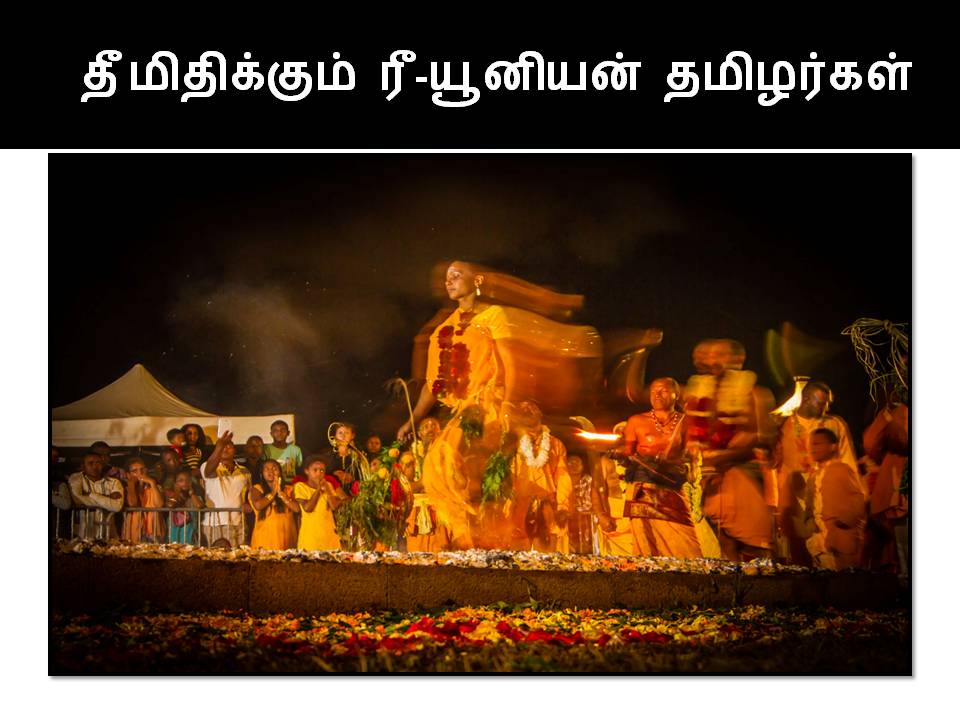
It cannot be said that Catholic faith dominates the island's religious character. It is visible in the shrines along every highway and byway, in caves, on cliff tops and in the many saint's days and holidays. St-Denis shuts down on Sunday, when half the city goes to the beach. Hindus and Muslims follow their respective religions freely and most large towns have both a mosque and a temple. Popular Hindu rites include teemeedee, which involves fire walking, and cavadee, involving piercing one's cheeks with silver needles, often take place. A great deal of syncretism with Catholicism has evolved over the years, and vice versa. Thus a hybrid religion had come into existence. People celebrating all festivals and worshipping all deities have produced a hybrid religion of tolerance. Lot of Hindu Temples is there for Lord Shiva, Lord Muruga and Godess Kaali.

French is the official language, but Créole is the most widely spoken. Few people speak English. Réunion Créole is even beyond most French people. A word, which means one thing in French, can mean something completely different in Créole. But the island which has around 4 lakh Tamils who own Tamil names and celebrate Hindu festivals, yet unable to speak Tamil. The Tamil Nadu Finance Minister Navalar Nedunchezian participated in a world Tamil Cultural Movements conference in neighbouring Mauritius and visited Reunion too. During this visit the Reunion Tamil Kazhagam seeking the help of Tamil Nadu Government to teach Tamil to the people of Reunion and to promote cultural exchanges with mainland Tamils put up demands. It remains still and unfulfilled dream. People in a distant place do not haunt our memory as we have other chores to attend in everyday life. But the Government of Tamil Nadu and Pondicherry must open Cultural Exchange Centres in all these isolate islands, and like the Alliance Francaise that keeps teaching French throughout world, institutionalized teaching of Tamil and spreading the tenets of Tamil Culture must be undertaken, all who visit islands like Reunion will have these thoughts linger in their minds.

The Maha Bhadrakaliaaman Temple authorities and the Natha Musical Academy of Reunion have invited the students of TamilNadu Government Music College to provide them some insights into Tamil folk arts. Professor M.Anbarasan who teaches folk arts in the College of Music who heads the team comprising his students Miss K.Kala, Miss.K.Vijayalaxmi, Miss.N.Selvarani, Miss.Santhi and Mr.Nallusamy will be participating in various functions in Reunion as depicted in this poster. This ambassadors of Tamil culture carry forward the message of goodwill from the people of Tamil Nadu, and whole Reunion Tamils must be reassured that in upholding Tamil customs, religious practices, arts, music and language, a day will come that Reunion cultural ambassadors arrive here and capture our attention and can win our admiration. Where there is a will, there will be a way, goes the saying. Reunion Tamils have the will. Let them cherish their hybrid culture with Tamil component, we all hope and wish so.

N.Nandhivarman


Courtesy: New Indian Express dated: 13th April 2004

Friday, July 11, 2014

DECCAN CHRONICLE NEWS ON NEED FOR TAMIL SCHOOLS IN GUADELOUPE


பிரான்சில் உள்ள நான் இந்தியாவை காதலிக்கிறேன் அமைப்பின் தலைவருமான சாம் விஜய்

நந்திவர்மன் இல்லத்தில் உலகத் தமிழ்ப் பண்பாட்டு இயக்க யுநெஸ்‌கோ ஒருங்கிணைப்பாளரும் பிரான்சில் உள்ள நான் இந்தியாவை காதலிக்கிறேன் அமைப்பின் தலைவருமான சாம் விஜய் அவர்களுக்கு பொள்ளாச்சி நசன் அவர்களின் தமிழம் நெட், புதுவை பிரஞ்சு அரசின் நிறுவனம் Ecole Francaise de Extreme Orient  இரவி-பாபு ஆகியோர் பட வடிவக் கோப்பக்கி தந்த அரிய நூல்களை பரிசளித்தபோது நரம்பை கனகசபை எடுத்த படங்கள்.


Sunday, July 6, 2014

HENRI SIDAMBAROM


PRESENTATION DU COMITE HENRY SIDAMBAROM


Président : Jacques SIDAMBAROM
Vice-président : Henry ROSEMOND
Trésorier : Maddly LATCHAN
Secrétaire : Valencia SIDAMBAROM
Membres du Conseil d’Administration :
Arlette BOGAT
Sylvain BOGAT
Andrée SIDAMBAROM
Monette SIDAMBAROM

Association culturelle créée le 11 mars 1988, placée sous l’égide du Conseil général de la Guadeloupe. Régie par la loi du 1er juillet 1901.
J.O. numéro 15 du 13 avril 1988. Déclarée en Préfecture de Basse-Terre le 11 mars 1988 sous le numéro 9710002345. Numéro Sirène 441 000 297 5411. Code APE 913e.

  
EVENEMENTS MARQUANTS DU COMITE HENRI SIDAMBAROM

En mai 1981 la ville de PONDICHERY en Inde a été officiellement jumelée avec la ville de BASSE-TERRE, capitale administrative de la GUADELOUPE, PONDICHERRY était représentée par une délégation conduite par Monsieur SAVARI RADJAN, Ministre de l’Intérieur du territoire de PONDICHERRY.
C’est à cette occasion qu’un hommage officiel est rendu pour la première fois à la personnalité d’Henry SIDAMBAROM, d’abord avec l’inauguration de « l’Avenue SIDAMBAROM », comprise entre le pont José Marti « Cité Grain d’ Or » et la limite de la RN2 avec Saint-Claude.

Dans la foulée, le 31 mai 1981, en présence de M. Savari RADJAN est posée une stèle d’Henry SIDAMBAROM à Fonds-Cacao dans la commune de Capesterre-Belle-Eau.

Dès lors naît l’idée de créer un Comité Henry SIDAMBAROM  pour faire connaître l’œuvre de cette grande personnalité guadeloupéenne.

La concrétisation de cette idée se fait attendre et est finalement relancée après « L’année de l’Inde en France » en 1985-1986. C’est donc en 1988 qu’est officiellement créé le Comité Henry SIDAMBAROM.
En 2004, la Guadeloupe célèbre le 150ème anniversaire de l’arrivée des indiens dans l’archipel. Coïncidence de l’histoire, cette même année célèbre le 100ème anniversaire du lancement du procès politique pour la reconnaissance des droits civiques des indiens  de Guadeloupe (23 février 1904-avril 1923). Ce combat de haute lutte mené par Henry  SIDAMBAROM placera définitivement l’homme, au rang des grandes personnalités de l’histoire politique de notre département.

L’année 2013 a été l’année de la célébration du 150ème anniversaire de la naissance d’Henry SIDAMBAROM.  Des institutions telles que le Conseil Régional de la Guadeloupe, du Conseil Général et du Rectorat ont contribué à la bonne marche de cette année commémorative. A cette occasion a été créé un comité guadeloupéen pour la commémoration du 150ème anniversaire composée de plusieurs associations culturelles indiennes de la Guadeloupe ayant collaboré avec la Comité Henry SIDAMBAROM en vue d’organiser sur tout le territoire de la Guadeloupe les manifestations lui rendant un hommage. Ce comité créé à cet effet, a été essentiellement composé des

   
BIOGRAPHIE

Henri Moutou SIDAMBAROM (1863-1952) : C’est le 5 juillet 1863 que naît Henri Moutou ALLAMELOU, sur l’habitation Source Pérou à Capesterre-Belle-Eau. Ses parents, des travailleurs immigrés originaires de Tamil Nadu, état du sud de l’inde, se marient le 8 juillet 1873.
C’est à l’issue de cette union qu’Henri est reconnu par son père, Joseph SIDAMBAROM et portera désormais son nom.

Henry Moutou ALLAMELOU est reconnu le 15 décembre 1865 par son père et s’appelle désormais Henry Moutou Sidambarom.

IMPLICATION  POLITIQUE : Afin de financer son projet politique et ainsi être autonome financièrement, il abandonne la fonction publique pour retourner travailler à Pointe-à-Pitre dans le commerce de son parent, Adolphe SIDAMBAROM. Il rejoint alors Charles DANAE, politicien connu sur la place et qui prépare alors sa campagne pour les élections municipales.

Il prend part aux préparatifs et est inscrit sur la lise de Danaé. En juin 1897,  il est élu conseiller municipal de la ville de Pointe-à-Pitre. Durant son mandat, il sera deux fois rapporteur de la commission budgétaire et financière.  Deux ans après son élection au poste de conseiller municipal de la ville de Pointe-à-Pitre, Henry SIDAMBAROM quitte la ville pour retourner à Capesterre-Belle-Eau s’occuper des affaires de son père malade. Ce dernier meurt en 1901.

Trois ans plus tard, Henri SIDAMBAROM, en tant que tête de liste, remporte les élections municipales de la ville et doit être élu maire. Cependant, à la suite d’une manœuvre de sa propre liste,  il  est écarté du poste au prétexte de son indianité et un autre est nommé à sa place.

VIE DE FAMILLE : C’est dans le contexte social très particulier de la GUADELOUPE Post-esclavagiste que Henri SIDAMBAROM rencontre celle qui deviendra sa femme, Rose Nagaman NAREMBIN, elle aussi, fille de travailleurs immigrés d’Inde. Le couple voit naître son premier enfant en 1882 et bien que ces derniers soient engagés l’un envers l’autre depuis 1881, ce n’est qu’en 1919 qu’ils se marient au domicile d’Henry SIDAMBAROM  car sa femme, malade, n’est pas capable de se déplacer à l’église ou à la mairie. De leur union naitront six enfants : André,  Henri, Joseph, Valencia, Marguerite et Hubert. Son épouse meurt le 25 avril 1937 après 18 ans de mariage.

ACTION SOCIALE ET CULTURELLE : En 1910, il fonde l’Obole des travailleurs, une société de secours mutualiste de la commune dont il fut président de façon ininterrompue durant 35 ans. Par ailleurs, il fonde plus syndicats dont « les ouvriers agricoles » qui se sont affirmé lors de la grande grève de 1910. D’autre part, il sera le premier à introduire un cinéma-théâtre dans la ville de Capesterre-Belle-Eau.
En janvier 1944, il est nommé Juge de Paix du Canton de Capesterre. Il occupe cette fonction pendant 5 ans. Cette fonction lui permis de préparer correctement les municipales de 1945 en mettant à jour la liste électorale afin d’éviter toute contestation du scrutin.

En 1948, le Conseil Municipal de Capesterre-Belle-Eau décide de lui attribuer la Croix de la légion d’honneur pour son œuvre en tant qu’apôtre de l’émancipation des travailleurs indiens.

En 1948, le Conseil Municipal demande à la Préfecture de Guadeloupe d’inscrire Henry Moutou Sidambarom sur la liste des récipiendaires de la Croix de la légion d’Honneur.
En octobre 1950, le Conseil Général de la Guadeloupe approuve cette proposition et vote une demande qui va dans le même sens.
 NOTE D’OPPORTUNITE
REPERES HISTORIQUES

Liens entre la France et  l’Inde.
Pondichéry, capitale des possessions françaises dans l’Inde, d’une superficie de 513 km2, jusqu’en 1954, année de sa rétrocession à l’Union Indienne. C’est le lien entre l’Inde et la France depuis la création des cinq comptoirs.
v  Pondichéry fondée en 1674.
v  Chandernagor fondée en 1686.
v  Mahé fondée en 1721.
v  Yanaon fondée en 1725
v  Karikal fondée en 1739.
Le lien entre ces comptoirs et la Guadeloupe débute en 1853, Pondichéry est le port d’embarquement des travailleurs indiens vers les Antilles françaises.
En mai 1853 le navire l’Aurélie débarque en Martinique le premier contingent de travailleurs indiens, suivi d’un autre convoi de 344 travailleurs débarqués cette fois-ci dans le port de Pointe-à-Pitre Guadeloupe le 25 décembre 1854.
En 1889, le Nantes-Bordeaux débarque à Pointe-à-Pitre 605 travailleurs, répartis comme suit :
229 embarqués le 30 octobre 1888 à Calcutta,
228 embarqués le 4 novembre 1888 à Pondichéry

148 embarqués le 7 novembre à Karikal.

THE TAMILS OF REUNION AND THEIR HYBRID CULTURE


Colonialism cannot be condemned outright. This may sound outrageous. But colonialism in a way introduced the concept of outsourcing attempted in the bygone centuries and currently being debated in the free market era. In a world where free market dominates, the sweat and toils of the slave labourers may be forgotten, but we must realize that in their sufferings the foundations for global market economy is sown. ReUnion is a typical example of outsourcing by the French East India Company, and its history reveals how an hybrid culture emanated amidst Tamil settlers there, who are Tamils but could not speak Tamil, their mother tongue lost in the interregnum of 5 generations of separation from their homeland namely Pondicherry.

The archipelago, comprised of Mauritius, Rodrigues and Réunion, was christened the Mascarenes by Portuguese navigator Pedro de Mascarenhas, following its European discovery in 1512. In 1642 the French settled in the island when La Compagnie des Indes Orientales (the French East India Company) sent its ship, the St-Louis, and the King of France named it Île Bourbon. Much water had flown in the five rivers that irrigate this tiny island since then.

The French Revolution is a turning point in its history. The greatest achievement of the 1848 revolution for the colonies was the abolition of slavery. Slavery, the foundation of economic life in Martinique, Guadeloupe, Guyana and Reunion, had been abolished by the Convention in 1794 but was re-instituted by Napoleon.  National Assembly by way of definitive decree on April 27, 1848 declared that `slavery is an attack on human dignity', it `destroys the principal of natural law and duty . . . it is a flagrant violation of republican dogma," and that great unrest could erupt in the colonies if slavery were not ended, the law abolished slavery in all French colonies and possessions.  Thus a total of 262,564 slaves were thereby freed, most of them in the plantation colonies of the West Indies and Réunion.

But with this abolition of slave labour the need to fill that vacuum arose and plantation owners looked for French India to compensate the loss of slave labour. Thus lot of Tamils found their way to the island of Reunion situated in the Indian Ocean closer to Madagascar. Lot of people from Pondicherry and its surrounds went to the coffee and other plantations in Reunion as labour.

The coffee plantations were destroyed often destroyed by cyclones and the Tamil labour had to struggle hard facing the fury of Nature. Napoleon Bonaparte lost the island to the British for a short break of five years.  Under British rule, sugar cane was introduced to Réunion and quickly supplanted food production as the primary crop. It resulted in the dispossession of many small farmers who were forced to sell out to those with capital to invest in the new monoculture. The supplanted farmers migrated to the interior to find land and carry on with their agricultural activities. During this period, the Desbassyns brothers rose to success as the island's foremost sugar barons. The vanilla industry, introduced in 1819, also grew rapidly. The golden age of trade and development in Réunion lasted until 1870, when competition from Cuba and the European sugar beet industry, combined with the opening of the Suez Canal, resulted in an economic slump. Shipping decreased, the sugar industry declined and land and capital were further concentrated in the hands of a small French elite. Close on the cessation of hostilities in First World War global demand for sugar increased. This helped Reunion's economy out of the doldrums. But during World War II, an economic blockade once again crippled the island's economy. A colony under French law must provide to the French mainland goods of greater value than the amount of money allocated to it. A colony had to be profitable. This obligation was lifted in 1946, when Réunion's status changed from colony to overseas department, a change in status intended to provide the island with the benefits of social and political equality with the mainland. The island still falls under the jurisdiction of the French government.

It cannot be said that Catholic faith dominates the island's religious character. It is visible in the shrines along every highway and byway, in caves, on cliff tops and in the many saint's days and holidays. St-Denis shuts down on Sunday, when half the city goes to the beach. Hindus and Muslims follow their respective religions freely and most large towns have both a mosque and a temple. Popular Hindu rites include teemeedee, which involves fire walking, and cavadee, involving piercing one's cheeks with silver needles, often take place. A great deal of syncretism with Catholicism has evolved over the years, and vice versa. Thus a hybrid religion had come into existence. People celebrating all festivals and worshipping all deities have produced a hybrid religion of tolerance. Lot of Hindu Temples is there for Lord Shiva, Lord Muruga and Godess Kaali.

French is the official language, but Créole is the most widely spoken. Few people speak English. Réunion Créole is even beyond most French people. A word, which means one thing in French, can mean something completely different in Créole. But the island which has around 4 lakh Tamils who own Tamil names and celebrate Hindu festivals, yet unable to speak Tamil. The Tamil Nadu Finance Minister Navalar Nedunchezian participated in a world Tamil Cultural Movements conference in neighbouring Mauritius and visited Reunion too. During this visit the Reunion Tamil Kazhagam seeking the help of Tamil Nadu Government to teach Tamil to the people of Reunion and to promote cultural exchanges with mainland Tamils put up demands. It remains still and unfulfilled dream. People in a distant place do not haunt our memory as we have other chores to attend in everyday life. But the Government of Tamil Nadu and Pondicherry must open Cultural Exchange Centres in all these isolate islands, and like the Alliance Francaise that keeps teaching French throughout world, institutionalized teaching of Tamil and spreading the tenets of Tamil Culture must be undertaken, all who visit islands like Reunion will have these thoughts linger in their minds.

The Maha Bhadrakaliaaman Temple authorities and the Natha Musical Academy of Reunion have invited the students of TamilNadu Government Music College to provide them some insights into Tamil folk arts. Professor M.Anbarasan who teaches folk arts in the College of Music who heads the team comprising his students Miss K.Kala, Miss.K.Vijayalaxmi, Miss.N.Selvarani, Miss.Santhi and Mr.Nallusamy will be participating in various functions in Reunion as depicted in this poster. This ambassadors of Tamil culture carry forward the message of goodwill from the people of Tamil Nadu, and whole Reunion Tamils must be reassured that in upholding Tamil customs, religious practices, arts, music and language, a day will come that Reunion cultural ambassadors arrive here and capture our attention and can win our admiration. Where there is a will, there will be a way, goes the saying. Reunion Tamils have the will. Let them cherish their hybrid culture with Tamil component, we all hope and wish so.

N.Nandhivarman


Courtesy: New Indian Express dated: 13th April 2004

அடுத்த 11 வது உலகத் தமிழ்மாநாட்டிலாவது சுவாமி விபுலானந்தரின் எழுத்துக்களையும் பேச்சையும் ஆய்வு செய்ய....

தமிழ் ஆய்வுலகமும் தமிழ்ப் பல்கலைக்கழங்களும் அடுத்த 11 வது  உலகத் தமிழ்மாநாட்டிலாவது சுவாமி விபுலானந்தரின் எழுத்துக்களையும் பேச்சையும் ஆ...