Showing posts with label French. Show all posts

Thursday, September 20, 2018

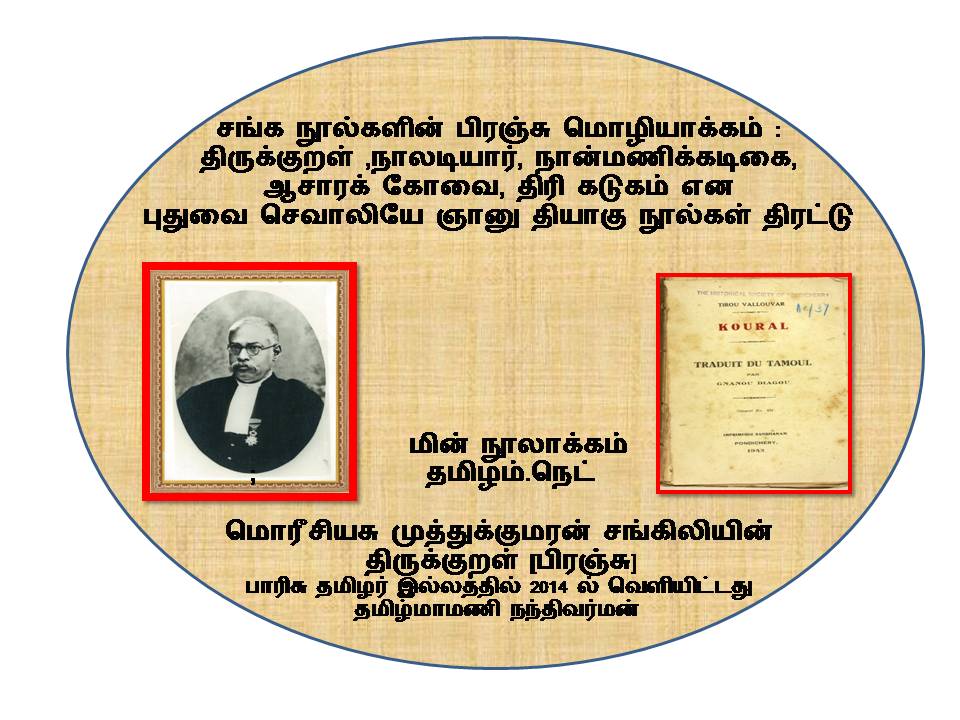
Great litterateur Gnanou Diagou


 Great litterateur Gnanou Diagou

Great men and great deeds may get lost in the sands of history. But a grateful society leaves monuments for successive generations to remember  them with gratitude.

Behind every monument there is a history. A statue at the Pondicherry Government Hospital reminds us of the donor who gifted the land for its construction. The  clock tower of grand Bazaar also rekindles memories of its donor, the grandfather of an illustrious, son of the soil, Le Bottennier Gnanou Diagou.

 The 127th birth anniversary of Le Boutonnière Gnanou Diagou, a man of letters and philanthropist falls on August 15. Not just the monuments but Gnanou Diagou’s contribution to Tamil Literature has been forgotten by the literary world and local population. His French translations of Kamba Ramayanam, Araneri Saaram, Assara Kovai, Nanmani Kadigai, Naladiar and the Thirukural are everlasting contributions that must be lauded by a grateful society. Sir CP Ramaswamy Iyer, in the foreword written to the French Translation of the Thirukural lauds thus, ‘‘Mr Gnanou Diagou’s rendering of Thiruvalluvar’s Kural into French is important and significant to international cultural collaboration.’

Gnanou Diagou, born on August 15, 1877, was an eminent lawyer and served as the president of Bar association. For nearly three decades he taught students of the Ecole de Droit Pondicherry as Professor of Law and wrote several Books on Hindu and Mohammedan law. He was also a popular political leader of Pondicherry from 1908 to 1925. He founded The Historical Society and left his imprint as its Vice President from 1911 till his son Cojande Dairianathan succeeded him in 1948.

 The conferment of honours initiated by Napolean Bonaparte in 1802 has the following titles of honour similar to our padma Bhushan, Padma Vibhushan and Padmasri. Grand Officier da la Legion d’ honneur is the first in rank. The second one is Chevalier de la legion d’ honneur. This was conferred on meritorious people for social service and the French government in recognition of his services had honoured him by conferring the second medal of honour, The Legion of Honour, on January 15, 1920. He also won awards like Officier d’ Academie and Chevalier du merite agricole. A member of the Counseil General, the the French version of the Legislative assembly with limited powers, he served the public. 

Gnanou Diagou was the descendent of one of the oldest and distinguished ‘‘Dubash’’ families of Pondicherry. Lazario De Motha Tanappa Modeliar, the illustrious ancestor of Gnanou Diagou had collaborated with Francois Martin in 1673 in the very foundation of the French settlement in Pondicherry. His successors Moutiappa Modeliar and his son Pedro canagaraya Modeliar were no less distinguished. Pedro Canagaraya  Modeliar was the recipient of the gold medal from Louis XV, King of France, for his good offices in securing Karaikal from the Maharaja of Tanjore in 1739. There is a street named after him that in current days called Canteen Street, though in name it exists in street boards. His son Diagou Modeliar, the grandfather of Gnanou Diagou, erected the clock tower in the Grand Bazaar apart from many choultries to feed the poor. The Street parallel to Nehru Street is named after Diagou Modeliar.

 Hailing from such an illustrious family, Gnanou Diagou scaled greater heights in public esteem through his literary works . He wanted to preserve the history of Pondicherry and was instrumental in having the manuscript of Ananda Ranga Pillai’s diaries copied from the original for publication purposes. He analyzed the decisions of the Superior Council from 1735 to 1820, the work of almost a century, and published them in eight volumes. He has written an authoritative book on General de lally, the  unlucky successor of Dupleix in whose period the entire white town including the Palace of Dupleix was destroyed.

 History is not a mere record of the events of the past. It has a meaning to be learnt. The acts of philanthropy are lauded to inculcate in the present generation such noble qualities. The intercultural exchange by taking the essence of Tamil classical literature to French, as done by Gnanou Diagou, is an incomplete mission for every generation of writers.


Courtesy: The New Indian Express-week end-14.08.2004


Friday, August 31, 2018

THE TAMIL FRENCH LITERARY CONNECTIONS


 Thiruvalluvar’s Thirukural is Tamils pride and everybody’s guide in life. Secularism, essence of our constitutional principles springs from each and every couplet of this great treatise of wisdom written 2000 years ago. And Sir C.P.Ramasamy Iyer places a befitting tribute to its grandeur on record. In his preface to the French Translation of Thirukural Sir C.P.Ramasamy Iyer says “ It has been rightly remarked that the Kural addresses itself to all classes and communities, and indeed to the whole human race and charges itself with the promulgation of virtue and of right conduct in the guise of familiar and friendly advice. In a series of pithy maxims, it lays down rules of universal acceptability dealing with most of our domestic and social problems and situations. In the well known words of the philosopher, Spinoza, it is written sub specie eternitate though characterized by tenderness and comprehensive human sympathy, human life and love in all their forms as well as the regular of existence in the social and economic fields are alike dealt with on the basis of practical spirituality”.

 Thirukural, the secular book on morals had been translated in many languages and is next to that of Bible in the number of such translations. The French version of Thirukural rendered by a great littérateur Mr.Gnanou Diagou had fascinated many scholars. It is a matter of pride to all Pondicherrians that Mr.Gnanou Diagou is one of the illustrious sons of this soil having earnt a name and fame in the 19th century.Thirukural had been translated into the following languages. 1) Burmese Mr. Myo Thant, Thirukkural 2) Chinese Mr.Chi Eng Hsi, Thirukkural (1967) 3). Czech Mr. Kamil V Zvelebil, Thirukural (1952-1954 4) Dutch Mr. D.Kat, Thirukural (Netherlands, 1964) 5) Fiji, Mr.S.L Berwick, Na. Thirukkurala, 1964) 6) Finnish Mr. Aalto, Pentit, Kural - The Ancient Tamil Classic (1972) 7) German Albrecht, Fenz and K. Lalithambal: Thirukural von Thiruvalluvar aus dem Tamil, Madurai (1977), Mr.A.F Cammera, Thirukural Leipzig (1803) Mr Karl. Graul, Der Kural des Thiruvalluvar, (London 1854), Mr. Karl Graul, Der Tamu lische gnomes dichtar Thiruvalluvar, (Leipzig, 1865) Mr.Frederick Rickert Thirukural, selections, (Berlin, 1847) Mr. William and Norgate, Der Kural des Thiruvalluvar, (2nd ed, London, 1866) 8) French Ariel, M, Kural de Thiruvalluvar (traduits du tamoul), Paris, 1848, Barrigue de, Fontaineu, G, Le livre de l'amour de Thiruvalluva, Paris, 1889, Danielou, Alain, Thiruvallouvar Kural, Pondicherry, 1942, Jacolliot, Louis, Kural de Thiruvalluvar, (selections) Paris, 1767 Lamairesse, M, thirukural in French, Pondicherry, 1867) 9) Latin Graul, Charles, Kural of Thiruvalluvar, Tranquebar, 1866 Veeramamunivar, Thirukural (Books I and II), London, 1930 10) Malay Ismail, Hussein: Thirukural sastera kalasik Tamil yang, Kuala Lumpur, 1967,Ramily Bin Thakir Thirukural (in verses), Kuala Lumpur, 1964 11) Polish  Umadevi, Wandy Dynowskiev, Thiruvalluvar Kural, Madras, 1958 12) Russian  J.J Glazov and Krishnamurthi, A, Thirukural, a book on virtue, politics and love, Moscow, 1963 Glazov,  Thirukural in couplets with illustrations, Moscow, 1974 13)Swedish Frykholm Ingya, Thirukural, Uddavalla, 1971. The list is incomplete. 

The complete list of languages in which Thirukural got translated is yet to be compiled. The irony is we live in an age of information technology where at our fingertips we should keep these facts. Many authors will boast that next to Bible the only other book that was translated in many languages is Thirukural. Yet none bothers to compile the data of all such translations undertaken and books published in various languages. Let scholars and institutions start compiling such lists, uploading in the Net to enable all Tamil lovers easy access. Particularly Pondicherry with all its connections with France and with prestigious institutes like French Institute functioning here it will be appropriate that better coordination exists between Pondicherry University, Pondicherry Institute of Linguistics and Culture which hopes to become a deemed University soon and other Tamil scholars well versed in both the languages.

 A great bilingual scholar Desigam Pillai in his book Tamizhagamum Frenchukararum dutifully records the services of scholars who promoted cultural exchanges with zeal. The Jesuits priests who came here to propagate their religion learnt Tamil and for the purpose of their kinsmen to understand the nuances of Tamil they wrote many books in French. The services of Mr.Boucher (1655-1732), Mr.De la Lane (1669-1746), Mr.Bouze (1673-1735), Mr.Gargam (1690-1742), Mr.Calmette (1693-1740), Mr.Coeurdoux (1699-1774) in writing books to help French acquire proficiency in Tamil, is thus listed by Desigam Pillai. Mr.Desigam Pillai, a lawyer and Tamil scholar also mentions the names of those who learnt Tamil. Mr.Perrin (1754-1820), Mr.Maguy (1758-1822), Mr.Dubois (1770-1848), Mr.Dupuis (1806-1874), Mr.Mousset (1808-1888), Mr.Legouste (1880-1863), Mr.Lap (1834-1893). These lists may be tiring to normal readers. But it is a list to be remembered to understand the cultural fraternity that developed between the French and Tamil-speaking peoples.

Many scholars who collected the Tamil manuscripts and palm leaf texts during their stay in Pondicherry had given them to the Bibliotheque Nationale de Paris. Even now in many homes including this writer there remains palm leaf texts ravaged by time. It is high time that academic institutions in the soil of Pondicherry and the Governments here that speak of heritage engage in a quest to collect all such texts, digitalize them and microfilm such rare collections hidden in Museums of both countries and private homes. Messrs.Mousset and Dupuis wrote the Dictionnaire Français Tamoul (French Tamil Dictionary) running into 1270 pages and a Dictionnaire Tamoul Français-2 Vols. (Tamil French Dictionary) running into 1660 pages. Mr.Jules Gordin who came from France to contest an election here for the house of elders and who became a French Senator took steps to start Tamil section in the Paris University. The dream came true in 1879. From 1890 in the Ecole des Langues Orientales Tamil classes became a reality. Mr. Vinson Julien wrote a grammar called Manuel De La Language Tamoule Grammaire, Texts, Vocabulaire ,and Mr.P.Lap, A Brege De La Grammaire Française Tomoule.Mr.M.J.Baulez wrote on colloquial Tamil Méthode De Tamoul Vulgaire

These are the pioneers and many authors who succeeded them had laid down firmly the path of inter cultural exchange and language fraternity. To a layman it appears that in the post independence era, these exchanges have mellowed down, and an impetus is needed to reactivate the vigour with which Tamil was welcomed with open arms by French. The entire French literature must be translated into Tamil and vice versa. The unfinished agenda must be undertaken with renewed interest. Before the old generation that had mastery over both languages bids adieu to earthly existence, these unfinished tasks must be taken up with urgency, while for younger generations the need to nourish this cultural legacy left between the most lovable languages on earth, becomes a quest with thirst for knowledge.   


Saturday, October 3, 2015

இந்துமாக்கடலில் தமிழர்களின் ரீ-யூனியன்

RE-UNION IN INDIAN OCEAN
CLICK THE LINK FOR YOU TUBE
Published on Dec 10, 2014
 இந்துமாக்கடலில் தமிழர்களின் ரீ-யூனியன் பிரஞ்சு அரசின் கீழ் ஒரு துறையாக உள்ளது, அங்கு தமிழ்ப் பள்ளிகளை பிரஞ்சு, இந்திய, தமிழக , புதுவை அரசுகள், தமிழும் பிரஞ்சும் தெரிந்த புதுவை வாழ் ஓய்வு பெற்ற தமிழாசிரியர்களை கொண்டு நடத்த கோரும் நந்திவர்மனின் தொலைகாட்சி உரை. l 


Wednesday, September 30, 2015

THE TAMIL FRENCH LITERARY CONNECTIONS


THE TAMIL FRENCH LITERARY CONNECTIONS

 N.Nandhivarman

Thiruvalluvar's Thirukural is Tamils pride and everybody's guide in life. Secularism, essence of our constitutional principles springs from each and every couplet of this great treatise of wisdom written 2000 years ago. And Sir C.P.Ramasamy Iyer places a befitting tribute to its grandeur on record. In his preface to the French Translation of Thirukural Sir C.P.Ramasamy Iyer says " It has been rightly remarked that the Kural addresses itself to all classes and communities, and indeed to the whole human race and charges itself with the promulgation of virtue and of right conduct in the guise of familiar and friendly advice. In a series of pithy maxims, it lays down rules of universal acceptability dealing with most of our domestic and social problems and situations. In the well known words of the philosopher, Spinoza, it is written sub specie eternitate though characterized by tenderness and comprehensive human sympathy, human life and love in all their forms as well as the regular of existence in the social and economic fields are alike dealt with on the basis of practical spirituality".

Thirukural, the secular book on morals had been translated in many languages and is next to that of Bible in the number of such translations. The French version of Thirukural rendered by a great littérateur Mr.Gnanou Diagou had fascinated many scholars. It is a matter of pride to all Pondicherrians that Mr.Gnanou Diagou is one of the illustrious sons of this soil having earnt a name and fame in the 19th century.Thirukural had been translated into the following languages. 1) Burmese Mr. Myo Thant, Thirukkural 2) Chinese Mr.Chi Eng Hsi, Thirukkural (1967) 3). Czech Mr. Kamil V Zvelebil, Thirukural (1952-1954 4) Dutch Mr. D.Kat, Thirukural (Netherlands, 1964) 5) Fiji, Mr.S.L Berwick, Na. Thirukkurala, 1964) 6) Finnish Mr. Aalto, Pentit, Kural - The Ancient Tamil Classic (1972) 7) German Albrecht, Fenz and K. Lalithambal: Thirukural von Thiruvalluvar aus dem Tamil, Madurai (1977), Mr.A.F Cammera, Thirukural Leipzig (1803) Mr Karl. Graul, Der Kural des Thiruvalluvar, (London 1854), Mr. Karl Graul, Der Tamu lische gnomes dichtar Thiruvalluvar, (Leipzig, 1865) Mr.Frederick Rickert Thirukural, selections, (Berlin, 1847) Mr. William and Norgate, Der Kural des Thiruvalluvar, (2nd ed, London, 1866) 8) French Ariel, M, Kural de Thiruvalluvar (traduits du tamoul), Paris, 1848, Barrigue de, Fontaineu, G, Le livre de l'amour de Thiruvalluva, Paris, 1889, Danielou, Alain, Thiruvallouvar Kural, Pondicherry, 1942, Jacolliot, Louis, Kural de Thiruvalluvar, (selections) Paris, 1767 Lamairesse, M, thirukural in French, Pondicherry, 1867) 9) Latin Graul, Charles, Kural of Thiruvalluvar, Tranquebar, 1866 Veeramamunivar, Thirukural (Books I and II), London, 1930 10) Malay Ismail, Hussein: Thirukural sastera kalasik Tamil yang, Kuala Lumpur, 1967,Ramily Bin Thakir Thirukural (in verses), Kuala Lumpur, 1964 11) Polish Umadevi, Wandy Dynowskiev, Thiruvalluvar Kural, Madras, 1958 12) Russian J.J Glazov and Krishnamurthi, A, Thirukural, a book on virtue, politics and love, Moscow, 1963 Glazov, Thirukural in couplets with illustrations, Moscow, 1974 13)Swedish Frykholm Ingya, Thirukural, Uddavalla, 1971. The list is incomplete. The complete list of languages in which Thirukural got translated is yet to be compiled.

The irony is we live in an age of information technology where at our fingertips we should keep these facts. Many authors will boast that next to Bible the only other book that was translated in many languages is Thirukural. Yet none bothers to compile the data of all such translations undertaken and books published in various languages. Let scholars and institutions start compiling such lists, uploading in the Net to enable all Tamil lovers easy access.

Particularly Pondicherry with all its connections with France and with prestigious institutes like French Institute functioning here it will be appropriate that better coordination exists between Pondicherry University, Pondicherry Institute of Linguistics and Culture which hopes to become a deemed University soon and other Tamil scholars well versed in both the languages. A great bilingual scholar Desigam Pillai in his book Tamizhagamum Frenchukararum dutifully records the services of scholars who promoted cultural exchanges with zeal. The Jesuits priests who came here to propagate their religion learnt Tamil and for the purpose of their kinsmen to understand the nuances of Tamil they wrote many books in French. The services of Mr.Boucher (1655-1732), Mr.De la Lane (1669-1746), Mr.Bouze (1673-1735), Mr.Gargam (1690-1742), Mr.Calmette (1693-1740), Mr.Coeurdoux (1699-1774) in writing books to help French acquire proficiency in Tamil, is thus listed by Desigam Pillai. Mr.Desigam Pillai, a lawyer and Tamil scholar also mentions the names of those who learnt Tamil. Mr.Perrin (1754-1820), Mr.Maguy (1758-1822), Mr.Dubois (1770-1848), Mr.Dupuis (1806-1874), Mr.Mousset (1808-1888), Mr.Legouste (1880-1863), Mr.Lap (1834-1893). These lists may be tiring to normal readers. But it is a list to be remembered to understand the cultural fraternity that developed between the French and Tamil-speaking peoples.


Many scholars who collected the Tamil manuscripts and palm leaf texts during their stay in Pondicherry had given them to the Bibliotheque Nationale de Paris. Even now in many homes including this writer there remains palm leaf texts ravaged by time. It is high time that academic institutions in the soil of Pondicherry and the Governments here that speak of heritage engage in a quest to collect all such texts, digitalize them and microfilm such rare collections hidden in Museums of both countries and private homes. Messrs.Mousset and Dupuis wrote the Dictionnaire Français Tamoul (French Tamil Dictionary) running into 1270 pages and a Dictionnaire Tamoul Français-2 Vols. (Tamil French Dictionary) running into 1660 pages. Mr.Jules Gordin who came from France to contest an election here for the house of elders and who became a French Senator took steps to start Tamil section in the Paris University. The dream came true in 1879. From 1890 in the Ecole des Langues Orientales Tamil classes became a reality. Mr. Vinson Julien wrote a grammar called Manuel De La Language Tamoule Grammaire, Texts, Vocabulaire ,and Mr.P.Lap, A Brege De La Grammaire Française Tomoule.Mr.M.J.Baulez wrote on colloquial Tamil Méthode De Tamoul Vulgaire

These are the pioneers and many authors who succeeded them had laid down firmly the path of inter cultural exchange and language fraternity. To a layman it appears that in the post independence era, these exchanges have mellowed down, and an impetus is needed to reactivate the vigour with which Tamil was welcomed with open arms by French. The entire French literature must be translated into Tamil and vice versa. The unfinished agenda must be undertaken with renewed interest. Before the old generation that had mastery over both languages bids adieu to earthly existence, these unfinished tasks must be taken up with urgency, while for younger generations the need to nourish this cultural legacy left between the most lovable languages on earth, becomes a quest with thirst for knowledge.


Thursday, September 24, 2015

THE TAMILS OF REUNION AND THEIR HYBRID CULTURE


THE TAMILS OF REUNION AND THEIR HYBRID CULTURE

Colonialism cannot be condemned outright. This may sound outrageous. But colonialism in a way introduced the concept of outsourcing attempted in the bygone centuries and currently being debated in the free market era. In a world where free market dominates, the sweat and toils of the slave labourers may be forgotten, but we must realize that in their sufferings the foundations for global market economy is sown. ReUnion is a typical example of outsourcing by the French East India Company, and its history reveals how an hybrid culture emanated amidst Tamil settlers there, who are Tamils but could not speak Tamil, their mother tongue lost in the interregnum of 5 generations of separation from their homeland namely Pondicherry.

The archipelago, comprised of Mauritius, Rodrigues and Réunion, was christened the Mascarenes by Portuguese navigator Pedro de Mascarenhas, following its European discovery in 1512. In 1642 the French settled in the island when La Compagnie des Indes Orientales (the French East India Company) sent its ship, the St-Louis, and the King of France named it Île Bourbon. Much water had flown in the five rivers that irrigate this tiny island since then.

The French Revolution is a turning point in its history. The greatest achievement of the 1848 revolution for the colonies was the abolition of slavery. Slavery, the foundation of economic life in Martinique, Guadeloupe, Guyana and Reunion, had been abolished by the Convention in 1794 but was re-instituted by Napoleon.  National Assembly by way of definitive decree on April 27, 1848 declared that `slavery is an attack on human dignity', it `destroys the principal of natural law and duty . . . it is a flagrant violation of republican dogma," and that great unrest could erupt in the colonies if slavery were not ended, the law abolished slavery in all French colonies and possessions.  Thus a total of 262,564 slaves were thereby freed, most of them in the plantation colonies of the West Indies and Réunion.

But with this abolition of slave labour the need to fill that vacuum arose and plantation owners looked for French India to compensate the loss of slave labour. Thus lot of Tamils found their way to the island of Reunion situated in the Indian Ocean closer to Madagascar. Lot of people from Pondicherry and its surrounds went to the coffee and other plantations in Reunion as labour.

The coffee plantations were destroyed often destroyed by cyclones and the Tamil labour had to struggle hard facing the fury of Nature. Napoleon Bonaparte lost the island to the British for a short break of five years.  Under British rule, sugar cane was introduced to Réunion and quickly supplanted food production as the primary crop. It resulted in the dispossession of many small farmers who were forced to sell out to those with capital to invest in the new monoculture. The supplanted farmers migrated to the interior to find land and carry on with their agricultural activities. During this period, the Desbassyns brothers rose to success as the island's foremost sugar barons. The vanilla industry, introduced in 1819, also grew rapidly. The golden age of trade and development in Réunion lasted until 1870, when competition from Cuba and the European sugar beet industry, combined with the opening of the Suez Canal, resulted in an economic slump. Shipping decreased, the sugar industry declined and land and capital were further concentrated in the hands of a small French elite. Close on the cessation of hostilities in First World War global demand for sugar increased. This helped Reunion's economy out of the doldrums. But during World War II, an economic blockade once again crippled the island's economy. A colony under French law must provide to the French mainland goods of greater value than the amount of money allocated to it. A colony had to be profitable. This obligation was lifted in 1946, when Réunion's status changed from colony to overseas department, a change in status intended to provide the island with the benefits of social and political equality with the mainland. The island still falls under the jurisdiction of the French government.

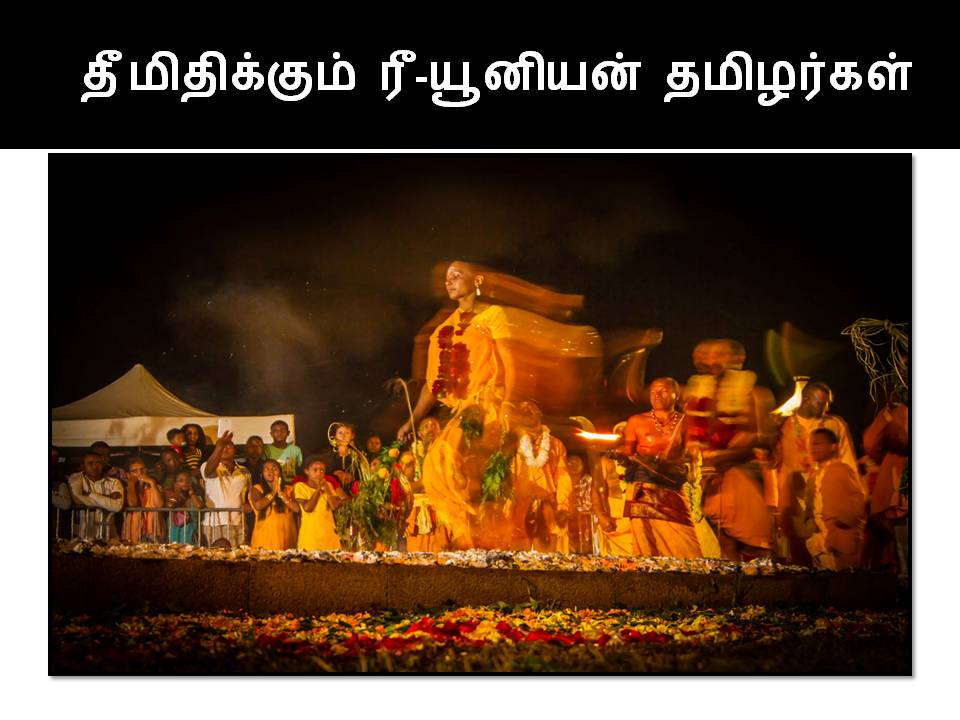
It cannot be said that Catholic faith dominates the island's religious character. It is visible in the shrines along every highway and byway, in caves, on cliff tops and in the many saint's days and holidays. St-Denis shuts down on Sunday, when half the city goes to the beach. Hindus and Muslims follow their respective religions freely and most large towns have both a mosque and a temple. Popular Hindu rites include teemeedee, which involves fire walking, and cavadee, involving piercing one's cheeks with silver needles, often take place. A great deal of syncretism with Catholicism has evolved over the years, and vice versa. Thus a hybrid religion had come into existence. People celebrating all festivals and worshipping all deities have produced a hybrid religion of tolerance. Lot of Hindu Temples is there for Lord Shiva, Lord Muruga and Godess Kaali.

French is the official language, but Créole is the most widely spoken. Few people speak English. Réunion Créole is even beyond most French people. A word, which means one thing in French, can mean something completely different in Créole. But the island which has around 4 lakh Tamils who own Tamil names and celebrate Hindu festivals, yet unable to speak Tamil. The Tamil Nadu Finance Minister Navalar Nedunchezian participated in a world Tamil Cultural Movements conference in neighbouring Mauritius and visited Reunion too. During this visit the Reunion Tamil Kazhagam seeking the help of Tamil Nadu Government to teach Tamil to the people of Reunion and to promote cultural exchanges with mainland Tamils put up demands. It remains still and unfulfilled dream. People in a distant place do not haunt our memory as we have other chores to attend in everyday life. But the Government of Tamil Nadu and Pondicherry must open Cultural Exchange Centres in all these isolate islands, and like the Alliance Francaise that keeps teaching French throughout world, institutionalized teaching of Tamil and spreading the tenets of Tamil Culture must be undertaken, all who visit islands like Reunion will have these thoughts linger in their minds.

The Maha Bhadrakaliaaman Temple authorities and the Natha Musical Academy of Reunion have invited the students of TamilNadu Government Music College to provide them some insights into Tamil folk arts. Professor M.Anbarasan who teaches folk arts in the College of Music who heads the team comprising his students Miss K.Kala, Miss.K.Vijayalaxmi, Miss.N.Selvarani, Miss.Santhi and Mr.Nallusamy will be participating in various functions in Reunion as depicted in this poster. This ambassadors of Tamil culture carry forward the message of goodwill from the people of Tamil Nadu, and whole Reunion Tamils must be reassured that in upholding Tamil customs, religious practices, arts, music and language, a day will come that Reunion cultural ambassadors arrive here and capture our attention and can win our admiration. Where there is a will, there will be a way, goes the saying. Reunion Tamils have the will. Let them cherish their hybrid culture with Tamil component, we all hope and wish so.

N.Nandhivarman


Courtesy: New Indian Express dated: 13th April 2004

FRENCH CITIZENS OF PONDICHERRY AND THEIR RIGHTS


FRENCH CITIZENS OF PONDICHERRY 

AND THEIR RIGHTS

 N.Nandhivarman
 
French drafted men for their army from colonies, and these soldiers have sacrificed their lives fighting for France in the World War I and II. Large sections who  completed their services in French army comprise the main component of French citizens in Pondicherry. There are more than 20 million French citizens living abroad in various former French colonies including Pondicherry. It will be interesting to note that in the post-colonial period too France maintains links with these citizens in a unique fashion giving them representation.
 
One hundred and fifty five delegates are elected by direct universal suffrage by the French communities abroad for a period of 6 years and this body is presided by the Minister of Foreign Affairs of France.  French citizens in America elect 32 delegates and from Africa 47 seats thus representatives from the total of “A series of constituencies” is 79. In “B series” there are 76 seats and the break up is 52 seats from Europe and from Asia-Oceania and from the Orient 24. Within these 24 seats two are chosen from Pondicherry. Half of the electoral  college is renewed every 3rd year.  All former colonies are divided into 52 electoral districts, with one or more delegates per district. A country may have several electoral districts, just as an electoral district may cover several countries.
 
Apart from Indian elections, the regular exercise in Pondicherry is the elections  to choose 2 representatives to the “Assembly of French People Living Abroad” known  as CSFE ( Counseil Superieur des Francaise de l’Etranger). It is recently renamed as AFE from 9th August 2004, published in Official Gazette of 11 August 2004 by the Government of France.  Lieutenant-Colonel Mouhamad Moustafa and Mr. Ejilane Souprayen were elected on 18 June 2000 for a 6 year-term for the Pondicherry constituency comprising all segments of the Union Territory of Pondicherry. The next elections will be held in 2006. It is interesting to note that both these representatives have served in the French army.
 

French people residing abroad through their 155 representatives elect twelve Senators to French Parliament. They get elected one-third at a time for 8 years in 2004 and for 7 years in 2007 and for 6 years from 2010. Currently the political party UMP (Union pour un mouvement populaire, which means Union for Popular Government) has 9 members thus elected. They are Mrs. Paulette Brisepierre, Mr. Jean-Pierre Cantegrit, Mr. Christian Cointat, Mr. Robert-Denis Del Picchia, Mr. Hubert Durand-Chastel, Mr. Louis Duvernois, Mr. André Ferrand, Mr. Michel Guerry, and Mr. Xavier de Villepin.
 
Parti Socialiste has 2 Senators, Mrs Monique Cerisier Ben Guiga and Mr. Guy Penne.The party CRC (Communiste, Républicain et Citoyen) has one Senator Mr. Pierre Biarnes.Twelve personalities appointed by the French Minister of Foreign Affairs for six-year terms "by reason of their competence in matters concerning the general interests of France abroad". They are renewed one-half at a time every three years. 

The Constitution of 27 October 1946 (IVth Republic) stipulated that the new Parliament would comprise a National Assembly and a "Council of the Republic" (as the Senate was called until 1958) within which "the French of the Exterior" would be represented. This may be like our lower and upper houses in Parliament. The National Assembly pondered and decided how to effect this representation. It decreed, in a resolution dated 13 December 1946, that three "Councillor of the Republic" seats (out of 320) would go to personalities representing Non Resident French citizens living in Europe, America and Asia-Oceania-Orient respectively.

Subsequently then Prime Minister, Robert Schuman, and his Foreign Minister, Georges Bidault signed a Decree setting up the High Council for French People residing abroad. on 7 July 1948. The first High Council was composed of 55 members and 8 ex officio members.. The first CSFE elections of 1950 were held in seventy countries of Europe, America, Asia and Oceania, according to a protocol defined in a Ministerial Decree dated 10 December 1949 and signed by Robert Schuman..
 
Article 24 of the Constitution of 25 September 1958 states, "French nationals settled outside France shall  be represented in the Senate." Two Executive Orders were issued, on 15 November 1958 and 4 February 1959 respectively, for organizing this representation and providing the CSFE with new status. The CSFE, while retaining its advisory role, became the sole electoral  college for electing Senators from abroad.

Their numbers   increased from three to six, two representing Europe and America, one representing Asia-Oceania and three representing Africa. It was thus divided into three sections for the Senatorial elections of 23 April 1959. The CSFE had 84 elected members   but it  became clear that Europe and America were under-represented in comparison with Africa.  The number of Senators was therefore brought up to nine for 1962 elections.

After the creation of the Democratic Association of French Citizens Abroad (Association Démocratique des Français à l´Etranger - ADFE) in 1980, the CSFE was reconstituted in 1982. The Act of 7 June 1982 paved way for the election by universal suffrage of Delegates to the CSFE, which (with the exception of twenty-one members chosen for their competence but not having Senatorial voting rights) was no longer a body of appointed personalities. And the election of twelve Senators thereafter is only by the elected members of the CSFE.

The AFE  is entrusted by law with the task of advising the Cabinet. The Minister of Foreign Affairs defines the objectives and priorities of the assembly chaired by him. The Senators place before the Senate, the National Assembly and the Economic and Social Council the propositions, motions, resolutions and wishes expressed by their electors. The twelve Senators, ex officio members of the AFE, can introduce Bills or legislative amendments reflecting the hopes and needs of French people living around the world.

By this unique system the ties between  French citizens living in Pondicherry and their chosen country France remains fostered conferring rights to its citizens and providing them a voice in the democratic set up.

Courtesy : New Indian Express dated : 19th March 2005


Friday, December 12, 2014

Dr. Shuddhananda Bharati : Chant de l’Unité

La vision d'un Rishi
 
Dr. Shuddhananda Bharati, Maharishi, Kavi Yogi

Présentation du Dr. Shuddhananda Bharati
11 mai 1897 – 7 mars 1990

Chant de l’Unité
 
Unissez-vous, unissez-vous, ô âmes
Unissez-vous et jouez votre rôle
Unissez-vous en esprit, unissez-vous par le cœur
Unissez-vous dans le tout et dans la partie
Comme les mots, les accords et le sens dans le chant
Que l’Est et l’Ouest s’unissent et vivent longtemps
Les arbres sont nombreux, le bocage est un
Les branches sont nombreuses, l’arbre est un
Les rivages sont nombreux, l’océan est un
Les membres sont nombreux, le corps est un
Les corps sont nombreux, le Soi est un
Les étoiles sont nombreuses, le ciel est un
Les fleurs sont nombreuses, le miel est un
Les pages sont nombreuses, le livre est un
Les pensées sont nombreuses, le Penseur est un
Les goûts sont nombreux, le goûteur est un
Les acteurs sont nombreux, le drame est un
Les pays sont nombreux, le monde est un
Les religions sont nombreuses, la vérité est une
Les sages sont nombreux, la sagesse est une
Les êtres sont nombreux, le souffle est un
Les classes sont nombreuses, le collège est un.
Trouvez l’Un derrière la multitude,
Vous vivrez dans la paix et l’harmonie.

Hymne à la Paix
Paix pour tous, paix pour tous,
Pour tous les pays, paix !
Joie pour tous, joie pour tous,
Pour toutes les nations, joie.
Une paix matinale rosée,
Une joie estivale souriante
 !
(Refrain : Paix pour tous)

Tous pour un et un pour tous,
Telle est la règle d’or ;
Vie, lumière, amour pour tous,
Pour tous les vivants notre amour.
(Refrain : Paix pour tous)

Travail, nourriture, vêtements pour tous,
Statut égal pour tous ;
Santé, foyer, école pour tous,
Un monde heureux pour tous.
(Refrain : Paix pour tous)

Pas de riche oisif, plus de mendiants,
Tous travaillent également ;
Fini les pleurs, fini les peurs,
Le cœur résonne de vivats !
(Refrain : Paix pour tous)

Ni terreur atomique, ni gras mammon,
Porte close pour le démon de la guerre ;
Comme les feuilles des arbres,
Comme les rayons du soleil
Nous sommes Une Communion,
Une Communion divine !

Le bon en nous est le bien de tous
Le Dieu en nous est le Dieu pour tous
Votre amour est l’amour de tous
(En chœur : paix pour tous)

Pour lui ou elle ou cela ou le reste
Cette vie collective est la meilleure
Cette vie universelle est la meilleure
Le Nord ou le Sud ou l’Ouest ou l’Est
(En chœur : paix pour tous)

La paix pour les plantes et les oiseaux, les bêtes
Les collines, les rivières, les forêts
La paix dans la patrie et l’air et la mer
Nous voyons une paix dynamique

La paix pour tous, la paix pour tous
Paix immortelle pour tous
 
Courage !
 La nuit est traversée
La chaîne d’esclavage
Elle est déjà brisée –
Je suis plein de courage !
 Dans la paix du matin
Un soleil d’or s’élève ;
Comme un lion surhumain
Pour accomplir mon rêve.
 Un bon espoir sourit
Comme un docile enfant
Qui joue dans l’infini
Avec un astre ardent.
 Mon voyage est fini ;
Je m’amuse du temps ;
L’univers est mon nid ;
De l’éternel printemps.

A plus de 90 ans, dans son école en Inde du Sud, le 
Kavi Yogi 
Maharishi (Grand poète divin visionnaire, sage) Shuddhananda Bharati travaillait comme un jeune homme de 20 ans. A qui lui demandait son âge, il répondait : « Mon âge est Courage ! » Le yogi a écrit plusieurs dizaines d’ouvrages en anglais, français, tamoul, hindi, télougou et sanskrit, ainsi que des chants et des poèmes en français, langue qu’il a apprise à Pondichéry.
L’œuvre majeure de cet homme conscient de la présence de Dieu en lui, Bharata Shakti (en 50 000 vers), décrit son idéal : une seule humanité vivant en communion avec Un seul Dieu dans un monde transformé ! Dans ce texte monumental et unique, le yogi dépeint l’essence de toutes les religions, de tous les prophètes et saints, de toutes les approches du yoga et de toutes les cultures sur une toile allégorique.
L’engagement de l'auteur est résumé dans son livre autobiographique L’Ame Pèlerine (Pilgrim Soul). Les trois poèmes cités en ouverture expriment à merveille son idéal.
Son mantra, Aum Shuddha Shakti Aum, nourrit notre âme et guide nos pas vers la joie intérieure Ananda. Il signifie : la lumière de la Grâce et l’énergie du Tout-Puissant suprême pur nous bénissent de paix, béatitude et prospérité !
Que la beauté et la grandeur d’âme de Shuddhananda Bharati fleurissent et parfument la Terre entière de son divin message et de son rayonnement spirituel unificateur et bienfaiteur !
Je suis très honoré d’avoir le privilège d'éditer les écrits du Dr. Shuddhananda Bharati. 
Le nom de Shuddhananda (pure félicité) lui a été donné par son ami Yogi Jnana Siddha (sage hindou) en 1905. Le titre de Kavi Yogi  Bharati lui a été donné quelques années plus tard par le Jagadguru de Sringeri, Sri Satchidananda Siva Abhinava Narasimha Bharati, nom monastique de Sivaswami (1879-1912). En 1954, Swami Sivananda lui conféra le titre de Maharishi, grand visionnaire, ce qu'il est réellement. Le 23 mars 1984 il reçu le Raja Rajan Award de l'Université Tamil à Tanjore, Université de la meilleure littérature Tamil pour son opus magnum (œuvre majeure) Bharata Shakti et l'entier de son œuvre avec le titre honorifique de Docteur Shuddhananda Bharati.

Dr. Shuddhananda Bharati est le
 créateur et fondateur du Sama Yoga. Son idéal de vie est la vision d'un monde, d'une humanité et d'un Dieu. Son leitmotiv est Pureté, Unité, Divinité. Il nous a transmis ses poèmes et ses œuvres pour le développement de bases nouvelles pour l'avenir et l'évolution de notre société.
Son enseignement nous ouvrent les portes à la rencontre du Divin en nous, par l'ouverture de la conscience, la poésie et la sadhana.
Christian Piaget
 

Dr. Shuddhananda Bharati
11.05.1897 - 07.03.1990
 

அடுத்த 11 வது உலகத் தமிழ்மாநாட்டிலாவது சுவாமி விபுலானந்தரின் எழுத்துக்களையும் பேச்சையும் ஆய்வு செய்ய....

தமிழ் ஆய்வுலகமும் தமிழ்ப் பல்கலைக்கழங்களும் அடுத்த 11 வது  உலகத் தமிழ்மாநாட்டிலாவது சுவாமி விபுலானந்தரின் எழுத்துக்களையும் பேச்சையும் ஆ...