On Tamil culture,civilization,history,literature,heritage and Tamil Diaspora
Saturday, October 3, 2015
SAINTS OF SOUTH ARCOT DISTRICT TAMILNADU
CLICK THE LINK FOR YOU TUBE
Published on Oct 26, 2014
தென் ஆர்க்காடு மாவட்ட மகான்கள் , சமயக் குரவரில் இருவர், பன்னிரு ஆழ்வாரில் மூவர் , வள்ளலாரின் ஒளி வணக்கமே உலக மதங்களில் பல வடிவம் கொண்டது என்பது முதல், வள்ளலாரால் ஈர்க்கப்பட்ட ஓமந்தூரார், சுத்தானந்த பாரதியார் உள்ளிட்ட பல செய்திகள் அடங்கிய வெளியே தெரியாத வரலாறு 64 வது உரை, நந்திவர்மன் 26. 10. 2014 இல்
Friday, October 2, 2015
SUBRAMANIA BHARATHIAR SCHOOL OF TAMIL STUDIES
LANGUAGE LABOUR
Pondicherry University, a Central
University established the Department of Tamil in 1986, and later upgraded to a School of Tamil. Yes, thus came the
Subramania Bharathi School of Tamil Language and Literature. “This school had
produced 60 scholars who have done their Ph.D’s and 28 are currently striving
to become Doctors of Literature. 181 scholars obtained M.Phil degrees and
currently 34 are studying. The research culminates in presentation of scholarly
thesis” states Dean of the School Dr. A.Arivunambi. Dr.Arivunambi also
functions as Acting Vice Chancellor during the absence of the regular Vice
Chancellor. As the leading beacon of Tamil Development he states with pride
that Pondicherry University is the first and only one to have got a grants for
5 years under Special Assistance Scheme from the University Grants Commission.
This recent achievement gives impetus to draw plans for the development of
Classical Tamil.
“If you want to know about
the Tamil computing researchers, www. tamilsoftware.biz lists out only 2 people
from the Union territory of Pondicherry. They are Professor Kuppusamy, who
heads the Computer Sciences Department of Pondicherry University and Prasanna Venkatesan,
Lecturer of same faculty. At one faculty two researchers exist to give impetus
for promoting Tamil in the world of web, and the other side we have a Tamil
Department which had yet to avail this talent within the campus to equip Tamil
scholars and students with adequate knowledge to handle computers and to
elevate Tamil to the reach of netizens.” opined a Tamil scholar with anguish.
There seems to be fresh plans for inter departmental coordination after such
criticisms were aired in scholarly circles.
The western experiments to
open knowledge to one and all by creating Open Access Online Libraries, from
where all scholarly research papers could be availed by anyone interested from
any part of the globe is slowly spreading its influence over Tamil scholars.Tamil
lovers of Pondicherry are keen to know the subjects of the research undertaken
by various scholars in the Pondichery University. “The practice to upload all
research materials into Internet is a must and web publishing must be given top
priority so that what a researcher in Pondicherry University does becomes known
to other researchers all over the world,” said C.P.Thirunavukkarasu, President
of Anna Foundation. Though members of the faculty have brought out many books
and students too have many books and articles to their credit, in these days of
globalization, they have to market their achievements, publicize them and bring
it to public notice.
A report of the expert committee headed by
Va.Suba.Maniccam Former Vice Chancellor of Madurai Kamaraj University had in
the initial years suggested for creation of separate faculties for Tamil
Studies, Linguistic Studies, Fine Arts and Overseas studies. It had mooted the
suggestion that under the faculty of Tamil Studies departments of Tamil Literature,
Cultural studies, Religious and Mythological Studies, Comparative literature
and Indian folklore could be set up. The committee also had suggested separate
department for Bharathiar and Bharathidasan Studies. The Faculty of Linguistic
Studies with separate departments of Indian Grammatical Studies, Linguistics,
Translation, Dialectology and Tribal languages and The Faculty of Fine Arts
with Department of Music, dance, Drama and Painting must have been set up, if
the recommendations of the expert committee had been taken into consideration.
Much time is lost and because these faculties and departments were not created
in spite of the First Central university being started in a Tamil language
speaking region. Dr.R.Kothandaraman of Tholkaapiyar Centre for Fundamental
Research says that “ sixteen years had
passed and lot of opportunities are lost. There is a need to review the expert
committees suggestions and to have an update on its recommendations so that
fresh initiatives to develop Tamil studies could be explored”. Incidentally he
was one of the members of that Expert committee. Due to non allocation of funds
where our representatives failed, all such new departments could not come up
till 2007, the time when next five year plan launches. As a prelude for opening
Departments of Modern Literature and Religious Literature, two new M.Phil
courses have started , thanks to the initiatives of Dr.Ilamathi Janakiraman.
This unique Central
University must be made into a global meeting place for promoting Tamil as an
international language with state-of-the-art technology to connect to the
global Tamil community via the Information Highway feel the foreign scholars
doing research in Tamil.
“To help Tamil communities living abroad to
establish a digital network for promoting the study of Tamil language and
literature, to establish a grid of learning so that Tamil communities worldwide
may exchange Web-based resources, to develop and promote Tamil in electronic
form to enable Tamil learners to experience the glory of Tamil language and
culture, to promote a sense of Tamil identity both in nations having large
Tamil populations and all former French colonies with which still sizeable
Pondicherrians are culturally and professionally interlinked, Pondicherry
University had lot to do” opines Mannar Mannan, President of Puthuvai Tamil
Sangam.
“These former French
colonies have large population of Tamils who are on the verge of forgetting
their mother tongues. Hence online courses to impart Tamil learning to
geographically separate Tamil communities becomes the historical mission of
Pondicherry University and it is time it reaches out to those who need its
help” said Professor M.Lenin Thangappa.
But all scholars are hoping that Subramania
Bharathiar School of Tamil studies will surge ahead and scale great heights in
glory, since the very name of the school will be a source of inspiration for
all knowledgeable Tamils to pool their goodwill to make this School known
internationally.
Courtesy:New Indian
Express-weekend:7.05 2005
Wednesday, September 30, 2015
STONE INSCRIPTIONS SPEAKETH
STONE INSCRIPTIONS SPEAK
N.Nandhivarman
Monuments, Inscriptions and copper plates speak. They
reveal the past. Epigraphists unearth history hidden in these. There are around
535 stone inscriptions found out till date which includes Sanskrit (4), Kannada
(2), Latin (1), French (2), Armenian (1) and most of the ones in Tamil. Late
Pulavar Kuppusamy and Villianur Venkatesan did the compiling of these
epigraphs. Professor Vijayavenugopal Senior Research Fellow of the Epigraphy
Section of Ecole Francaise D’ Extreme-Orient of Pondicherry had translated these and a new
book is on the anvil.
For more than 1000 years of our history could be
traced in these stone inscriptions. The
rule of Rastrakooda king Kannaradevan comes to light through 16 inscriptions.
Similarly sixteen Chozha Emporers have ruled Pondicherry region, which is recorded in 220
inscriptions. Eight Pandyan kings (18), Two later Pallavas (13), Thirteen
Vijayanagara Kings (27) and under Sambuvaraiyer (3) are the break up of the
total 535 stone inscriptions found in and around Pondicherry .
Almost all major villages of Pondicherry
and Karaikal regions have these inscriptions namely Thirubuvanai (188),
Madagadipattu (83), Thirunallaru (51), Villianur (50), Thiruvandarkoil (42),
Bahour (45), Pondicherry
(30). In Karaikal region at Karaikal (10), Thirumalairayanpattinam (6),
Nallambal (7), Mathur (1), Nedungadu (1), Sethur (3), Sorakudi (1), Melponsethi
(1) Pandasozhanur (7), Thirukanji (3), Kariamaniccam (2), Keezhkasakudi (2),
Melkasakudi (1) and Dharmapuram (1).
Coming to recent past a monument of a brave soldier
reminds us about the year 1778 when Pondicherry
was under siege by the British. The brave sons of Pondicherry with only 1000 soldiers defended
their soil fiercely against the 24,000 attackers. An isolated commemorative
stele of a brave Englishman Captain Aug de Morgan killed by the French
artillery on 11 th October 1778 stands on a barren terrain near Jipmer Hospital .
This monument reminds us of not only the bravery of Pondicherrians but also
their nobility to pay due respects even to the enemy warrior.
Another Tomb of Pauline de Kerjean nephew of Dupliex,
a little girl who served in the Deccan wars
epitomizes brave French womanhood.” The skulls, bats and tibia are symbols more
sinister than comforting flames that represent the eternal soul,” writes
M.Bourdat, Professor of Literature in Lycee Francaise.
The Annual Reports of Indian Epigraphy 1887-1905 is
the first of its kind in Indian subcontinent on listing out the various stone
inscriptions. J.Burges, the Director General of Archaeological Survey of India
and E.Holtzsch, the Epigraphist of the Archaeological Survey of South India are
the pioneers who laid down the foundation for epigraphic studies. In French
India at the same time French scholars have unearthed many stone inscriptions.
Jouveau Dubaille found a stone monument in the garden in front of present day
Raj Niwas which speaks about the fortifications on the shore together with“Port
Marine” built by Joseph Françoise Dupliex, the Governor of Pondicherry.
While these speak about recent history stone
inscriptions are useful to know how this area was ruled. Though 535 epigraphs
speak about various rulers at most of the period Pondicherry was part and parcel of Nadu Nadu,
which means middle country. There are historical reasons for this region to be
called as Nadu Nadu. The Pallava rule did not extend up to Pennaiyaaru and
Chozha rule was up to Vellaru. In between these around 10 small states were
there such as Vanagoppadi, Singapuranaadu, Oymanaadu, Vesalipadi nadu etc.
These areas ruled by small states were called Nadunadu. The Saivite book of
hymns Thevaram calls the pilgrimage centers in this region as Nadu Naattu
thirupathigal.
From these inscriptions we understand how the
territory was divided into Mandalam, Kottam, and Kootram similar to District,
Taluk and Panchayat. The subdivisions for purpose of revenue have been divided
into 28 valanaadugal. Athiraja valanaadu was named after Rajathirajan I. This
comes to public notice while epigraphists found this inscription at Tirunallar
which belonged to the regime of Rajendra II.
The book by the Ecole Francaise D’Extreme Orient had
generated lot of interest among public, as they were hoping that this book will
throw more light on how this region was ruled and what were the social customs
prevailing during that period etc. For instance in one inscription dating back
to 1000 years in Bahur the word untouchable (Theendathagar) is used, wherein
the tank desalting work was forbidden to untouchables since that water reaches
the deity. That may be the first instance of that word being used, scholars
opine.
Anyhow stones reflect the societal practices of those
days be it good or bad. A true historical perspective emerges, and
Pondicherrians come to understand their region more with scholars throwing more
light.
[Courtesy: New Indian Express
dated: 16th April 2005]
THE TAMIL FRENCH LITERARY CONNECTIONS
N.Nandhivarman
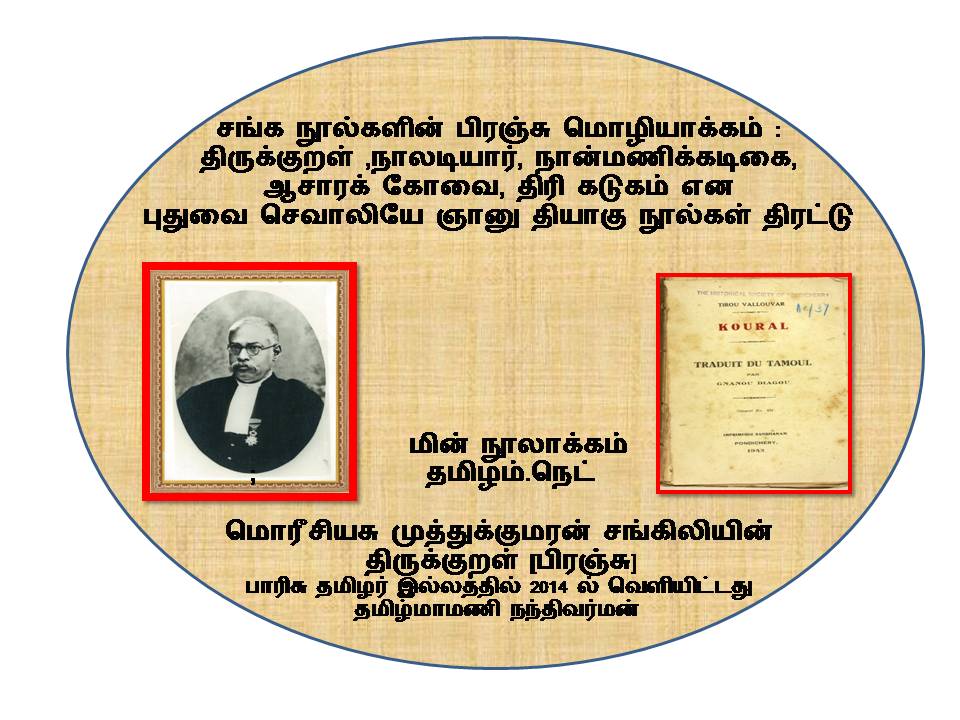
Thiruvalluvar's Thirukural is Tamils pride and
everybody's guide in life. Secularism, essence of our constitutional principles
springs from each and every couplet of this great treatise of wisdom written
2000 years ago. And Sir C.P.Ramasamy Iyer places a befitting tribute to its
grandeur on record. In his preface to the French Translation of Thirukural Sir
C.P.Ramasamy Iyer says " It has been rightly remarked that the Kural
addresses itself to all classes and communities, and indeed to the whole human
race and charges itself with the promulgation of virtue and of right conduct in
the guise of familiar and friendly advice. In a series of pithy maxims, it lays
down rules of universal acceptability dealing with most of our domestic and
social problems and situations. In the well known words of the philosopher,
Spinoza, it is written sub specie eternitate though characterized by tenderness
and comprehensive human sympathy, human life and love in all their forms as
well as the regular of existence in the social and economic fields are alike
dealt with on the basis of practical spirituality".
Thirukural, the secular book on morals had been
translated in many languages and is next to that of Bible in the number of such
translations. The French version of Thirukural rendered by a great littérateur
Mr.Gnanou Diagou had fascinated many scholars. It is a matter of pride to all
Pondicherrians that Mr.Gnanou Diagou is one of the illustrious sons of this
soil having earnt a name and fame in the 19th century.Thirukural had been
translated into the following languages. 1) Burmese Mr. Myo Thant, Thirukkural
2) Chinese Mr.Chi Eng Hsi, Thirukkural (1967) 3). Czech Mr. Kamil V Zvelebil,
Thirukural (1952-1954 4) Dutch Mr. D.Kat, Thirukural (Netherlands, 1964) 5)
Fiji, Mr.S.L Berwick, Na. Thirukkurala, 1964) 6) Finnish Mr. Aalto, Pentit,
Kural - The Ancient Tamil Classic (1972) 7) German Albrecht, Fenz and K.
Lalithambal: Thirukural von Thiruvalluvar aus dem Tamil, Madurai (1977), Mr.A.F
Cammera, Thirukural Leipzig (1803) Mr Karl. Graul, Der Kural des Thiruvalluvar,
(London 1854), Mr. Karl Graul, Der Tamu lische gnomes dichtar Thiruvalluvar,
(Leipzig, 1865) Mr.Frederick Rickert Thirukural, selections, (Berlin, 1847) Mr.
William and Norgate, Der Kural des Thiruvalluvar, (2nd ed, London, 1866) 8)
French Ariel, M, Kural de Thiruvalluvar (traduits du tamoul), Paris, 1848, Barrigue
de, Fontaineu, G, Le livre de l'amour de Thiruvalluva, Paris, 1889, Danielou,
Alain, Thiruvallouvar Kural, Pondicherry, 1942, Jacolliot, Louis, Kural de
Thiruvalluvar, (selections) Paris, 1767 Lamairesse, M, thirukural in French,
Pondicherry, 1867) 9) Latin Graul, Charles, Kural of Thiruvalluvar, Tranquebar,
1866 Veeramamunivar, Thirukural (Books I and II), London, 1930 10) Malay
Ismail, Hussein: Thirukural sastera kalasik Tamil yang, Kuala Lumpur,
1967,Ramily Bin Thakir Thirukural (in verses), Kuala Lumpur, 1964 11) Polish
Umadevi, Wandy Dynowskiev, Thiruvalluvar Kural, Madras, 1958 12) Russian J.J
Glazov and Krishnamurthi, A, Thirukural, a book on virtue, politics and love,
Moscow, 1963 Glazov, Thirukural in couplets with illustrations, Moscow, 1974
13)Swedish Frykholm Ingya, Thirukural, Uddavalla, 1971. The list is incomplete.
The complete list of languages in which Thirukural got translated is yet to be
compiled.
The irony is we live in an age of information technology
where at our fingertips we should keep these facts. Many authors will boast
that next to Bible the only other book that was translated in many languages is
Thirukural. Yet none bothers to compile the data of all such translations
undertaken and books published in various languages. Let scholars and
institutions start compiling such lists, uploading in the Net to enable all
Tamil lovers easy access.
Particularly Pondicherry with all its connections with
France and with prestigious institutes like French Institute functioning here
it will be appropriate that better coordination exists between Pondicherry
University, Pondicherry Institute of Linguistics and Culture which hopes to
become a deemed University soon and other Tamil scholars well versed in both
the languages. A great bilingual scholar Desigam Pillai in his book
Tamizhagamum Frenchukararum dutifully records the services of scholars who
promoted cultural exchanges with zeal. The Jesuits priests who came here to
propagate their religion learnt Tamil and for the purpose of their kinsmen to
understand the nuances of Tamil they wrote many books in French. The services
of Mr.Boucher (1655-1732), Mr.De la Lane (1669-1746), Mr.Bouze (1673-1735),
Mr.Gargam (1690-1742), Mr.Calmette (1693-1740), Mr.Coeurdoux (1699-1774) in
writing books to help French acquire proficiency in Tamil, is thus listed by
Desigam Pillai. Mr.Desigam Pillai, a lawyer and Tamil scholar also mentions the
names of those who learnt Tamil. Mr.Perrin (1754-1820), Mr.Maguy (1758-1822),
Mr.Dubois (1770-1848), Mr.Dupuis (1806-1874), Mr.Mousset (1808-1888),
Mr.Legouste (1880-1863), Mr.Lap (1834-1893). These lists may be tiring to
normal readers. But it is a list to be remembered to understand the cultural
fraternity that developed between the French and Tamil-speaking peoples.
Many scholars who collected the Tamil manuscripts and
palm leaf texts during their stay in Pondicherry had given them to the
Bibliotheque Nationale de Paris. Even now in many homes including this writer
there remains palm leaf texts ravaged by time. It is high time that academic
institutions in the soil of Pondicherry and the Governments here that speak of
heritage engage in a quest to collect all such texts, digitalize them and
microfilm such rare collections hidden in Museums of both countries and private
homes. Messrs.Mousset and Dupuis wrote the Dictionnaire Français Tamoul (French
Tamil Dictionary) running into 1270 pages and a Dictionnaire Tamoul Français-2
Vols. (Tamil French Dictionary) running into 1660 pages. Mr.Jules Gordin who
came from France to contest an election here for the house of elders and who
became a French Senator took steps to start Tamil section in the Paris
University. The dream came true in 1879. From 1890 in the Ecole des Langues
Orientales Tamil classes became a reality. Mr. Vinson Julien wrote a grammar
called Manuel De La Language Tamoule Grammaire, Texts, Vocabulaire ,and
Mr.P.Lap, A Brege De La Grammaire Française Tomoule.Mr.M.J.Baulez wrote on
colloquial Tamil Méthode De Tamoul Vulgaire
These are the pioneers and many authors who succeeded
them had laid down firmly the path of inter cultural exchange and language
fraternity. To a layman it appears that in the post independence era, these
exchanges have mellowed down, and an impetus is needed to reactivate the vigour
with which Tamil was welcomed with open arms by French. The entire French
literature must be translated into Tamil and vice versa. The unfinished agenda
must be undertaken with renewed interest. Before the old generation that had
mastery over both languages bids adieu to earthly existence, these unfinished
tasks must be taken up with urgency, while for younger generations the need to
nourish this cultural legacy left between the most lovable languages on earth,
becomes a quest with thirst for knowledge.
POONGODI PARANGUSAM
Kalai maamani POONGODI PARANGUSAM
N.Nandhivarman
Poet’s daughter being a Poet is rare, usually such
tradition lacks continuity. But thedaughter of Late Poet and Parliamentarian
Puthuvai Sivam has established her credentials as a Tamil Poet who had won the
prestigious kalaimaamani award for the year 2004-2005 for language and
literature. Poongodi Parangusam is an educationist who gave up her career to
devote more time to her family. But the passion for writing did not dry in her.
In most of the cultural meetings one could notice her either delivering
speeches or rendering poems.
Poongodi a postgraduate teacher worked in various schools
from 1964 to 1996 the last being Government High School Reddiarpalayam. She had
other roles to perform at home as mother of three children and wife of an
industrialist Parangusam. Her father S.Sivapragasam, known as Puthuvai Sivam
was Rajya sabha member in seventies. At that time she wedded Parangusam and her
marriage was performed by then Tamil Nadu Education Minister Navalar Nedunchezhian.
It is no surprise because her father an ardent disciple of Pavendhar
Bharathidasan was following the tradition of self-respect marriages. But when
it came to the marriages of her children she kept up that tradition in midst of
changing times. Her daughter Tamizharasi a dentist married Senthil Kumar a
dentist. Her second daughter Ezhilarasi an architect married Sridharan another
architect.
" The fore thought to give green signal to these
love marriages among persons of same profession shows Poongodi as a modern
mother. The most surprising part is her second daughter Ezhilarasi’s marriage
in a Namboodri family of Kerala, yet she conducted the marriages as self
respect marriages only," says Durai Malirayan a poet of many epics.
Having accomplished her family tasks she took voluntary
retirement and then she faced many legal battles with the land mafia and
undeterred she fights against heavy odds. All these experiences brought out a
poet activating her inner voice. She started writing poetry particularly the
traditional poetry with meter. " There are many who write modern verses.
But to write poetry following the rules of Tamil grammar is a daunting task.
And Poongodi does her poetical work with meticulous care and powerful
articulation " opines Professor Ilamathi Janakiraman of Pondicherry
University.
As a recognition of her works the Department Arts and
Culture of Pondicherry government had conferred kalaimaamani award for language
and literature. Her recent book Vanna Vilakkugal which means colorful lights is
a hit among the Tamil audiences. The themes she had chosen to write poetry is
varied and remarkable. She stresses the need for Tamils across the globe
uniting to uphold their language and culture. Poongodi records her voice on
feminism. Her poems include current governmental schemes like the Tank
Rehabilitation project executed with European Commission’s assistance. She had
written poems on Bharathiar, Bharathidasan, Deveneya Paavanar and Late
K.Kamaraj. Among the list of personalities glorified in her poems is the Chief
Minister Rangasamy whose simplicity and down to earth approach finds special
place in her poetic portrayal.
In the preface to her book Santhapaamani Aranga Natarasan
says "To me it seems she is the first Feminine Poet who had rendered A
book of Poems composed in accordance with Tamil grammatical rules and
meter" Poongodi Parangusam had not even left the India shining campaign of
last elections untouched. Her poetic criticism on the un-kept promises of
politicians election after election echoes general public opinion.
As she backs her husband in his dual role as
agriculturalist and industrialist, her poems stress the importance of farming
sector and the need to bring cheers to the tillers and toilers of soil. "
The award given to me has made me conscious of my contributions to society and
I am writing on the President A.P.J.Abdul Kalam’s dream of seeing India a Super
Power by 2020. It will be my humble token of respects to that great
visionary" says Poongodi Parangusam with eyes on future.
Courtesy: New Indian Express dated :27.08.2005
DANCING PEACOCK FROM SWITZERLAND
N.Nandhivarman
Ms.Mangalanayagi Vasanthakumar visited Pondicherry last
weekend as a cultural ambassador from Switzerland, the land of her domicile
since 1992 after having been uprooted from the war torn Srilanka. She lost her
parents in her early teens and went to Switzerland to live with her brother and
married a close relative Vasanthakumar. She is running a dance school in Luzern
area of Switzerland. Along with some other dance teachers is keeping the Tamil
dance tradition alive in Switzerland.
Rabindranath Tagore lamenting on the decline of
Bharathanatyam in India once said "Lord Siva gave his dance to Indonesians
and left India only with his ashes". But like a phoenix out of ashes, this
dance regained life in TamilNadu and now as torchbearers of Tamil culture,
Indian and Srilankan dancers are nourishing this tradition in whichever country
they live.
Anusha (Zug), Mathivathani and Gnanasundari (Zurich),
Bhavani (Basel), Chandravathani (Berne), Nimalini (Zug), Anusha (Berne),
Fedolina (Winterthur) and Meena (Olter) are the dance teachers teaching dance
to girls of Tamil parents and of Inter-country marriages. Every year these
teachers are sending their students to participate in the 4-day programme
during the Easter holidays, which will be held at Solothurn to select a "
Natya Mayil" which means dancing peacock. Nearly among 700 participants
the talented artist will be chosen for the award.Bharathanatyam is the
traditional Indian dance form, which is narrated in the 5560 couplets of Bharatha’s
Natya Sastra. Slowly this dance instead of being practiced by one and all
became confined to temples and devadasis. At that point of time it was known as
Sathirattam in Tamil. During the days of freedom struggle attempts were made to
involve women from all strata of society in practice of this dance. Krishna
Iyer, an advocate who used to play women’s roles in dramas wrote about Dance
and Health. He stressed the need for dancing ones way to sound health. Heeding
to his appeal, the daughter of Ganapathy Iyer one Miss Kalanithi staged her
performance in 1938, which was considered revolutionary in those days.
Sathirattam became known as Bharathanatyam and almost 7 decades are over with
such name change and now everyone practices this dance form. It is a sign of
liberation of women. And in keeping this dance tradition alive Mangalanayagi is
performing a laudable role in Switzerland. This year from Pondicherry
Kalaimamani K.Rajamanikam and Thirumudi Arun went to Switzerland to provide
live music for the dance competition to select the dancing peacock awardees for
2005. Thirumudi Arun is the last son of Late Thirumudi Sethuraman Chettiar
former M.P and a great philanthropist . Both artists came home deeply impressed
by the work done by Ms.Mangalanayagi. And Mangalanayagi underwent further
refresher course in dance under the guidance of Kalaimamani Rajamanikam.
Mangalanayagi originally learnt dance in Jaffna from Padmini Selvendrakumar and
underwent 5 year training by Sivajini Srikandarajah. In addition she had finished
3-year diploma course in Fine arts under the Jaffna University.
Her current guru Kalaimamani K.Rajamanikam started his
dance school Sangeetha Salangai Natyalaya in the year 1992. His disciples so
far had staged 27 arangetrams. Kalaimamani Rajamanikam got training under the
illustrious Thanjavor KP Kittappa Pillai and from Annamalai University
Isaimamani diploma. He had staged the dance dramas titled Puratchi Kavi, Veera
Thaai and Oru Karsilambu Niyayam Ketkirathu based on Silapathigaram epic. Currently
he is choreographing the dance drama Arunkalaiselvi Aayi, scripted by Poet
Jayarayor, who is known as silver-tongued poet of Pondicherry. This dance drama
is about Aayi who laid the foundations for drinking water supply to
Pondicherry.So far he had trained around 150 students who got married to grooms
from overseas and in Europe he has many disciples of his school.
Sangeetha Salangai Natyalaya of Pondicherry on 17 th July
2005 in a function conferred the title Kalaignanamani on Mangalanayagi. The
Speaker of Pondicherry Legislative Assembly M.D.R.Ramachandiran conferred the
title and Former Minister K.Lakshminarayanan felicitated the artist. It is
recognition for her services in Switzerland, and Pondicherry keeping its
cosmopolitan outlook honours talent from whichever part of the globe.
While acknowledging the award with humble thanks,
Mangalanayagi Director of Salangai Narthanalayam said " Switzerland’s
International Institute of Tamil Arts in Zurich is holding trainings and
classes in Dance, Music both vocal and instrumental and accords seven grades in
selection of artists. There is specified syllabus for every grade and students
have to prove their mettle in theory as well as practical. These courses are
taught through Tamil medium of instructions" Thus apart from private
initiative collective steps to nourish Tamil Dance and Music contributes to the
preservation of cultural heritage. Timely warning by Tagore had awakened Tamils
and they are keeping their tradition alive.
[Courtesy: New Indian Express : July 23 / 2005]
Subscribe to:
Posts (Atom)
அடுத்த 11 வது உலகத் தமிழ்மாநாட்டிலாவது சுவாமி விபுலானந்தரின் எழுத்துக்களையும் பேச்சையும் ஆய்வு செய்ய....
தமிழ் ஆய்வுலகமும் தமிழ்ப் பல்கலைக்கழங்களும் அடுத்த 11 வது உலகத் தமிழ்மாநாட்டிலாவது சுவாமி விபுலானந்தரின் எழுத்துக்களையும் பேச்சையும் ஆ...
-
Siddha Research: The Basic Difficulties by Dr. T. N. Ganapathy, Ph D Director of the Tamil Siddha Yoga Research Project (The f...
-
Master Thesis Proposal Author: Ravi Devaraj guide: Mr.N.Nandhivarman E-mail: ...
-
G U Pope’s Metrical Translation of the Tirukkural: An Evaluation of the Translation of a Classic R. Margaret Joy Priscilla Wom...