Sunday, September 14, 2014

THE GREATEST BARD OF TAMIL BHARATHIAR


THE GREATEST BARD OF TAMIL BHARATHIAR


N.Nandhivarman

The ordeals of Poets in the colonial era to see their masterpieces in print could be easily understood by a letter through which Mahakavi Bharathiar sought financial support from his well wishers. In an open appeal written in 1921, the Great Bard of Tamil Renaissance states, “All of my manuscripts, accumulated labour of my 12 year exile have arrived here from Pondicherry. They are to be divided into 40 separate books. Most of my works which I have selected for publication are prose, stories, sensational at the same time classical, very easy, lucid, clear, luminous and all but too popular in style and diction and at the same time chaste, pure, correct, epic and time defying.” By this appeal the Poet not only exudes confidence in his creative literature and its contents but also is convinced that he is standing at the cross roads of critical times and is destined to play a crucial role. His words further down in the same appeal will be enough to portray the missionary zeal that burnt in him. “The historic necessity of my works for the uplift of the Tamil Land which again is a sheer necessity of the inevitable, imminent and heaven-ordained revival of the East”, says Mahakavi. These words firmly reflects the inner feelings of the most enlightened Tamil mind of our times, which was destined to leave an everlasting impact on the Tamil society.

Stands Apart

The Poet’s vision was clear and he pursued his life’s mission with all his inherent strength, doing what was destined to be done. He wrote a satirical story “ The Fox with a Golden Tail”, which was published in 1914. It should also be mentioned that Aurobindo Ghosh lauded the flowery language of Bharathiar in that story. Dr.Nanjunda Rao of Chennai who was immensely pleased ordered for 500 copies and many letters of appreciation poured in from all quarters. Kuvalai Kannan read those letters to Bharathiar hoping he would be pleased. But Bharathiar stated as follows: “ Using my brain to its fullest capacity while I write in my mother tongue Panchali Sabadam, you alone read it, whereas if it is in English our men who are slaves to English colonial culture order for copies after copies”, the poet retorted with contempt records R.A.Padmanabhan in Chitra Bharathi, a compilations of pictures and historical notes on Bharathiar.

Tamil Medium

At that point of time when all men of letters under colonial rule were crazy over the proficiency in the tongue of the ruling classes, Bharathiar stands apart as a champion of the Tamil cause. In his book Essays and Other Prose Fragments published in 1937 writing under the title “ Vernaculars” Bharathiar extends support to the Tamil medium of instruction in the schools of Education.

Let me reproduce his views in verbatim: “ I do not blame the Madras Council of Indian education for their anxiety to have Professor Geddes’ views on the subject of employing Indian languages as media of instruction in Indian schools. For I am aware those men’s thoughts are ordinarily moulded by their environments. Nor do I blame the good and learned Professor Geddes for his innocent comparison of the revival of Indian languages with the Gaelic revival in Wales and in Ireland. I do not know if Gaelic has any extensive and living literature. But I feel it is high time to remind all parties concerned, in the discussions like this, that most of the Indian languages have great, historic and living literatures. Of course their luster has been slightly dimmed by economic conditions during these later days. The English educated minority in this country can be pardoned for being frightfully ignorant of the higher phases of our national literatures, but they will well do to drop that annoying attitude of patronage and condescension when writing and talking about our languages. The Tamil language for instance has a living philosophical and poetical literature that is far grander, to my mind, than that of the vernacular of England. For the matter of that, I do not think that any modern vernacular of Europe can boast of works like Kural of Valluvar…” so goes on the Great Bard. This quality and courage of conviction is rare among the educated of his times and even today the ignorance of the educated towards the grandeur of the Tamil language and their wild goose chase of the foreign language continues unabated even after the wise counsel by Bharathiar.

The themes

His book Essays and Prose Fragments contains the following topics 1) To the being of the Universe 2) The Service of God 3) The Siddha and the Superman 4) Immortality 5) Fatalism 6) The Dawn 7) Rasa- The Keyword of Indian Culture 8) Blunting the Imagination 9) The Crime of Caste 10) The Place of Women 11) Women’s Freedom 12) Love and Marriage 13) Patriotism and Religious Differences 14) The National Congress 15) New Birth 16) Matri Puja 17) India and the World 18) In Memoriam 19) The Coming Age 20) Reflections 21) Some Political Maxims 22) Free Speech 23) India and war 24) Nammalvar 25) Andal 26) Rights and Duties 27) Vernaculars 28) The occult element in Tamil speech. The list of the essays will reveal the subjects that were near and dear to his heart.

Feminism

Of particular mention is his voice for the cause of feminism. Speaking about the greatness of womanhood the Poet stands apart with no sign of male chauvinism, a characteristic flaw that causes even today gender bias and female infanticide. Let me quote him “ But if woman has always been the civiliser and, therefore, the spiritual superior of man, why did she get enslaved at all? For it is not only among Indians but also among the European and the Chinese and the Japanese and the Hottentots as, indeed all brutes and birds and insects, that the female has been content, till now, to occupy an enslaved, or if you please, a subordinate place to the male.” There cannot be a champion of the cause of feminism than Mahakavi Bharathiar in that point of time in the history of Tamils. A forerunner for the cause of feminism he had left his imprint by way of many articles and poems.


Crusader against Caste


Bharathi describes caste as a crime against humanity and let us know his feelings well expressed in his own style “ You sometimes quote ethnology, eugenics, hydrostatics and what not, to support these four thousand castes! But, alas, the ignorant masses of our country have been made to believe that this caste chaos is a special divine gift to our country and whoever transgresses it has to go to Hell. It is this belief more than anything else that makes people insensible to the injurious results of caste. If you really have your justification in ethnology or hydrostatics, then you have been cheating people during all these centuries by telling them a different story. No science can justify cheating”. The scientific temper, which the poet possesses, is what anyone who cares for fellow beings will want to inculcate in a caste- ridden society. The Poets are conscience keepers of their culture and the society in which they hail, and in unmistaken terms Bharathiar registers his voice of protest against the caste-infected society.

Spreading his message globally


Bharathiar’s Tamil poems translated in many languages have established his greatness beyond an iota of doubt, at the same time very few attention is shown towards his writings in English, and it is high time his scholarly opinion on contemporary issues be understood. The Hindu in its sub-editorial dated 12 th September 1921 records the demise of this great poet thus: “ We regret to learn the death of Varakavi Subramanya Bharathi at his residence in Triplicane last night. The deceased was an ardent nationalist, a great thinker, a shining speaker and a powerful writer. He is the author of number of Tamil works including National songs. His recitation of the national songs infused genuine patriotism in the hearts of his listeners. He, like many other patriots of India, was an exile in Pondicherry for some years, because his patriotic speeches did not please the Gods in power. He has for some time past been ailing and by his premature death the country has lost a born poet and a sincere patriot. Swadesamithran too paid tributes in its editorial. But it is a sad fact that only handfuls were present when his body was cremated. Let us learn to respect great men when they are alive and be grateful for the great bards who uphold our culture universally.


Wednesday, August 20, 2014

THANJAVUR TAMIL UNIVERSITY and FRENCH INSTITUTE CREATE DIGITAL ATLAS


THE GRANDEUR OF SENJI THE FORT OF VALOUR

THE GRANDEUR OF SENJI THE FORT OF VALOUR

N.Nandhivarman


“The Travels of Father Pimenta in 1597” led him to Senji, the Fort town in Tamil Nadu 60 kms away from Pondicherry coast. “ Oh! It is bigger than any city in Portugal, except that of Lisbon “ he exclaimed. Kindt in 1614 on his visit admitted that Senji is as large as Amsterdam. Jean Deloche, the noted historian from the Ecole Francaise D’Extreme Orient of Pondicherry frequented Senji for 6 long years to do research and in his valuable French treatise  “Senji Ville Fortifie’e du pays Tamoul (2000) “says, “Senji, immortalized by Desingh’s ballad, still popular in South India, is a significant place in the Tamil country. Successively occupied by the Hindus of Vijayanagar, the Nayaks, the Muslims of Bijapur, the Marathas, the Mughals and finally by the French in 1750, it was, at the end of the sixteenth century, one of the biggest cities of the peninsula.”

C.S.Srinivasachari in his “History of Gingee and its Rulers” (1943) narrates the ground situation thus “ It is a melancholy reflection for the historian, that what was once a scene of bustling animation, the dazzling military pomp, can boast at present of only few humble habitations, with a handful of peaceful agriculturalists. Where once chargers pranced in martial array, the bullocks drag the plough share, goaded by a half naked farmer and the spider weaves its web where rulers once sat in state and administered the affairs of the realm.”

The Fort may be in ruins, the town may have lost its grandeur, but among the rulers only one name and that too of a young boy hailing in a family that came all the way from Bundhelkand to rule a Tamil territory has been adored for his valour and folklore made his name immortal in peoples memory. Yes it is Raja Desingh who flashes in our mind whenever we think of Senji. M.G.Ramachandran played the role of Raja Desingh in a Tamil movie, but his fans could not digest the death of the hero and the film failed at box office. But in real life the memory of Raja Desingh is “preserved even to this day in every town and village of South India. The wandering minstrel sings to groups of villagers under the banyan tree of the heroism of Raja Desingh of how he loved and fought and fell,” says C.S.Srinivasachari.

The Moghul Monarch Aurengazeb made a chieftain from Bundhelkand, Swarup Singh, the ruler of Senji in 1700 A.D. Swarup Singh passed away in his old age in Senji in 1714 A.D. Hearing his death, the son of Swarup Singh, Desingh started from Bundhelkand towards Senji. At that juncture he would never have dreamt that the journey to immortality had started. Since a firman had been granted by Aurengazeb in his father’s favour by way of hereditary right Desingh took up formal possession of the jaghir. The Nawab of Arcot Sadatullah Khan was aghast at this assumption of office, since Swarup Singh was a defaulter to the tune of 70 lakhs for a prolonged period of a decade. This contentious issue led to an uneven war. Nawab Sadatullah Khan’s army comprising 8000 horsemen and 10,000 soldiers marched to capture Senji. Raja Desingh had only 350 horses and 500 troopers but he could not be cowed down by brutal force. He stood up against a mighty army and fought till last breath. His queen immolated herself in the funeral pyre. Thus a young Rajput of 22 years old got a unique place in the history of Senji, a fort of many a siege and wars.

Now while researches are undertaken the amazing facts about Senji are emerging slowly.
“This site is particularly interesting for a student of military architecture, because it is the only one in India where a full sequence of the defense systems used in the subcontinent, from the Vijayanagar period to the European conquest, can be observed. It is also the only one where we can follow, for at least four centuries, the adaptation of the defense to the progress of artillery” That is how Professor Jean Deloche of the Ecole Francaise D’Extreme Orient describes in his French book Senji (gingi) Ville fortifie’e du pays Tamoul published in 2000 with 40 line drawings and 334 photographs. This book is the only one of its kind and we have to wait for another six months to see its English version in print.

In his researches Jean Deloche is stunned by “ the deep knowledge of water management, a noteworthy engineering skill and boldness of enterprise. Water is made available throughout the year because it is stored in the weathered granite mass, acting as sponge or a filter and reappears as springs in natural reservoirs called “sunai”. On the six fortified hills, all depressions, cavities, anfractuosities, deep fissures, fractures, where water could be stored have this way been used. Moreover they were systematically enlarged by addition of a brick wall “

This impregnable fortress had fallen in alien hands and such defeats are made a post mortem by a French scholar Bourdot in his book “18 th Century Pondicherry.”  “It was a revolt amongst the besieged that opened the gates to Bijapur’s army. It was an act of treason that enabled the Maharatta Shivaji to take possession of it in 1677. Without the help of corruption the place would never had fallen to the Moghul power twenty years later. Lastly it is doubtful whether Bussy with his 200 men would have been able to succeed in just few hours, with a raid that resulted in the surrender of the garrison, had it not been the panic and terror that could overcome the most courageous of the defenders during a night attack contrary to all rules especially that night was without moon or stars and when the assailants are yelling demoniacally in an unknown tongue”. M.Bourdat deserves due applauds for placing these truths in the pages of history to set the record straight.

 Jain Saints had dwelled in the hills of Gingee from 2 nd century to 6 th century, as evident by many stone carvings and other evidences of being citadel of Jainism. Gingee was under Pallava Emperors between 600 to 900 AD. Chozha Emperors ruled Gingee between 900 to 1103 AD. In the stone epigraphs at Aanangur of Athitya Chozhan (871-907) and of Athiya Chozhan II (985-1013) it becomes crystal clear that Chozha Emperors ruled Gingee. Pandya Emperors, Chozha Rulers and Hoysala Kings ruled between 1014 to 1190 AD. Yadhava kings ruled Gingee between 1190 to 1330 AD. It came under Vijayanagar rule from the fag end of 14 th century and for 150 years it was under Vijayanagar rule. It saw the rule of Bijapur Sultans between 1649-1677 AD. Maharastrians ruled from 1677-1697. Moguls were in power from 1700-1750 AD. It slipped between British and French rule from 1750. This is in nutshell the historical imprints left on Gingee, and for such a Fort which has a history dating back to 1800 years if proper publicity is made in abroad it will definitely attract world tourists. It also needs the help of world agencies that protect heritage to improve its infrastructure and other amenities.

The Fort at Gingee declared as National Monument from 1921 is under the Archeological Department. Its history and the archeological finds in its vicinity must be publicized to promote archeological and historical tourism. But no steps are afoot in governmental promotion of archeological and historical tourism. It is a miracle that a Fort that has seen many a battle is still there for everyone to see. The Collector of South Arcot recommended to the Board of Revenue in 1803 to demolish the Gingee Fort fearing it may fall into the hands of French. Around 1850 again someone wanted to convert Gingee Fort into a depot for storage of salt. . Fortunately these suggestions were not carried out.

We have a living monument, a marvel which should be utilized properly and Union Tourism Ministry must contemplate on marketing Senji in the Tourism market.

Courtesy : New Indian Express :25 th September 2004
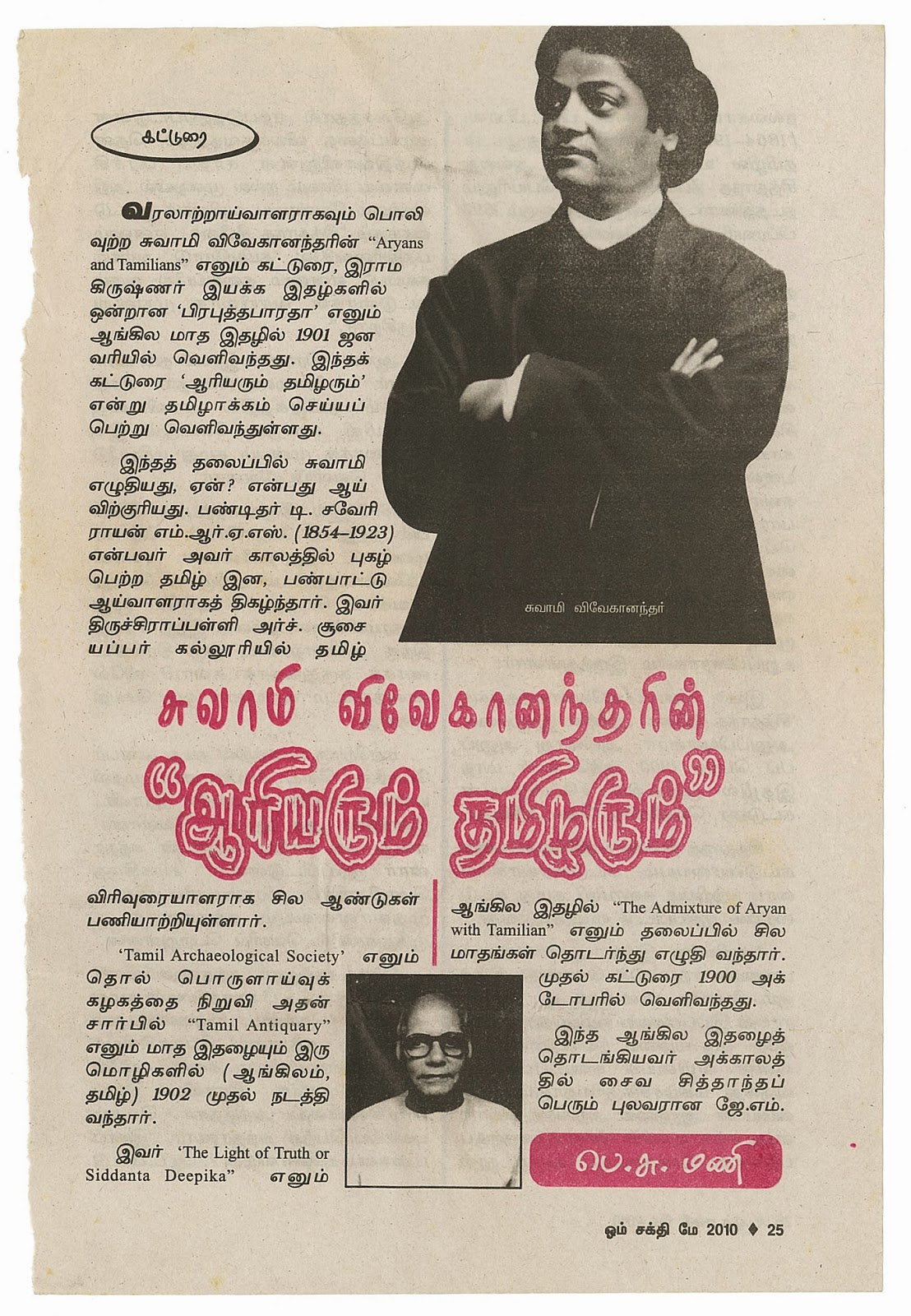
அடுத்த 11 வது உலகத் தமிழ்மாநாட்டிலாவது சுவாமி விபுலானந்தரின் எழுத்துக்களையும் பேச்சையும் ஆய்வு செய்ய....

தமிழ் ஆய்வுலகமும் தமிழ்ப் பல்கலைக்கழங்களும் அடுத்த 11 வது  உலகத் தமிழ்மாநாட்டிலாவது சுவாமி விபுலானந்தரின் எழுத்துக்களையும் பேச்சையும் ஆ...